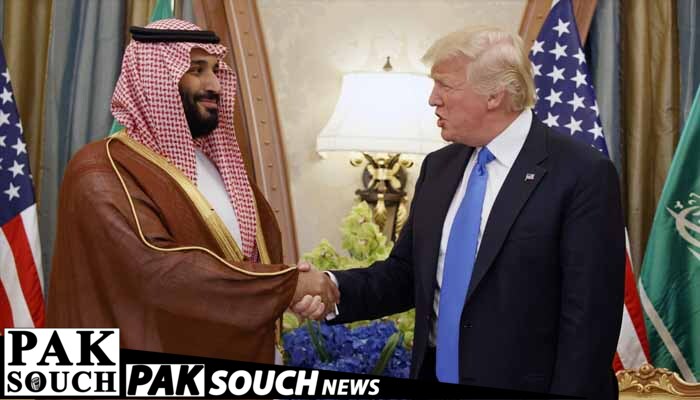
US President Donald Trump has confirmed that he will meet Saudi Arabia’s Crown Prince next week, signalling that the upcoming engagement will be far more consequential than a routine bilateral encounter. The president spoke to reporters aboard Air Force One, where he offered key hints about defense cooperation, potential arms sales, and the broader geopolitical agenda expected to shape the forthcoming discussions.
Referring to the planned meeting, Trump said, “It’s not just a meeting — it will be bigger than that.” His remark immediately drew attention in diplomatic circles, with analysts interpreting it as a sign that Washington and Riyadh may be preparing to announce significant new agreements or strategic commitments.
During the media interaction, a journalist asked President Trump whether the United States had decided to approve the sale of F-35 fighter jets to Saudi Arabia — an issue that has been under active consideration given Riyadh’s long-standing interest in advanced American defense technology. Trump acknowledged the question and confirmed that Saudi Arabia has expressed a serious desire to significantly expand its air-defense capabilities. “Saudi Arabia wants to buy many aircraft. They want a large number of F-35s and other fighter jets,” he said.
The president took the opportunity to highlight America’s defensive and technological prowess. “The United States builds the best aircraft and the best missiles in the world,” Trump proclaimed, reiterating his administration’s position that strengthening military partnerships with allied nations serves US strategic interests and reinforces global stability. His comments also indicated Washington’s willingness to consider expanded military sales to Saudi Arabia, though he did not explicitly confirm whether a final decision had been reached.
The potential sale of F-35 fighter jets — one of the most advanced and stealth-capable aircraft in the world — would represent a major upgrade for Saudi Arabia’s air force. It would also reflect deepening strategic cooperation between the two countries, particularly in light of evolving regional security dynamics, including tensions with Iran, challenges in the Red Sea, and ongoing counter-terrorism operations.
Trump also discussed the Abraham Accords — the series of normalization agreements first signed under his previous administration that established diplomatic ties between Israel and several Arab states, including the UAE, Bahrain, Morocco, and Sudan. When asked whether the accords would feature in his upcoming meeting with the Saudi Crown Prince, Trump confirmed that they would: “These agreements will absolutely be part of our talks. I hope Saudi Arabia will join the Abraham Accords soon.”
His comments suggest renewed US efforts to bring Riyadh into the normalization framework, a move repeatedly encouraged by Washington and one that could reshape political alliances in the Middle East. US officials believe that Saudi Arabia’s inclusion would serve as a “strategic multiplier,” potentially influencing other Muslim-majority countries to reassess their own diplomatic stance toward Israel.
Diplomatic observers note that the possibility of Saudi Arabia joining the Abraham Accords has increased as regional powers seek greater economic and security cooperation amid shifting geopolitical landscapes. However, the issue remains sensitive within the kingdom, given Saudi Arabia’s historic position on Palestinian statehood. Trump’s remarks, however, hint that negotiations may have gained momentum behind closed doors, perhaps involving security guarantees, defense packages, or economic incentives.
The president’s conversation with reporters also comes at a time when US-Saudi relations are under close global scrutiny. Issues such as regional security, oil prices, arms sales, and the future of US engagement in the Middle East continue to shape the bilateral agenda. A meeting described as being “more than just a meeting” suggests that both governments may use the occasion to announce decisions with long-term strategic impact.
Analysts believe the timing of the interaction — aboard Air Force One — was deliberate, designed to generate anticipation and signal the importance of Washington’s next diplomatic steps. Given Trump’s emphasis on expanding America’s defense exports alongside his ambition to strengthen alliances in the Middle East, the conversation with the Saudi Crown Prince is expected to carry significant policy implications.
As the United States shifts its strategic focus while simultaneously recalibrating its presence in key global regions, the outcome of the meeting could influence defense cooperation, economic ties, and political alignment among US allies. For Saudi Arabia, the potential acquisition of advanced aircraft like the F-35 would represent a major leap forward in terms of military modernization and regional deterrence.