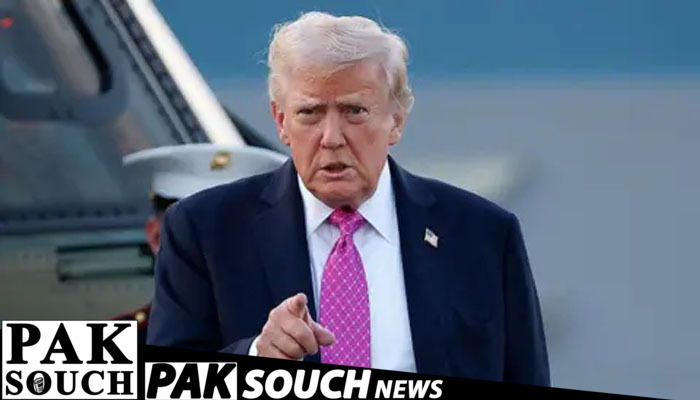
US President Donald Trump has declared that he will initiate legal action against the British Broadcasting Corporation (BBC) next week, alleging that the global media outlet deliberately misrepresented him by inaccurately editing one of his speeches in a documentary broadcast last year. The announcement was made during an informal conversation with journalists aboard Air Force One, where Trump signaled that his administration’s legal team is preparing a high-value lawsuit seeking substantial damages.
Speaking to the press, Trump said his lawyers believe the BBC could be liable for one billion dollars or more in damages. “Our legal team thinks the case is strong. They say the BBC could face a lawsuit of a billion dollars, maybe more,” the president said. He added that his administration was “very likely” to file the case inside the United States, a jurisdiction where defamation and media-ethics lawsuits can result in significant penalties if wrongdoing is proven.
Trump confirmed that he has not yet spoken to the British Prime Minister about the issue. “I haven’t talked to the British Prime Minister yet,” he said, referring to Sir Keir Starmer, who assumed office earlier this year. “But I will speak to him about it. We will talk to Sir Keir Starmer as well.” His remarks suggest that the dispute may spill into the diplomatic arena, potentially complicating the usually stable US-UK relationship, especially regarding press freedom, media regulation, and the rights of public figures.
The controversy began when the BBC aired a documentary in 2024 that included a segment of Trump’s speech that the broadcaster later admitted was incorrectly edited. The edited clip, according to the White House, distorted the context of the president’s remarks and portrayed him in a misleading manner. After widespread criticism—particularly from political supporters of Trump—the BBC issued an apology acknowledging the editing mistake. However, the corporation refused to offer financial compensation, arguing that it had acted in good faith and that the error was corrected promptly once detected.
The BBC also announced that the documentary in question would not be broadcast again. The commitment to permanently remove the edited version from future programming was framed as an additional gesture of accountability.
Despite the BBC’s apology, Trump and his legal advisers appear determined to pursue the matter aggressively. According to sources close to the president, he views the issue not simply as an editorial mistake, but as part of a broader pattern of what he describes as “media manipulation” targeting him and his political agenda. Trump has frequently accused major Western news outlets—including CNN, The New York Times, and others—of spreading misinformation or presenting biased coverage. The BBC, a publicly funded broadcaster known for its global reach, is now the latest organization to face his legal and political ire.
Legal experts have begun analyzing the implications of such a lawsuit. If the Trump administration proceeds, it could become one of the highest-profile defamation cases involving a foreign media institution in US courts. Lawsuits of this scale require proving both reputational damage and malicious or reckless disregard for accurate reporting. The BBC’s public apology may complicate or mitigate the argument for punitive damages, but the high visibility of the case means it could still have far-reaching consequences.
Diplomatic officials in Washington and London are monitoring the situation. While the United Kingdom generally avoids direct intervention in editorial disputes involving the BBC due to the broadcaster’s independent charter, any legal complications involving a sitting US president could require political attention. Trump’s decision to inform journalists that he plans to personally raise the issue with Prime Minister Starmer underscores the potential geopolitical weight of the conflict.
The situation also highlights ongoing tensions between political leaders and media institutions worldwide. In many countries, debates over press freedom, editorial integrity, and the boundaries of criticism versus defamation have intensified. For Trump, who has consistently positioned himself as a critic of “mainstream media,” the case represents another chapter in his long-standing confrontations with major news organizations.
Observers say the optics of this situation are significant. By choosing to announce the lawsuit aboard Air Force One, Trump framed the issue not as a private concern, but as an extension of his official capacity and broader political narrative. The move also places pressure on the BBC, which must now prepare for a potentially expensive and high-stakes legal challenge in a foreign jurisdiction.
As the date for filing the lawsuit approaches, both sides are likely consulting legal teams, public-relations experts, and diplomatic advisers. For the BBC, the immediate challenge will be to defend its editorial process while maintaining its reputation as a trusted global news source. For the Trump administration, the case may provide an opportunity to reinforce its stance on media accountability while mobilizing political support.