


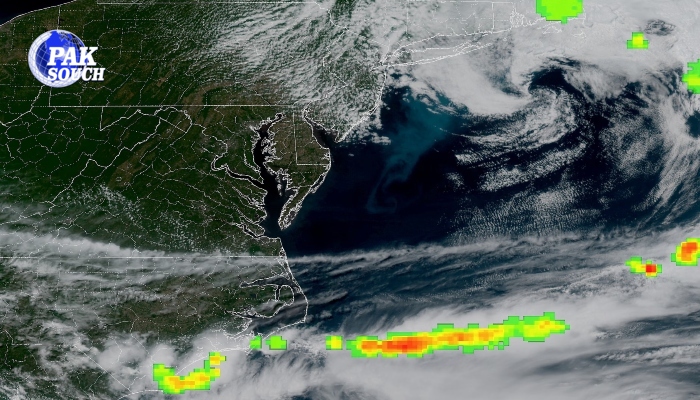
WASHINGTON: A meteor traveling toward Earth exploded high above the northeastern United States, producing a powerful blast that released energy equivalent to approximately 300 tons of TNT, according to the National Aeronautics and Space Administration (NASA). The spectacular event lit up the sky, generated a loud sonic boom, and attracted widespread attention from residents across several states.
NASA confirmed that the fireball was observed over northeastern Massachusetts and southeastern New Hampshire at around 2:00 p.m. local time. Witnesses reported seeing a bright streak of light crossing the sky before it suddenly burst apart in a dramatic explosion. Many residents also heard a loud rumbling sound moments later, which experts say was caused by the shockwave generated when the meteor fragmented in the atmosphere.
According to NASA official Jennifer Durren, the object was a naturally occurring meteoroid and not a piece of space debris or a satellite re-entering Earth’s atmosphere. She explained that the meteor was traveling at extremely high speed when it entered the atmosphere, creating intense friction with air molecules. This friction caused the object to heat up rapidly, producing a brilliant glow before ultimately breaking apart.
“The object was a natural celestial body,” Durren said. “It was not related to any human-made spacecraft or orbital debris. The energy released during the explosion was estimated to be comparable to the detonation of about 300 tons of TNT.”
Scientists noted that meteors enter Earth’s atmosphere every day, although most are relatively small and burn up completely before reaching the ground. Larger meteoroids, however, can produce dramatic fireballs and powerful airbursts similar to the one witnessed over the northeastern United States. Such events are uncommon but not unprecedented.
Experts explained that when a meteoroid enters Earth’s atmosphere at high velocity, it experiences enormous pressure and heat. If the object is large enough, the stress can cause it to fragment violently. This process releases a significant amount of energy and may produce a shockwave capable of being heard over a wide area. In some cases, fragments survive the descent and reach the ground as meteorites, though no confirmed reports of meteorite impacts had been received immediately following this event.
Residents across Massachusetts and New Hampshire took to social media to share videos and photographs of the phenomenon. Several eyewitnesses described the fireball as brighter than the sun, while others reported that the sonic boom shook windows and startled people indoors. Emergency services in some communities reportedly received calls from concerned residents who feared an explosion or aircraft incident had occurred.
NASA and other scientific organizations are continuing to analyze data collected from weather satellites, ground-based cameras, and sensor networks to better understand the meteor’s size, speed, and trajectory. Preliminary estimates suggest that the object disintegrated at a high altitude, reducing the likelihood of significant debris reaching populated areas.
Astronomers emphasized that events like this provide valuable scientific information about the composition and behavior of small celestial objects. By studying meteors and their atmospheric explosions, researchers can learn more about the materials that make up the solar system and improve methods for tracking potentially hazardous near-Earth objects.
The incident has also renewed public interest in planetary defense efforts. NASA and international space agencies maintain monitoring programs designed to detect and track asteroids and other objects that could pose a threat to Earth. While the vast majority of meteors are harmless and burn up in the atmosphere, larger objects have the potential to cause damage if they reach the surface.
Fortunately, officials reported no injuries or significant property damage as a result of the explosion. The meteor’s disintegration high in the atmosphere prevented it from becoming a direct threat to communities below.
Scientists say the event serves as a reminder that Earth is constantly interacting with material from space. Although most of these encounters go unnoticed, occasional spectacular fireballs and atmospheric explosions highlight the dynamic nature of our planet’s relationship with the broader cosmos. The northeastern U.S. meteor explosion, with its energy release equivalent to 300 tons of TNT, stands as one of the most notable recent examples of this natural phenomenon and demonstrates the immense forces at work in space just beyond our atmosphere.
About The Author