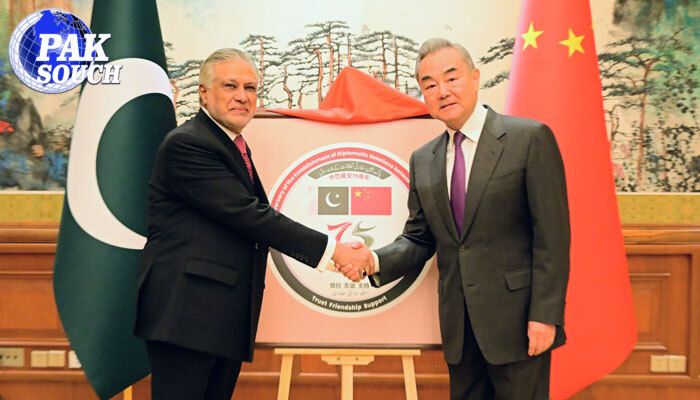
Pakistan and China have reaffirmed their commitment to a zero-tolerance policy against terrorism and agreed to further enhance bilateral security and defense cooperation, underscoring the depth of their long-standing strategic partnership. The agreement was reached during the 7th Pakistan–China Strategic Dialogue, held in Beijing under the joint chairmanship of Chinese Foreign Minister Wang Yi and Pakistan’s Deputy Prime Minister and Foreign Minister Ishaq Dar.
Following the conclusion of the dialogue, a joint communiqué was issued, outlining the key understandings and decisions taken by the two sides. According to the statement, Ishaq Dar visited China from January 3 to January 5 at the invitation of the Chinese government, reflecting the high level of trust and engagement between the two “iron brothers.”
The joint communiqué stated that both sides held in-depth discussions on regional and global developments, with a particular focus on peace and stability in South Asia. Pakistan and China jointly emphasized the need to avoid unilateral actions, promote dialogue, and resolve disputes through peaceful means. Both countries reaffirmed the importance of United Nations resolutions for the peaceful settlement of the Jammu and Kashmir dispute, reiterating their shared position on the issue.
On core interests, Pakistan once again expressed its firm support for China’s One China Policy, reaffirming full backing for China’s stance on Taiwan, Xinjiang, Tibet, Hong Kong, and the South China Sea. In return, China reiterated its strong support for Pakistan’s sovereignty, territorial integrity, and its ongoing efforts in the fight against terrorism. The Chinese side acknowledged Pakistan’s sacrifices in counterterrorism and assured continued cooperation in addressing shared security challenges.
The communiqué highlighted that comprehensive discussions were held on Pakistan–China relations, including defense and security collaboration, trade and investment, economic cooperation, and people-to-people exchanges. Both sides agreed to further enhance strategic communication, strengthen mutual trust, and maintain close coordination at all levels to safeguard shared interests.
A key outcome of the dialogue was the agreement to expand cooperation under the zero-tolerance policy against terrorism. Both Pakistan and China recognized terrorism as a common threat and pledged to deepen coordination, intelligence sharing, and capacity-building measures to counter militant and extremist elements. The two sides emphasized that no country should allow its territory to be used for terrorist activities against others.
The joint statement also reaffirmed the importance of the China–Pakistan Economic Corridor (CPEC) as a flagship project of the Belt and Road Initiative. Both countries agreed to accelerate work on CPEC Phase II, with a focus on industrial cooperation, agriculture, mining, and energy development. Special emphasis was placed on enhancing cooperation related to the Gwadar Port, which both sides view as a key driver of regional connectivity and economic growth.
In addition, Pakistan and China agreed to explore new areas of cooperation, reflecting their shared vision of taking the bilateral relationship beyond traditional domains. The communiqué noted that both sides are committed to ensuring that Pakistan–China friendship is passed on from generation to generation, further strengthening the foundations of their “all-weather strategic cooperative partnership.”
Another significant highlight of the dialogue was cooperation in science and technology, particularly in the field of space exploration. Both sides expressed satisfaction over progress in space cooperation and agreed to advance plans for the future participation of Pakistani astronauts at the Chinese space station, a move seen as symbolic of the deep trust and advanced level of bilateral collaboration.
The two countries also announced that they would begin preparations to celebrate 75 years of diplomatic relations in 2026. A series of events, exchanges, and joint initiatives are expected to mark the milestone, aimed at highlighting the historic nature of Pakistan–China relations and strengthening people-to-people bonds.
Pakistan, in the joint communiqué, praised China’s development achievements and modernization model, describing them as a source of inspiration for developing countries. China, on its part, expressed confidence in Pakistan’s economic potential and reiterated its willingness to support Pakistan’s development goals.
The dialogue concluded with both sides reaffirming their commitment to maintaining close coordination on regional and international platforms, supporting each other on issues of core national interest, and working together for peace, stability, and development in the region and beyond.
The outcomes of the 7th Pakistan–China Strategic Dialogue once again underscored that the Pakistan–China relationship remains resilient, forward-looking, and rooted in mutual respect, strategic trust, and shared interests, with counterterrorism cooperation and regional security firmly at the center of their partnership.