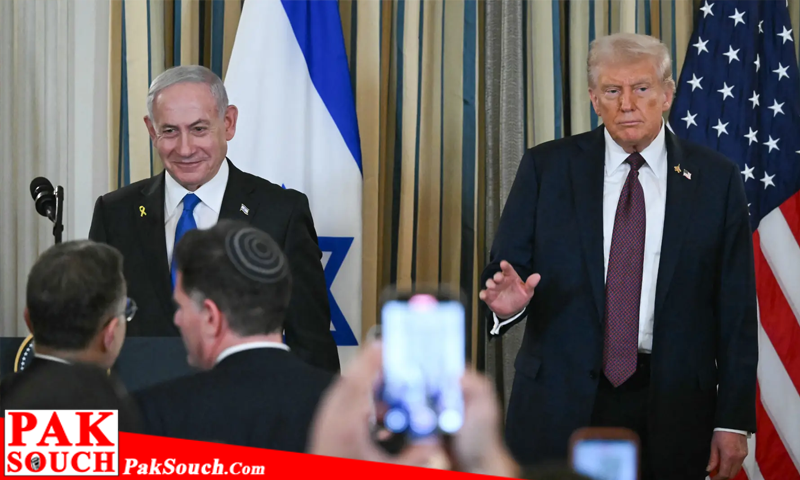
US President Donald Trump’s plan for a ceasefire in Gaza may become a pivotal moment after nearly two years of war. It presents both the opportunity for a short-term cessation of hostilities and a long-term pathway to reordering Gaza and the occupied Palestinian territories.
In the short-term, if accepted by both Hamas and Israel, it would immediately bring relief to the Palestinian people. That’s the only positive bit for the people of occupied Palestine, in the wake of Israel’s brutal bombardment campaign over the last two years that has killed over 65,000 people and injured more than 165,000 civilians.
A hostage-prisoner exchange will also relieve Israeli families. To this end, a template from the temporary ceasefire in January can be adopted.
Beyond that, for the long-term, the proposal is way too ambitious, and frankly speaking, unworkable. Intractable conflicts aren’t resolved suddenly through sketchy plans. Politics is difficult to square across Palestine, Israel and the Muslim world. And while this ‘peace plan’ has been drawn up following considerable pressure from across the globe, eventually President Trump’s focus will shift away to the next crisis and then, implementation will become even more challenging.
Ironically, the plan doesn’t even attempt to hold Israel accountable for its indiscriminate bombing of civilians, especially children over the past two years.
Ceasefire: Realistic yet elusive
For the people of Gaza and occupied territories, the two urgent priorities are a ceasefire agreement, followed by the resumption of aid. At this point, they cannot even think about the long-term mechanics of peace and prosperity. For them, a halt to the ongoing genocide and the indiscriminate bombing of civilians is a daily nightmare. This needs to end now.
Until the atrocities are stopped, any concurrence of Israel’s Netanyahu to any version of Trump’s plan is meaningless. Unfortunately, even after Nethanyahu agreed to the American proposal, bombardment in Gaza continued. On Wednesday, the Israeli defence minister issued a final warning to the residents of Gaza city to flee towards the southern part of the strip, as the Israeli military intensified its ground offensive to encircle the city. For the people of Gaza, even the prospect of a ceasefire is elusive, until the strikes continue.
For a realistic and sustainable ceasefire, a mechanism that places limitations on Israel’s military activity should have been included in the plan. Absent that, all substantive demands — political, military and governance — are being presented to Hamas as a fait accompli. The reason being: desperation of external stakeholders, especially regional actors, to broker a ceasefire where the fighting stops, even at the cost of the long-term interests of the Palestinian people.
Enter the Muslim world and the US
In recent weeks, as global diplomacy picked pace in New York on the sidelines of the annual session of the United Nations General Assembly, focus remained on the humanitarian crisis and the ongoing genocide in Gaza.
To respond to global rage, the US leadership engaged leaders of leading Muslim-majority countries, even outside the Arab world, to craft a new plan that would achieve both: a ceasefire and an attempt at a long-term mechanism for peace. The original goal has been short-term — secure a ceasefire, at any cost, while the long-term details are ironed out. Qatar’s leadership has stated as much on the record, giving an insight into the motivations behind the frantic diplomacy witnessed in recent days.
At a certain level, Israel and the US are adapting to the growing public pressure by Western and Muslim countries for establishing a ceasefire.
Israel’s international isolation has been growing and was on stark display during the annual session of the UN General Assembly, where Saudi-France efforts to recognise a Palestinian state and push for a two-state solution dominated the diplomacy.
For Gulf countries, especially Qatar, the Israeli airstrike in Doha proved to be a jolt: if war lingers, it can even reach secure cities of the Gulf. For President Trump, the relentless Israeli strikes and expanding ground invasion of Gaza undercut his pitch for the Nobel Peace prize: how could President Trump claim to have achieved world peace when a genocide in Gaza continues?
By consenting to the American and Arab-backed peace proposal, Israel is tactically changing the story in the court of international public opinion.
After the ceasefire: Challenge for Arab and Muslim leaders
The first part of the 20-point plan aims to establish a ceasefire in Gaza’s territory followed by a hostage-prisoner exchange and resumption of humanitarian aid.
Beyond that, it ventures into disarming Hamas, reordering governance in Gaza and the West Bank, and establishing a new security mechanism. It envisions managing the security of the occupied Palestinian territories by a multi-national International Stabilisation Force, in coordination with the Israeli military, while a Board of Peace comprising Trump and Tony Blair and a technocratic apolitical Palestinian administration implement the plan and run the region.
The multi-pronged plan, in its current form, is a vision that requires deliberations on each aspect between different Palestinian factions, and among the regional stakeholders. To implement the plan would require sustainable oversight and empowered regional or international mechanism.
In its current form, the plan appears to be a package proposed to secure a ceasefire by advancing aspirational ideas for the end-state of Gaza and occupied Palestinian territories. Even the end-state envisioned in the plan is problematic, as it pushes an unsustainable and asymmetric peace deal.
The fragility of the plan is manifested by shifting positions of Arab and Muslim countries, where notably Pakistan and Qatar have stated on the record that the document released by the White House has been modified without consultation with regional partners.
Crucially, Doha is stressing that details on future mechanics can be worked out later, while a ceasefire is realised now. This will create a new status-quo where a conditional ceasefire may be secured while the implementation of the plan will stay in limbo until the finer details are worked out.
Politics of the next steps
Beyond immediate ceasefire concerns, each stakeholder involved in framing the peace deal, as well as the parties who are expected to implement the plan will be guided by their own political imperatives and constraints.
For Israel, the deal in its current form as released by the White House, gives it a decisive veto over the future trajectory of the occupied Palestinian territories. The timeframe and guarantees related to the withdrawal of the Israeli military from Gaza are vague, and this can enable Netanyahu to own the deal politically, while boasting that Israel can begin military operations again, if it so wishes.
For Hamas, it is a decisive moment, where its future role either as a military force or a political movement will be determined. As Hamas faces pressure from its key partners — Qatar and Turkey — to agree to the ceasefire, its leadership will find it difficult to accept the full framework being advocated by the US and the regional countries.
Any amendments proposed by Hamas to its future role will complicate the viability of the fragile agreement and make the task of the Trump administration and mediating parties difficult. On its part, Hamas will continue to be a formidable force in Gazan society though its current bargaining position is under strain.
Beyond Israel and Hamas, the leading Muslim countries have entered uncharted territory. In their bid to secure a ceasefire and avert the displacement of Gazans from their territory, Muslim countries cannot become accessory to enabling Israel’s permanent military occupation.
Moreover, by shifting the responsibility of ensuring that Hamas agrees to the peace plan, the US has put Muslim leaders in the political spotlight — if Hamas doesn’t agree to the framework draft, then the onus of escalation in Israeli military activity rests with Hamas and Muslim countries. Conversely, even if the plan is implemented in some shape, then Muslim countries, especially Pakistan, Turkey and Indonesia, will have to engage with Israel on security coordination of the Gaza and West Bank, which will spark its own new challenges, both domestically and across the region.
The Gulf states will provide both diplomatic support and economic resources for rebuilding Gaza and the rehabilitation of Gazans, but they will likely not take on security responsibilities.
Peacebuilding is inherently chaotic, as witnessed in recent days. Crucially, peacebuilding requires patience and continuous engagement by all parties, and these are the two elements that are currently missing. For a peace initiative to be sustainable across Gaza and the occupied Palestinian territories, it must have political ownership of the people of Palestine. Absent that, all efforts will only lead to a temporary cessation of hostilities until the next round.
Header Image: US President Donald Trump and Israeli Prime Minister Benjamin Netanyahu stand at the conclusion of a joint press conference in the State Dining Room of the White House in Washington, DC on September 29, 2025. — AFP


The author is a South Asia security researcher at the University of Technology Sydney.