

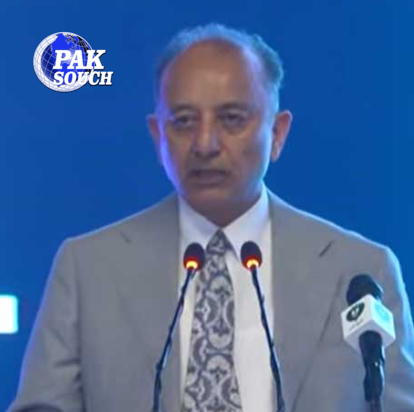
ISLAMABAD: Federal minister for Climate Change, Musadik Malik, on Tuesday called for a new international legal framework to protect transboundary water resources, arguing that disputes over shared rivers were no longer merely environmental or climate issues but matters of justice, food security and global stability.
Addressing a seminar on the Indus Waters Treaty organised by the Institute of Regional Studies, Malik said the world needed to move beyond “non-binding declarations” and establish an enforceable international covenant carrying political, economic and diplomatic consequences for states that violate water-sharing obligations.
“There must be a covenant which has political consequences, economic consequences and diplomatic consequences,” he said. “Rise now, or hold your peace forever.”
Framing his remarks around the story of a Pakistani farmer, Iqbal Solangi, Malik said repeated floods had destroyed the man’s livelihood over the past 15 years, forcing him to abandon farming after generations of cultivating the land.
According to the minister, Solangi survived devastating floods in 2010, returned to rebuild his farm, only to lose everything again in 2012 and then once more in 2022. His livestock, home, children’s school and means of livelihood were washed away, ultimately forcing him to seek labour work in Karachi.
Malik said Solangi’s story reflected the experiences of millions across the world, from Bangladesh to Africa, where communities were increasingly vulnerable to disruptions in river flows.
“Iqbal Solangi is not alone in this universe,” he said, drawing parallels with Bangladeshi farmers and fishermen, women in Africa’s Sahel region who walk miles each day to collect water, and communities living along the Nile, Mekong and the shrinking Aral Sea.
He argued that the central challenge was not simply floods or droughts but the inability of downstream populations to control the water on which their lives depended.
“The danger is not just too little water or too much water. The danger is that someone else who is not you has his hand on the tap that controls your water,” Malik said.
Referring to fluctuations in water flows at Marala, he said river discharge had risen dramatically before falling again without corresponding rainfall, describing it as evidence that upstream control over water posed a serious threat to downstream communities.
The minister said nearly half of Pakistan’s population, around 120 million people, depended on agriculture, while about a quarter of the country’s economy and its entire food security relied on the uninterrupted flow of the Indus river system.
“This is neither a crisis of climate nor a crisis of water,” he said. “This is a crisis of justice.”
Malik also linked climate change to water insecurity, saying the same neighbouring country that Pakistan accused of seeking control over river flows was among the world’s largest greenhouse gas emitters, contributing to rising temperatures, accelerated glacier melt and increased downstream flooding.
Questioning the adequacy of international law governing shared rivers, he said countries could not simply reject international legal jurisdiction over transboundary water disputes without undermining global confidence in treaty-based arrangements.
He urged the international community to develop binding legal mechanisms to govern shared water resources, arguing that while global institutions existed to regulate trade and nuclear proliferation, comparable enforcement mechanisms for water security remained absent.
“We have organisations and laws that govern trade. We have organisations and laws that control nuclear proliferation. But you have no laws for water, for agriculture, for food, for drinking water,” Malik said, calling on international experts to pursue binding solutions rather than voluntary commitments.
Pakistan will respond if Indus waters are blocked: Tarar
Federal Information Minister Atta Tarar said Pakistan remained committed to the Indus Waters Treaty but would respond if any attempt was made to stop the country’s share of water, calling the treaty essential for regional stability and international law.
Tarar said climate change, accelerating glacier melt and growing water scarcity had made it more important than ever to safeguard the agreement.
He said South Asia’s future depended on turning water into a source of cooperation rather than conflict, adding that rivers transcended borders and political divisions and required shared solutions.
“The weaponisation of water, or attempts to unilaterally alter established arrangements, undermine not only regional peace and stability but also the broader framework of international law,” Tarar said. He added that international treaties could not be suspended or ignored at convenience and that respect for such agreements was essential for maintaining trust among nations.
The minister said Pakistan had consistently demonstrated its commitment to peaceful engagement, constructive dialogue and the faithful implementation of the treaty. However, he warned that the country’s leadership was determined to act if Pakistan’s water was obstructed.
“If an attempt is made to stop the water of Pakistan, our national leadership stands resolved to respond effectively to restore the water for the people of Pakistan,” he said.
Tarar also highlighted the role of the media in countering misinformation and promoting factual reporting, saying responsible journalism could help strengthen understanding, peace and confidence-building in the region.
Calling water an inalienable right of Pakistan’s 240 million people, Tarar said the government would continue raising the issue at international forums and challenge what he described as India’s “illegal attempts” to alter the treaty.
He said Pakistan remained committed to protecting the livelihoods of millions of people, particularly those dependent on agriculture, which he described as the backbone of the country’s economy. The minister added that despite challenges posed by climate change, Pakistan would continue to safeguard the treaty and ensure that the waters of the Indus remained a source of life, peace and shared prosperity.
India is using water as a weapon
Former federal minister Khurram Dastgir Khan accused India of using water as a weapon, alleging that New Delhi had repeatedly violated the Indus Waters Treaty since suspending it unilaterally in April 2025. Dastgir claimed Indian leaders had publicly declared that Pakistan “would not receive even a single drop of water”. He alleged that India had been releasing large volumes of water into the eastern rivers without prior notification and, at other times, withholding water before releasing it in a manner that caused flooding downstream.
“Water is being used as a weapon,” Dastgir said, adding that 7.3 million Pakistanis had been affected by India’s actions. He added that access to water was a fundamental human right and argued that depriving large populations of water, leading to food insecurity, constituted an international crime.
Referring to international legal frameworks, Dastgir said the Court of Arbitration had ruled that the Indus Waters Treaty could not be suspended unilaterally, while the Geneva Conventions also prohibited linking water to other disputes. He urged the international community to prevent the use of water as a political tool.
“The rivers covered under the Indus Waters Treaty are linked to our lives and our civilisation,” he said. “Pakistan will protect both its share of water and its civilisation, and we will raise the issue of the weaponisation of water at every regional and international forum.”
Bilawal says water security is key to regional peace
Chairperson PPP, Bilawal Bhutto Zardari said water was not merely a geographical issue but one that directly affected food security, livelihoods and the future of millions.
“Water is not just geography; it is about food, the future and life,” he said, adding that the world had increasingly recognised water resources as a central issue in global politics and security.
Drawing a comparison with global shipping routes, Bilawal said that just as any disruption in the Strait of Hormuz affected the global economy, uninterrupted flows in the Indus River system were vital to Pakistan’s survival.
“The use of sea lanes or water resources as a weapon is a dangerous trend for international peace,” he said, adding that lasting peace between Pakistan and India would not be possible without the restoration of the Indus Waters Treaty.
Bilawal said Pakistan had complied with the terms of the ceasefire, while India had not fully honoured its commitments. He stressed that Pakistan’s rights over the waters of the Indus, Jhelum and Chenab rivers were recognised under international agreements and should be fully protected.
“Water should not be viewed merely as a technical dispute but as a matter of national security,” he said, adding that Pakistan desired peace but would not compromise on its people’s fundamental rights or its water interests. “The entire Pakistani nation stands united in protecting the water rights of millions, and the use of water as political pressure or as a weapon is contrary to international law and treaties.”
Court rulings reaffirm binding nature of Indus Waters Treaty
Syed Muhammad Mehar Ali Shah who currently serves as the Pakistan Commissioner for Indus Waters (PCIW), said the agreement contains a comprehensive dispute resolution mechanism that begins with bilateral engagement through the Permanent Indus Commission and, if unresolved, progresses to third-party forums. “The sequence is deliberate: institutional settlement first, third-party determination where necessary, but no paralysis,” he said, adding that Pakistan had relied on the mechanism both in the past and in ongoing proceedings.
Referring to Article 9 of the treaty, Mehr said the Court of Arbitration had strengthened rather than weakened the agreement by reinforcing legal certainty. He noted that disputes intensified after India accelerated development projects on the western rivers in the early 2000s, prompting Pakistan in 2016 to seek a broader interpretation of the treaty’s provisions governing such projects.
Mehr said the Court of Arbitration had since issued two awards, one in August last year and a supplemental award a month ago, clarifying several key legal principles. “India’s non-appearance before the Court does not paralyse the proceedings,” he said, adding that the court had also ruled that India’s absence did not deprive it of jurisdiction and that its awards were “final, binding and controlling”. “This is not political rhetoric, and it is no longer Pakistan’s position paper. It is the treaty speaking through its own court,” he said.
He said the court’s rulings had translated the treaty’s legal obligations into practical operational standards. “The ‘let flow’ principle is the general rule for the western rivers,” Mehr said, adding that India could develop run-of-river hydropower projects only within the limits prescribed under the treaty. He said pondage must remain realistic and could not be inflated by overstating installed capacity or anticipated electricity demand, while minimum downstream flows and environmental obligations must also be respected.
Unilateral changes to Indus Waters Treaty
Russian water policy expert Roksolana Zhyhon also expressed concern over India’s position on shared water resources, saying statements about depriving Pakistan of water were inconsistent with international law and could undermine regional stability. She described the treaty as the foundation of equitable water sharing in the region and said it did not provide for unilateral withdrawal by either party.
“The Indus Waters Treaty is regarded globally as one of the world’s most successful water-sharing agreements, and its preservation is essential for peace and stability in South Asia,” she said.
She warned that any alteration in the flow of water by India could have serious consequences for Pakistan’s agricultural sector, noting that Islamabad had repeatedly raised concerns with New Delhi over unusual water flows in the Chenab River.
Zhyhon also cautioned that the construction of dams in upstream areas could heighten regional instability. “Attempts to use water as a weapon are deeply concerning,” she said, adding that unilateral and rigid policies risked eroding international trust and that weakening the treaty for political purposes could have dangerous consequences.
Suspension of treat ‘illegal’
Speaking at the same seminar, legal expert Ahmer Bilal Soofi said India’s decision to suspend the Indus Waters Treaty was unlawful and also violated the principles of the United Nations Charter. He said water, air and food were universally recognised as basic human necessities, making any attempt to suspend the treaty legally indefensible.
“India is trying to link the Indus Waters Treaty with other political and border disputes, which is contrary to international law,” Soofi said.
Referring to the aftermath of the Pahalgam incident, he said India should have shared written information with Pakistan but had instead chosen confrontation over legal engagement.
Soofi said the dispute over Jammu and Kashmir remained an internationally recognised issue and noted that Pakistan had already raised India’s suspension of the treaty before relevant international forums. “There is a clear legal dimension to every issue between Pakistan and India,” he said, adding that India’s actions amounted to a violation of the UN Charter.
About The Author