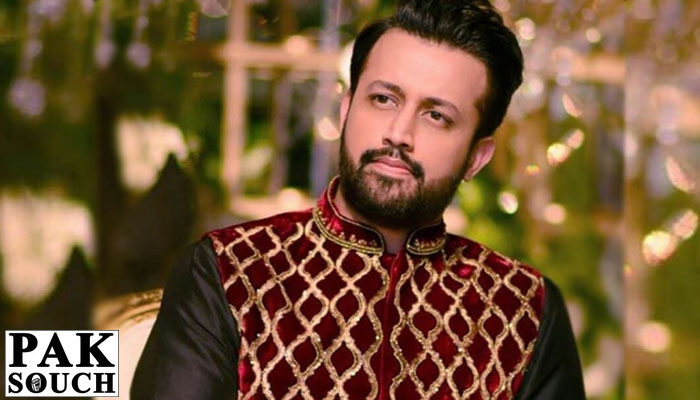
Toronto, Canada (Entertainment Desk): Globally acclaimed Pakistani singer Atif Aslam has broken his silence and firmly responded to critics who questioned his decision to perform at a concert just a day after his father’s death. Speaking candidly during an interview in Canada, the celebrated artist defended his choice, saying that his life, grief, and professional responsibilities should not be dictated by public opinion.
The Context of the Controversy
Last month, Atif Aslam’s father, Muhammad Aslam, passed away in Lahore. The very next evening, Atif performed at a large-scale Independence Day concert at Karachi’s National Stadium, an event that had been scheduled weeks in advance.
The move sparked a wave of mixed reactions. On one hand, many fans applauded the singer for his professionalism, noting that despite personal tragedy, he honored his commitment to perform for thousands who had bought tickets. Admirers praised him as a “true artist” who did not let personal grief overshadow national celebration.
On the other hand, critics argued that performing immediately after such a devastating personal loss was insensitive and inappropriate. Social media debates quickly emerged, with some accusing him of prioritizing career over family mourning traditions.
Atif Aslam’s Response
Currently on tour in Canada, Atif addressed the criticism in an interview with Indian-origin journalist and host Faridoon Shahryar. For the first time since the incident, he directly spoke about the negative comments.
“After my father’s death, everyone had something to say. People kept pointing out that I performed the very next day. What was happening inside my home became a topic for their TV channels and gossip,” he remarked with visible frustration.
He added that his personal choices should not be subject to constant judgment.
“It’s not my job to tell others what they should or shouldn’t do. Likewise, it is not for them to tell me how to grieve. I cannot maintain relations with the entire world. My work is my art—judge me for my music. If you love me, love me for my songs. If you dislike me, dislike me for my music, not for personal decisions about my life.”
Balancing Grief and Responsibility
Aslam emphasized that performing on stage, even during a time of grief, does not mean he was unaffected by his father’s passing. Rather, he saw it as a form of professional responsibility. The Karachi concert, he explained, was part of a major Independence Day celebration, and backing out at the last moment would have disappointed thousands of fans.
Industry insiders noted that concert cancellations at the eleventh hour often lead to financial and logistical chaos, and in many cases, hefty financial penalties. Atif’s decision to go ahead with the show may have been partly motivated by this reality, in addition to his sense of duty toward his audience.
Public Reaction: A Divided Audience
The debate surrounding Atif’s decision highlighted the cultural expectations around mourning in South Asia. Traditionally, family members observe extended periods of grief, avoiding social functions or public appearances. For some, seeing a beloved celebrity perform so soon after a parent’s death felt jarring.
Yet many others defended him, noting that grief manifests differently for each person. Some praised his resilience, suggesting that honoring commitments, especially at a national event, could be seen as a tribute to his late father’s values of discipline and dedication.
One fan tweeted:
“Atif Aslam lost his father and still performed for Pakistan the next day. That’s strength, not disrespect.”
Another critic wrote:
“The least he could have done was take a break. Performing on stage a day after your father’s death is not normal—it’s insensitive.”
The Artist’s Broader Philosophy
This is not the first time Atif has addressed the public’s tendency to scrutinize his personal life. In past interviews, he has emphasized the importance of being seen primarily as an artist, not as a public figure expected to conform to societal norms at every step.
Atif’s words—“I cannot maintain relations with the entire world”—reflect his growing frustration with unrealistic expectations placed on celebrities. In his view, the focus should remain on his contributions to music, rather than how he chooses to navigate personal grief.
Atif Aslam’s Global Journey
Atif Aslam, who rose to fame with hits like Aadat and went on to dominate the South Asian music industry with countless chart-toppers, has often faced intense public scrutiny. His career spans nearly two decades, with performances across the globe, Bollywood playback singing, and humanitarian recognition, including the Tamgha-e-Imtiaz, one of Pakistan’s highest civilian awards.
His international concerts frequently sell out, and his current Canadian tour is no exception, drawing thousands of South Asian expatriates eager to hear him live. For his fans abroad, Atif represents not only Pakistani music but also the cultural pride of the diaspora.
A Universal Question: How Should Artists Grieve?
Atif’s situation highlights a broader issue that many performers face: the pressure to separate personal life from professional commitments. For entertainers, who often live in the public eye, the expectation of maintaining appearances—sometimes even at moments of immense personal loss—can be overwhelming.
While some see performing in grief as insensitive, others argue it reflects resilience and a commitment to one’s craft. The balance between personal mourning and professional obligations remains deeply subjective and, as Atif suggested, perhaps beyond the judgment of outsiders.
Conclusion
Atif Aslam’s forthright response to critics reflects his determination to define his own boundaries. By insisting that he be judged for his art rather than his personal choices, he has drawn attention to the undue pressure placed on public figures to conform to societal expectations.
Ultimately, his words serve as a reminder that grief is deeply personal and manifests in different ways. For Atif, stepping onto the stage after his father’s passing may not have been a dismissal of his loss, but rather a way to carry forward the discipline and dedication that his father instilled in him.
As his Canadian tour continues, the debate is likely to linger. But for his millions of fans worldwide, Atif Aslam remains not just a singer, but a symbol of resilience, artistry, and the complex humanity behind the music.