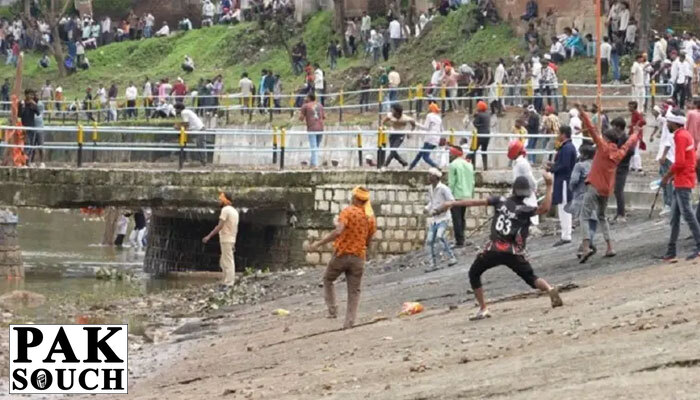
India is often known for its colorful festivals, deep-rooted traditions, and rituals that reflect its cultural diversity. However, some traditions, despite their cultural significance, are deeply violent and dangerous. One such ritual takes place in Pandhurna, a district in Madhya Pradesh, where for the last three centuries, villagers have gathered every year to participate in a brutal stone-pelting festival known as the Gotmar Mela.
This disturbing tradition involves villagers from two sides pelting stones at one another in a symbolic yet deadly re-enactment of a centuries-old love story. The result is often tragic—hundreds are injured annually, with some even losing their lives. Yet, despite repeated attempts by authorities to stop it, the festival continues, reflecting the powerful grip of cultural customs on communities.
The Ritual of Stone Pelting
The Gotmar Mela is held every year during the farming festival of Pola, in either August or September, and attracts thousands of participants and spectators not only from Pandhurna but also from surrounding areas.
The ritual begins early in the morning. According to local tradition, a man named Suresh Kawle plants a Palash tree in the middle of the Jam River, marking the start of the violent contest. The tree is then decorated with coconuts, red cloth, and shrubs, which are worshipped as part of the religious observance.
By 8 or 9 a.m., the real spectacle begins: men from the two opposing villages—Pandhurna and Savargaon—start hurling stones at each other, often using slings made of rope to increase the force. The clashes are fierce and chaotic, and the air fills with flying stones. Every year, between 500 to 600 people are injured, according to the local police, and occasionally lives are lost.
A Festival Rooted in Tragedy
The origin of the Gotmar Mela lies in a tragic love story that has been passed down through generations. According to local legend, centuries ago, a young man from Pandhurna fell in love with a girl from the neighboring Savargaon village. When her family opposed the marriage, the boy attempted to elope with her.
As the young couple tried to cross the river, the girl’s family discovered them and began pelting stones at the boy. Soon after, the boy’s family rushed in to defend him, and they retaliated with stones of their own. In the violent exchange, both the boy and the girl were killed.
Since then, the villagers have re-enacted this tragic event annually through the Gotmar Mela, claiming to honor the doomed lovers’ memory. However, what began as a symbolic act has evolved into a full-scale violent clash that injures hundreds every year.
Attempts to Ban the Festival
Local authorities have made multiple attempts to curb or ban the dangerous ritual. Over the years, police have tried to intervene by creating awareness campaigns, imposing restrictions, or even physically stopping the clashes. Yet, every attempt has been met with strong resistance from the villagers, who consider the Gotmar Mela not just a festival but a sacred tradition.
According to Sunder Singh Kanish, the Superintendent of Police of Pandhurna, despite the risks and bloodshed, villagers refuse to give up this ritual. For them, it is deeply tied to their cultural identity, and they see it as an essential part of their heritage, no matter how dangerous it may be.
Why the Festival Persists
Anthropologists argue that rituals like Gotmar Mela survive because they serve as a collective expression of community identity and history. Even though the violence causes immense harm, the act of participating provides villagers with a sense of belonging and continuity with their ancestors.
For the participants, bravery and endurance are often seen as marks of honor, and sustaining injuries in the festival is sometimes regarded as a badge of pride rather than a tragedy.
The Human Cost
While the villagers see the festival as sacred, the human cost is undeniable. Victims often suffer from broken bones, head injuries, permanent disabilities, and even death. Hospitals in the region prepare in advance for the influx of patients during the festival season.
What is particularly striking is the lack of protective measures. Unlike other traditional combat festivals in India where participants wear protective gear or use symbolic weapons, the Gotmar Mela involves real stones thrown with full force. This makes it one of the most dangerous traditional rituals in the country.
Balancing Tradition and Modernity
The Gotmar Mela highlights the tension between preserving cultural traditions and ensuring public safety. India, with its vast cultural diversity, often faces this challenge: how to respect centuries-old customs while preventing needless suffering.
Many activists and health officials argue that the festival should either be banned or modified into a safer form. Some have suggested symbolic stone-throwing using soft objects or controlled rituals that retain cultural significance without causing harm. However, given the villagers’ deep attachment to the ritual, change has been slow and highly contested.
Conclusion
The Gotmar Mela of Madhya Pradesh is a haunting reminder of how cultural traditions, even those rooted in tragic love stories, can evolve into violent spectacles. For over 300 years, villagers of Pandhurna and Savargaon have gathered to hurl stones at each other, turning what could have been a symbolic remembrance into an annual bloodbath.
Despite repeated injuries and fatalities, the ritual continues to thrive, highlighting the powerful grip of tradition on communities. Until a safer alternative is accepted, the Gotmar Mela will remain one of the most dangerous festivals in the world—a testament to the dark side of cultural heritage where devotion and violence coexist.