

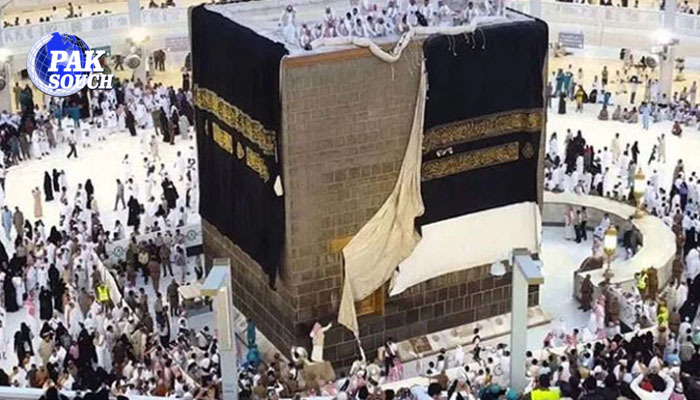
MAKKAH: Preparations are underway for the annual replacement of the Kiswah, the sacred black cloth that covers the Holy Kaaba, as the new Kiswah has officially been handed over to the Keeper of the Kaaba during a special ceremony held in Makkah.
The replacement of the Kiswah is one of the most significant religious traditions associated with Islam’s holiest site and is observed each year with great reverence and care.
Formal Handover Ceremony Held
Acting on behalf of the Custodian of the Two Holy Mosques, Saudi authorities organized a formal ceremony during which the newly prepared Kiswah was handed over to the Keeper of the Kaaba.
The event marked an important step in the annual process of replacing the covering of the Holy Kaaba.
Officials, religious representatives, and individuals associated with the administration of the Grand Mosque participated in the ceremony, which reflects the Kingdom’s longstanding commitment to serving Islam’s holy sites.
Kiswah to Be Replaced on 1st Muharram
Saudi authorities confirmed that the Kiswah will be replaced on 1st Muharram, marking the beginning of the new Islamic year.
As in previous years, a special and spiritually significant ceremony will accompany the replacement process.
The annual tradition symbolizes respect and care for the Holy Kaaba, which stands at the center of Masjid al-Haram and serves as the direction of prayer (Qibla) for Muslims around the world.
Millions of Muslims closely follow the event each year due to its religious and historical significance.
A Tradition with Deep Historical Roots
The practice of covering the Kaaba dates back centuries and has been maintained throughout Islamic history.
Over time, various rulers and Islamic governments have been responsible for producing and replacing the Kiswah. Today, the task is overseen by Saudi authorities through a specialized facility dedicated to its design, production, and maintenance.
The annual replacement is carried out with meticulous planning and precision to ensure that the process is completed smoothly and respectfully.
The Craftsmanship Behind the Kiswah
The Kiswah is regarded as one of the most intricate and valuable textile works in the Islamic world.
It is made from high-quality black silk and decorated with Quranic verses embroidered using gold- and silver-coated threads.
The production process involves skilled artisans and specialists who spend months preparing the cloth, calligraphy, and decorative elements.
The completed Kiswah consists of several large pieces that are carefully assembled before being installed on the Kaaba.
Spiritual Significance for Muslims
For Muslims, the annual replacement of the Kiswah is more than a ceremonial event. It serves as a reminder of the sanctity of the Holy Kaaba and the central role it occupies in Islamic worship.
The Kaaba is the focal point toward which Muslims around the world direct their prayers five times a day. It is also the centerpiece of the Hajj and Umrah pilgrimages, drawing millions of worshippers each year.
The changing of the Kiswah is therefore viewed as a deeply symbolic act that reflects the honor and respect accorded to Islam’s holiest sanctuary.
Preparations for the New Islamic Year
The replacement of the Kiswah on the first day of Muharram coincides with the beginning of a new Islamic year, adding further significance to the occasion.
Religious scholars often describe the event as an opportunity for reflection, renewal, and spiritual devotion as Muslims welcome the arrival of the new Hijri year.
The ceremony is expected to attract considerable attention from Muslims worldwide, many of whom follow the proceedings through media coverage and official broadcasts.
Continuing a Sacred Tradition
With the new Kiswah now formally handed over, final preparations are underway for its installation on the Holy Kaaba.
The annual replacement ceremony remains one of the most revered traditions associated with Masjid al-Haram, symbolizing continuity, devotion, and the enduring spiritual importance of the Kaaba for the global Muslim community.
As the new Hijri year begins on 1st Muharram, the sacred covering of the Kaaba will once again be renewed, continuing a centuries-old tradition that holds profound significance for Muslims around the world.
About The Author