


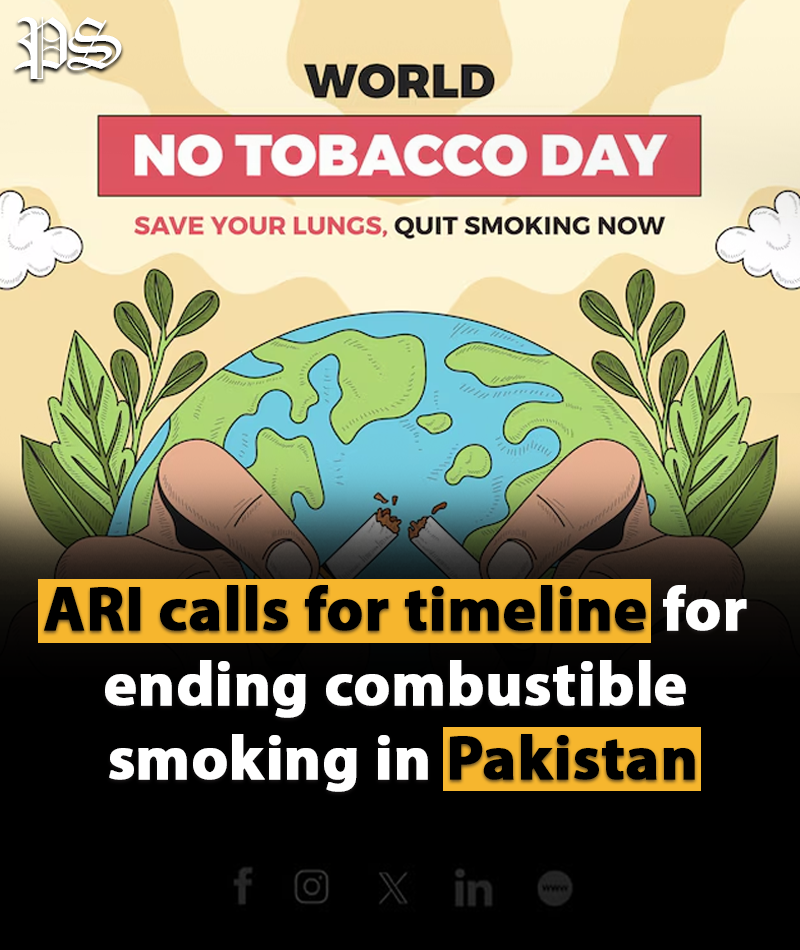
SUKKUR, 29 May,2026: The Alternative Research Initiative (ARI), together with NARI Foundation, has urged both federal and provincial governments to establish a clear timeline for phasing out combustible smoking in Pakistan.
“Ending combustible smoking in Pakistan is possible over the next ten years,” said Arshad Ali Syed, project director of ARI, in a statement on the occasion of World No Tobacco Day (WNTD). The focus of this year’s WNTD is “Unmasking the appeal – countering nicotine and tobacco addiction.”
He said ARI and NARI Foundation support all official measures against tobacco control in Pakistan. “We support all efforts to keep the young and never-smokers away from any sort of tobacco, including the reduced risk products.”
However, he added that combustible smoking still remains the main tobacco use. “Out of estimated more than 31 million tobacco users, 17 million are cigarette smokers.”
Almost two decades on after ratifying the FCTC in 2005, Pakistan is facing an uphill task in controlling the use of tobacco. Today the country has more than estimated 31 million tobacco users. Tobacco is consumed in 45.5% of households, more in poor (48.8%) than in rich (37.9%) households. The majority of these users are smokers. With little or no smoking cessation services available, smokers are on their own in their quit attempts. Less than 3% smokers successfully quit smoking in a year in Pakistan.
By recognizing cessation services as a basic human right, he said Pakistan will be taking the first step towards completely ending combustible smoking. “Adult smokers who have been unable to quit smoking need a helping hand.”
In this regard, he emphasized the role of provincial governments in providing cessation services at the district level. “Provincial governments should reach adult smoker in districts, tehsils, and union councils, especially those who have been unable to quit despite multiple attempts.”
The benefits of quitting smoking are immediate and lifelong. The day a smoker gives up this habit, the body starts clearing itself of all those nasty toxins and the repair process begins. According to WHO, within 20 minutes of cessation, heart rate and blood pressure drop, and after 12 hours, the carbon monoxide level in blood drops to normal. In 1-9 months, coughing and shortness of breath decrease, as the risk of coronary heart disease is about half that of a smoker’s in a year. The risk of stroke is reduced to that of a nonsmoker 5 to 15 years after quitting.
He also called for risk-appropriate policies for the use of alternative tobacco products in Pakistan. He emphasized the need for combining reduced-risk products, effective smoking cessation services, and forward-looking legislation to combat the tobacco crisis and steer Pakistan toward a smoke-free future.
About The Author