

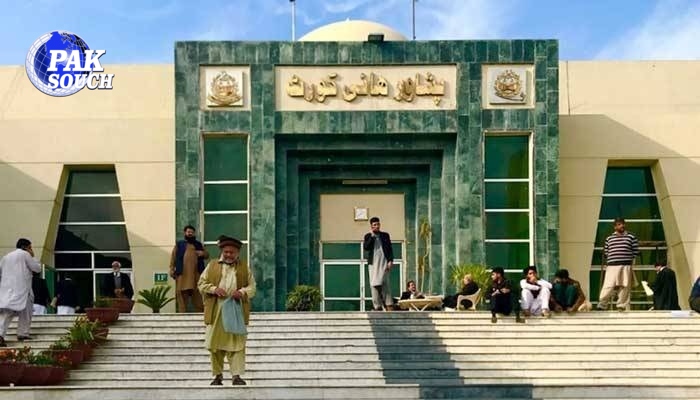
Peshawar: Chief Justice of the Peshawar High Court, Justice S.M. Atiq Shah, expressed strong dissatisfaction over the law and order situation in Khyber Pakhtunkhwa and criticized senior provincial officials during a court hearing, stating that a province of 40 million people was “burning” while no one appeared concerned.
The remarks were made during the hearing of a contempt of court petition regarding the non-implementation of a larger bench decision related to flaws in the criminal justice system.
The case was heard by a larger bench comprising Chief Justice S.M. Atiq Shah and Justice Ejaz Khan. During the proceedings, the Chief Secretary of Khyber Pakhtunkhwa, the Advocate General, and the provincial Home Secretary appeared before the court.
Addressing the officials, the Chief Justice questioned why the earlier court orders regarding reforms in the prosecution system had not been implemented.
“Chief Secretary sahib, tell us why the larger bench decision has not been implemented. The report submitted by your office contains nothing substantial. We had directed that the prosecution system be strengthened,” the Chief Justice remarked.
Justice Atiq Shah then strongly criticized the worsening security situation in the province, especially in the southern districts affected by terrorism.
“This is a province of 40 million people. The province is burning, yet no one seems to care,” he said.
He added that districts including Dera Ismail Khan, Karak, and Tank were severely affected by terrorism and had become unsafe.
“The southern districts are burning due to terrorism. No one can even travel there safely. I myself was planning to visit D.I. Khan but could not go because of security concerns,” the Chief Justice stated.
The court also questioned why officers from the prosecution department were unwilling to serve in remote and high-risk districts.
“Our female judges can perform duties there, so why can’t other officers go?” the Chief Justice asked.
Justice Atiq Shah further criticized the lack of forensic infrastructure in the province and termed the situation embarrassing.
“It is shameful that DNA samples from this province are sent to Lahore. One DNA test costs around Rs1.1 million, yet there is no proper DNA testing laboratory in the province,” he remarked.
The Chief Justice stressed that ordinary citizens were suffering because of administrative failures and weak institutional capacity.
“People are facing serious hardships. Practical measures should be taken to reduce their difficulties. If someone is not performing their duties, we will order action against them,” he warned.
During the hearing, KP Chief Secretary Shahab Ali Shah requested additional time from the court.
“Please give us two to three weeks. I will personally look into the matter. We have prepared a report which will also be shared with the court,” the Chief Secretary said.
In response, the Chief Justice granted one month to the provincial administration to improve the situation and implement the court’s earlier directives.
“Remove officers who are not working and appoint competent ones. If there is political interference, inform the court,” he directed.
The court later adjourned further hearing of the case until July 1.
The remarks by the Chief Justice have drawn widespread attention as they reflect growing concerns regarding terrorism, weak governance, and shortcomings within the criminal justice and prosecution systems in Khyber Pakhtunkhwa.
Security challenges in the province, particularly in southern districts bordering former tribal areas, have remained a serious concern in recent years due to increased militant activity and attacks on civilians and security personnel.
Legal experts say the court’s observations highlight the urgent need for institutional reforms, improved security arrangements, and stronger administrative accountability in the province.
About The Author