


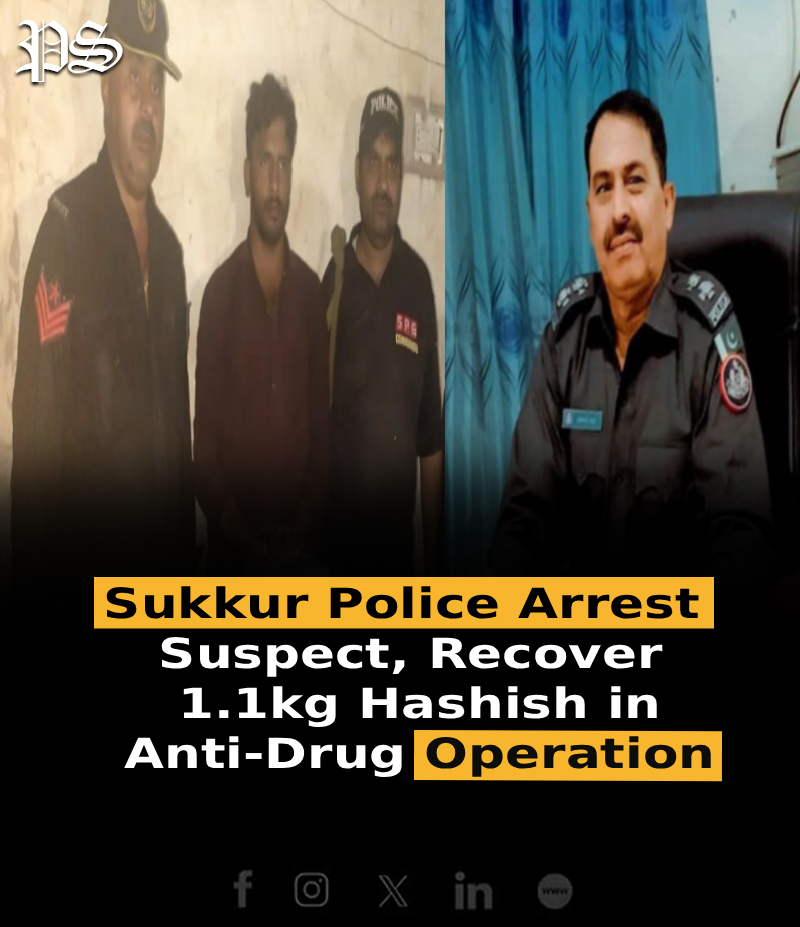
SUKKUR: Acting on the special directives of Sukkur Senior Superintendent of Police (SSP) Ahmed Faisal Chaudhry, police have intensified operations against criminal elements and drug-related activities across the district.
As part of the ongoing crackdown, police claimed to have arrested a suspected drug dealer and recovered 1,100 grams of hashish from his possession during an operation near the Sui Gas Point Canal in the Bachal Shah Miani area.
According to police, the operation was conducted by a team from Airport Police Station under the supervision of Station House Officer (SHO) Ahmed Ali Shar.
During the operation, police arrested a suspect identified as Muhammad Hassan, son of Muhammad Somar Dahar, a resident of Sharafabad.
Police officials said that 1,100 grams of hashish were recovered from the suspect during a search. The seized narcotics were taken into custody as evidence, while the arrested suspect was shifted to the police station for further legal proceedings.
A case has been registered against the accused at Airport Police Station under FIR No. 129/2026, invoking Section 9C(3) of the CNSA Act 2024.
Police said further legal proceedings are currently underway.
The Sukkur police have reiterated their commitment to taking action against drug peddlers and other criminal elements in the district. Officials said that operations would continue in different areas to curb the supply and distribution of narcotics and maintain law and order.
Authorities have urged citizens to cooperate with law enforcement agencies and report suspicious or illegal activities to the police so that timely action can be taken.
The latest operation is part of the ongoing efforts by Sukkur police to combat criminal activities and prevent the spread of narcotics in the city and surrounding areas.
About The Author