

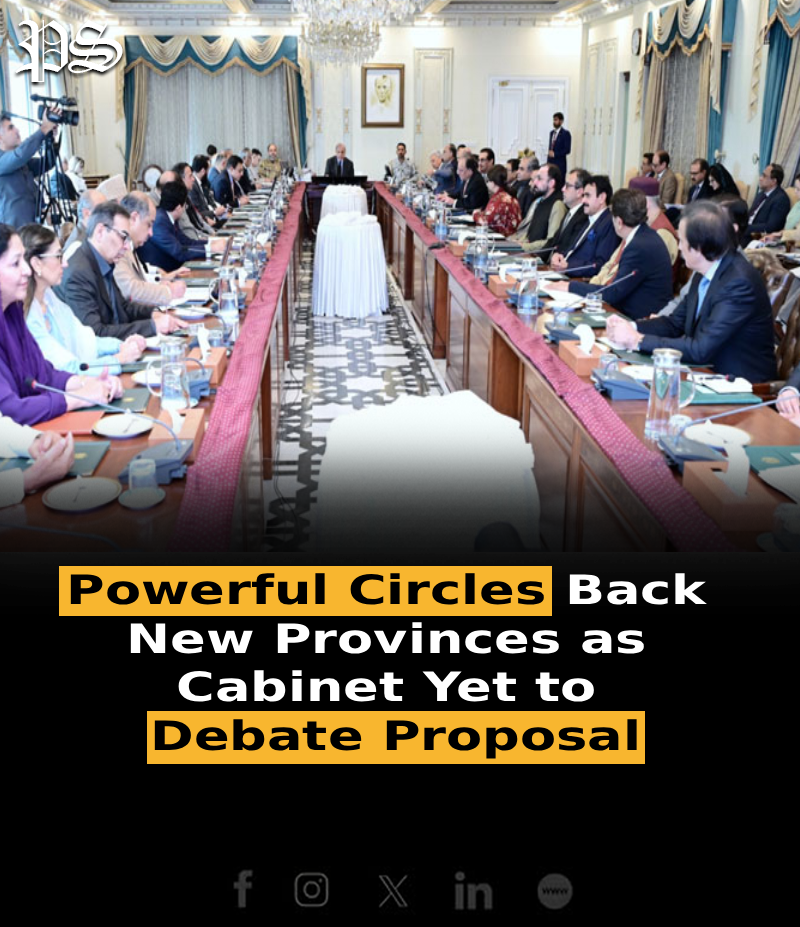
ISLAMABAD: Influential circles are reportedly in favour of restructuring Pakistan’s existing administrative system, potentially through the creation of additional provinces or administrative units. However, informed sources have told The News that the matter has not yet been formally discussed in the federal cabinet.
Sources said that although debate over creating new federal units has gained momentum in recent weeks, no formal proposal has so far been placed before the cabinet for consideration or approval.
The development comes as senior federal ministers have increasingly called for fundamental reforms to Pakistan’s administrative and governance structure.
Proposal for 12 to 15 provinces
Planning and Development Minister Ahsan Iqbal recently proposed the creation of 12 to 15 provinces, arguing that Pakistan’s existing four provinces have become excessively centralised.
According to Iqbal, the current administrative structure is no longer adequate for a country with a population of around 260 million. He has suggested, in principle, that each of the four provinces could potentially be divided into three smaller provinces.
However, Iqbal has emphasised that any such restructuring would require broad political consensus.
He has proposed that Prime Minister Shehbaz Sharif, through the law minister, establish a committee to examine administrative reforms and initiate a national and political debate on the issue.
Mohsin Naqvi also supports restructuring
Interior Minister Mohsin Naqvi, who helped bring the issue of reforming Pakistan’s governance system into the public debate, continues to support the creation of new administrative units or provinces.
Naqvi has argued that fundamental changes are necessary to improve public service delivery, accountability and access to justice.
His proposal subsequently received support from influential circles. The military’s media wing, Inter-Services Public Relations (ISPR), has also called for discussion on an “administrative reset” in view of Pakistan’s growing population and changing requirements.
The emerging debate, however, does not mean that the federal government has taken a final decision.
Strong resistance in Sindh
The proposal faces significant political opposition, particularly in Sindh.
The Sindh Assembly has opposed the creation of new provinces or administrative units in the province. Leaders of the Pakistan Peoples Party (PPP) have likewise strongly resisted any initiative that could result in the division of Sindh.
The issue is especially sensitive in Sindh because proposals involving new provinces or major administrative restructuring are viewed by many political parties as having potentially far-reaching political and territorial implications.
MQM-P, meanwhile, has maintained its position in favour of strengthening administrative units, although its leadership has indicated that the precise structure—whether provinces or another form of administrative arrangement—can be debated.
Khawaja Asif enters the debate
Defence Minister Khawaja Asif has also joined the discussion.
He has argued that the devolution of powers envisaged under the 18th Constitutional Amendment has not been implemented in its true spirit.
Asif has suggested that Pakistan’s existing 36 divisions could potentially serve as the basis for a new administrative system. However, he has said that the exact name and structure of such a system should be determined through consultation.
His comments have added another dimension to the debate, shifting the focus from simply creating new provinces to considering whether Pakistan could reorganise its existing administrative divisions and strengthen governance at lower levels.
No final decision yet
Sources familiar with the matter cautioned that the increasingly frequent public statements by senior government ministers should not be interpreted as evidence that a final government decision has already been made.
One source said influential circles were certainly of the view that Pakistan’s existing administrative structure needed to be reviewed, but stressed that the issue had not yet been formally discussed by the federal cabinet.
Another source said the discussion was currently focused less on deciding the number or boundaries of new provinces and more on building political and institutional consensus.
Several options are reportedly being considered informally. These include creating new provinces, but another possibility is to retain the constitutional status of the existing provinces while giving substantially greater powers to governments at the district level.
Empowered district governments as an alternative
Ahsan Iqbal has previously suggested an alternative to creating a large number of provinces: establishing approximately 160 empowered district governments.
Under such a model, administrative authority and public services would be brought closer to citizens without necessarily changing the constitutional status or boundaries of the existing provinces.
The argument behind this approach is that Pakistan’s governance problems may be addressed more effectively through decentralisation and stronger local institutions rather than simply increasing the number of provinces.
Constitutional hurdles
The creation of new provinces would be particularly sensitive because it would require constitutional amendments and extensive political agreement.
Relevant provincial assemblies and Parliament would have to play a role in any formal process involving changes to provincial boundaries or constitutional arrangements.
For now, therefore, the debate remains politically significant but institutionally at an early stage.
While several senior federal ministers have openly advocated restructuring Pakistan’s administrative system, no formal cabinet decision has been taken on the creation of new provinces or administrative units.
According to sources, moving towards a formal proposal would ultimately require consultations among the government’s coalition partners and other political stakeholders. Only after such consultations could a proposal potentially be brought before the federal cabinet and, subsequently, Parliament.
The issue is consequently likely to remain a major political debate in the coming months, particularly because any attempt to redraw provincial boundaries would involve not only administrative considerations but also constitutional, political and regional interests.
About The Author