

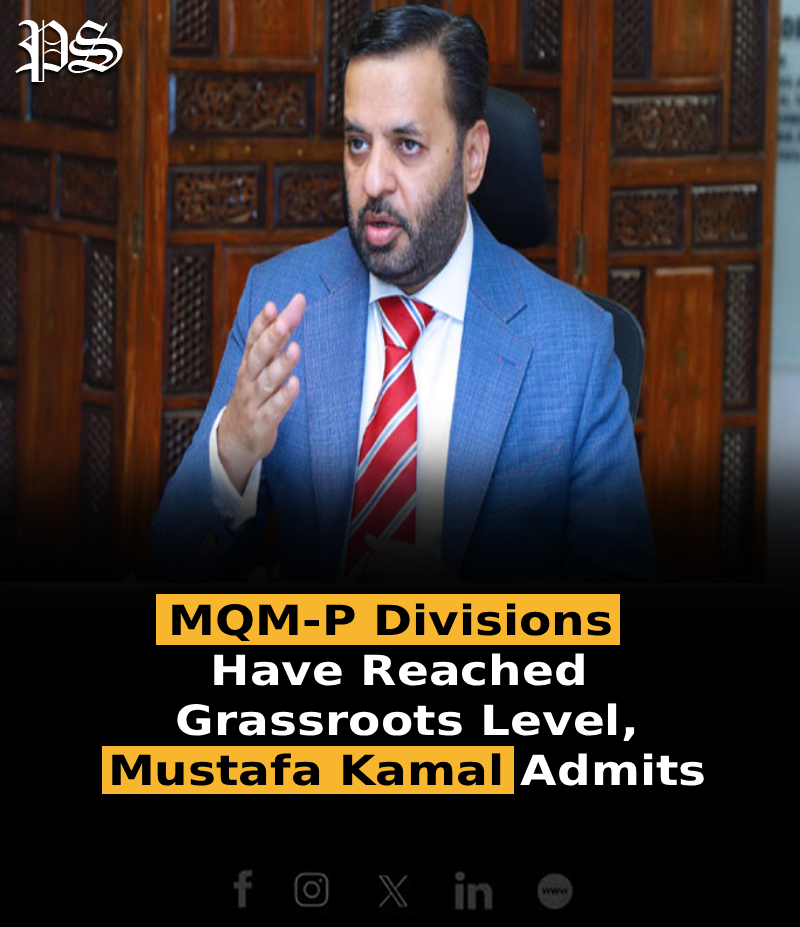
KARACHI: Federal Health Minister and Muttahida Qaumi Movement-Pakistan (MQM-P) leader Mustafa Kamal has acknowledged that differences within the party have intensified and spread down to the grassroots level.
Speaking to Geo News, Kamal said there were indeed disagreements within MQM-P and that the internal divisions had now “reached the lower levels” of the party.
He said the differences could not be permanently resolved without holding intra-party elections, which are scheduled for October.
Intra-party elections seen as way forward
Mustafa Kamal said efforts had been made to resolve the differences within the party, but acknowledged that some shortcomings may have remained.
He stressed that MQM-P could become stronger only through party elections.
According to Kamal, party workers would ultimately decide who succeeds and who fails in the elections, and all members of the organisation would have to accept the outcome.
He said that regardless of which group or individual emerged victorious, the decision of the party workers should be respected.
The admission comes amid reports of growing differences between factions within MQM-P, particularly between supporters of party leader Khalid Maqbool Siddiqui and Mustafa Kamal.
Tensions between the two groups have reportedly increased in recent months, with disagreements spilling into the party’s organisational structure. Dialogue and contacts between the rival groups have also been initiated in an effort to ease tensions.
Response to PPP criticism
Responding to criticism from the Pakistan Peoples Party (PPP), Kamal said the PPP did not need to concern itself with MQM-P’s internal affairs.
He rejected the impression that there were divisions within MQM-P over the Sindh government’s affairs, saying there was no confusion within the party regarding what he described as the provincial government’s poor governance.
Kamal maintained that the party’s position on governance and political issues remained clear despite its internal organisational disagreements.
Local government powers
The federal minister also spoke about the issue of transferring greater powers and resources to local governments.
He questioned what benefit MQM-P would gain simply from giving additional powers to local governments, arguing that the issue should instead be viewed in terms of strengthening governance and empowering people at the grassroots level.
Kamal said that had the proposed constitutional amendment been accepted, local governments could have had greater authority and resources in neighbourhoods and streets.
He further said that the outcome of the proposed 28th Constitutional Amendment should not be viewed as a victory or defeat for MQM-P.
Rather, he argued, its success or failure would represent a success or failure for the country as a whole.
The MQM-P leader’s comments come at a time when the party is attempting to manage internal differences while preparing for its intra-party elections. The October elections are expected to play an important role in determining the party’s future organisational structure and resolving the rivalry between its competing groups.
About The Author