

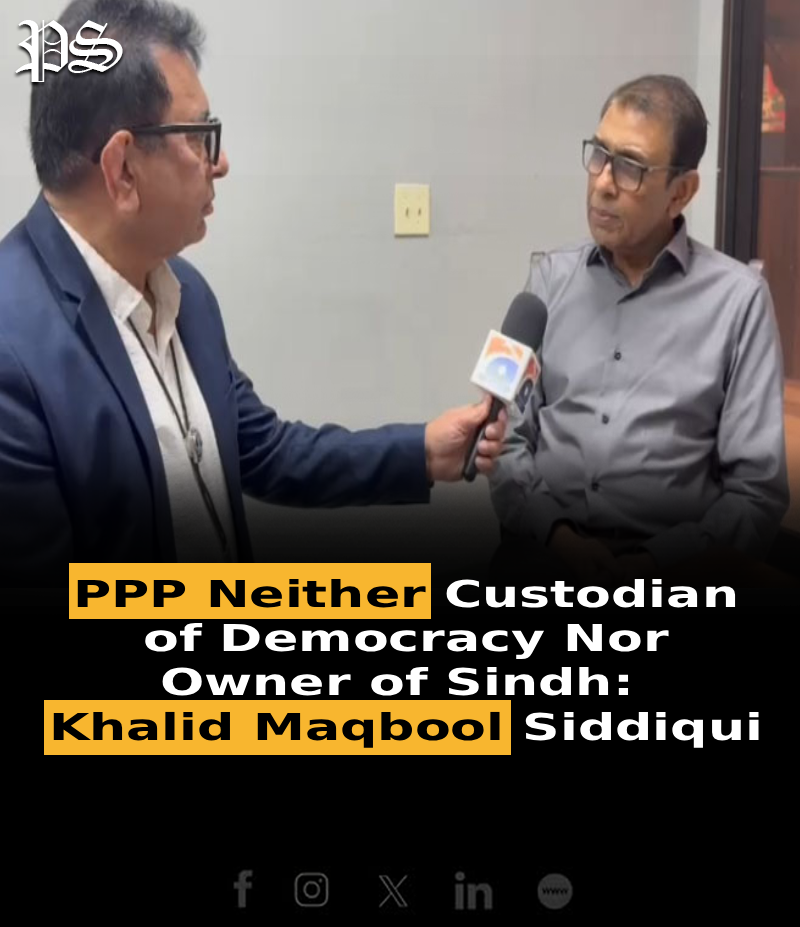
DALLAS: MQM-Pakistan Chairman and Federal Minister Dr Khalid Maqbool Siddiqui has said that the creation of new provinces has become necessary with Pakistan’s growing population, arguing that the country needs additional administrative units and a stronger third tier of government.
Speaking in an exclusive interview with Geo News during his visit to Dallas, Siddiqui discussed the demand for new provinces, Karachi’s political and administrative status, the role of the Pakistan Peoples Party in Sindh, MQM-Pakistan’s political position, the party’s internal divisions, former MQM leader Altaf Hussain and recent election controversies.
Call for New Provinces
Siddiqui rejected the idea that the demand for new provinces was merely political rhetoric. He argued that as the population increases, administrative units should also be expanded, just as new districts and divisions are created.
He said Pakistan needs a powerful and effective third tier of government so that political authority and the benefits of democracy can reach ordinary citizens directly.
Criticizing the existing administrative structure, Siddiqui claimed that divisions based primarily on linguistic identities had contributed to political polarization, misunderstandings and social distance.
He said Pakistan should move toward creating provinces on an administrative basis rather than linguistic grounds.
Strong Criticism of PPP
Taking aim at the PPP government in Sindh, Siddiqui said the party is “neither the custodian of democracy nor the owner of Sindh.”
He described the province’s current political structure as feudal in nature and claimed that Karachi remains the economic backbone of Sindh and a major contributor to the national economy.
“When Karachi prospers, the entire country prospers,” he said, arguing that any attempt to undermine Karachi ultimately harms Pakistan.
Siddiqui also raised questions about Karachi’s historical and constitutional status. He noted that Karachi served as Pakistan’s capital after independence and said issues concerning its subsequent administrative incorporation into Sindh should be discussed through democratic, constitutional and legal processes.
MQM’s Political Strength
Responding to questions about MQM’s internal divisions and its reduced political strength compared with the past, Siddiqui rejected the perception that the party’s vote bank had been divided.
He argued that political parties are not necessarily divided simply because some leaders leave. According to him, a party is truly divided only when its workers and voters split.
Siddiqui claimed that 80 to 90 percent of MQM workers remain united, adding that those who separated from the party under pressure could return if circumstances change.
He also alleged that MQM suffered electoral injustice during the 2018 general elections, claiming that several of the party’s seats were taken away. He said anyone who has objections to election results should seek legal remedies through the courts.
“Minus Altaf” and Election Controversy
When asked whether MQM was moving in the right direction after the “Minus Altaf” process, Siddiqui did not directly answer by focusing on Altaf Hussain. Instead, he said MQM was not a political family but an ideological movement belonging to its workers.
Responding to allegations that MQM’s recent electoral victories were linked to Form 47, Siddiqui strongly rejected the claim. He said MQM had been winning elections in Karachi for decades and challenged critics to approach the courts if they disputed the results.
He emphasized that the party’s identity was not Form 47 but “1947,” referring to the year Pakistan came into existence.
During the interview, Siddiqui strongly defended MQM-Pakistan’s political position and rejected criticism concerning the party’s divisions, leadership structure and electoral support. He maintained that Pakistan’s growing population and administrative challenges require a serious debate on creating new provinces and strengthening local government.
About The Author