


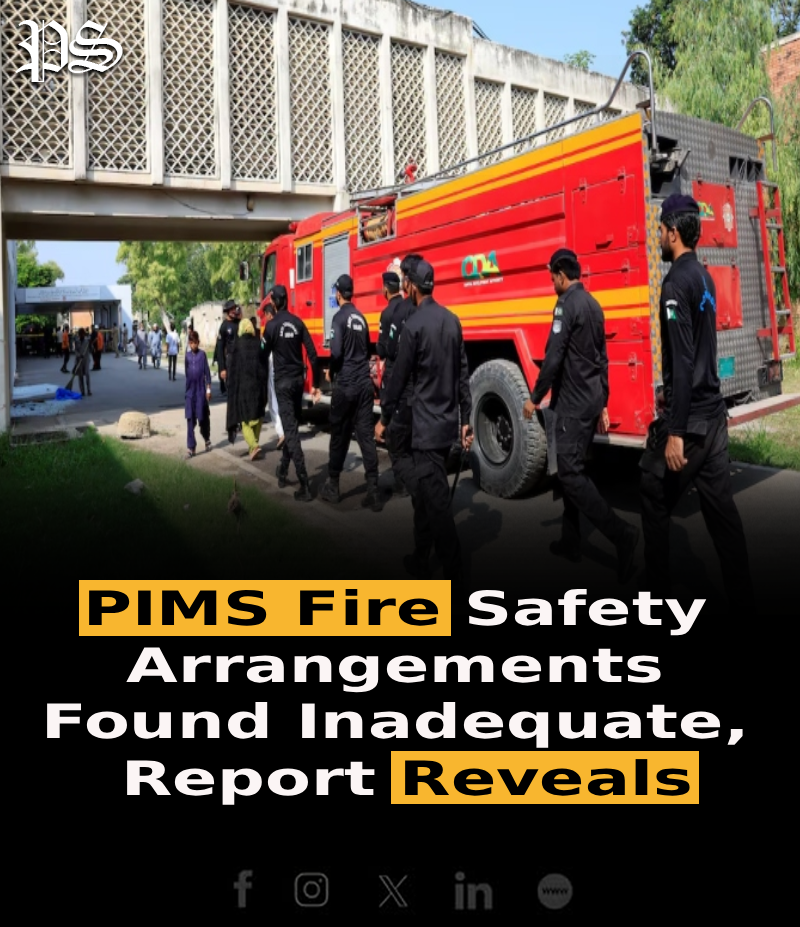
ISLAMABAD — The Capital Development Authority’s Fire Brigade Department has found serious shortcomings in fire safety and emergency arrangements at Pakistan Institute of Medical Sciences (PIMS) following the death of 14 newborn babies in a nursery fire.
According to the fire brigade report, PIMS did not have adequate arrangements to prevent fires or protect human lives. The report stated that the hospital’s fire safety arrangements did not meet the required standards, raising serious concerns about the preparedness of one of Islamabad’s major public hospitals.
The report identified several problems that allegedly created difficulties during the firefighting operation. Emergency exits at the hospital were reportedly permanently closed from the outside, while obstacles were also present along evacuation routes.
The condition of emergency exits is considered especially important in hospitals because many patients cannot leave a building without assistance. Newborn babies, critically ill patients and people connected to medical equipment require staff members to help them evacuate safely during an emergency.
The report also said that PIMS security personnel created difficulties for firefighters during their initial response to the incident. It further noted that arrangements for controlling the crowd at the scene were not adequate.
According to the fire brigade department, its first fire engine reached PIMS within six minutes of receiving the emergency call. The report indicates that despite the relatively quick arrival of the first firefighting vehicle, conditions inside the hospital created additional challenges for the emergency operation.
Rescue sources had previously highlighted several other problems at the hospital. They said there was no water available at the designated fire point when the emergency occurred. They also reported that the fire hoses did not have proper couplings, making firefighting operations more difficult.
The sources further claimed that emergency evacuation routes were locked. If emergency exits are locked or blocked, hospital staff and rescue teams may lose valuable time during a fire.
Another serious allegation concerns the presence of staff inside the incubation centre at the time of the incident. According to rescue sources, no doctors, ward attendants or other hospital staff were present in the incubation centre when the fire broke out.
The absence of staff could have made it more difficult to respond immediately and rescue vulnerable newborns. Babies in a nursery or incubation centre cannot evacuate themselves and require immediate assistance from trained medical personnel.
The fire broke out at approximately 6:45 a.m. in the nursery of the gynecology ward. Rescue sources said the fire started after an air-conditioning compressor reportedly exploded.
Hospital authorities had said that 15 babies were present in the nursery when the fire started. A female doctor was reportedly able to rescue one baby, while 14 newborns died in the incident.
The deaths have caused widespread concern and prompted questions about fire prevention and emergency preparedness in public hospitals. The latest fire brigade report has added further details about the conditions faced by firefighters during the emergency.
One of the key concerns raised by the report is the condition of emergency evacuation routes. Such routes must remain clear and accessible so that patients, staff and rescue workers can move quickly during a fire.
The report’s findings also raise questions about the maintenance of firefighting infrastructure at PIMS. A functioning fire safety system normally requires accessible fire points, adequate water supplies, properly maintained hoses and firefighting equipment, working alarms and clear evacuation routes.
Regular inspection and testing are also important. Fire safety equipment can become ineffective if it is not maintained or if access to it is blocked.
The alleged lack of water at a fire point is particularly concerning because firefighters depend on reliable water supplies when attempting to control a fire. Problems with hose couplings can also delay firefighting operations.
The report has also highlighted the importance of coordination between hospital security personnel and emergency responders. Security staff have an important role in controlling access to the building and managing crowds, but they must also ensure that firefighters can reach the affected area without unnecessary delays.
Crowd management is another important part of hospital emergency response. Large numbers of relatives, visitors and staff can gather at the scene of a serious incident, potentially making it harder for emergency teams to operate.
The fire brigade report therefore points to problems that go beyond the initial cause of the fire. It raises concerns about the overall preparedness of the hospital to respond to emergencies and protect patients.
The tragedy is likely to increase pressure on health authorities to conduct detailed fire safety inspections at major hospitals across the country. Similar inspections could identify blocked exits, faulty equipment, inadequate training and other problems before they lead to further loss of life.
Hospital staff also need regular fire safety training and evacuation drills. Employees should know where emergency exits are located, how to use firefighting equipment and how to safely move vulnerable patients.
For neonatal units, emergency planning is even more important. Staff must be prepared to move babies quickly while also ensuring that essential medical equipment is handled safely.
The PIMS incident has demonstrated the risks associated with weak emergency preparedness. Even when firefighters arrive quickly, blocked exits, missing equipment and poor coordination can make rescue operations more difficult.
The fire brigade report’s findings will now be important in determining whether safety failures contributed to the scale of the tragedy. A detailed investigation can help establish responsibility and identify the measures required to prevent similar incidents.
Authorities may also need to review the hospital’s maintenance records, fire safety certificates, emergency plans and staff training records. Any deficiencies should be corrected immediately and monitored regularly.
The deaths of 14 newborn babies have created deep concern among families and the wider public. The incident has also highlighted the responsibility of hospitals to provide safe environments for vulnerable patients.
The fire brigade report provides a clear warning that fire safety cannot be treated as a routine administrative requirement. Emergency exits must remain open, firefighting equipment must be functional, water supplies must be available and trained staff must be ready to respond.
The authorities now face the task of ensuring that the lessons from the PIMS tragedy lead to real improvements. Stronger inspections, better maintenance, regular drills and clear emergency procedures could help reduce the risk of another disaster.
For PIMS and other major hospitals, the priority must be to ensure that every fire safety system works when it is needed most and that patients can be evacuated quickly and safely during an emergency.
About The Author