


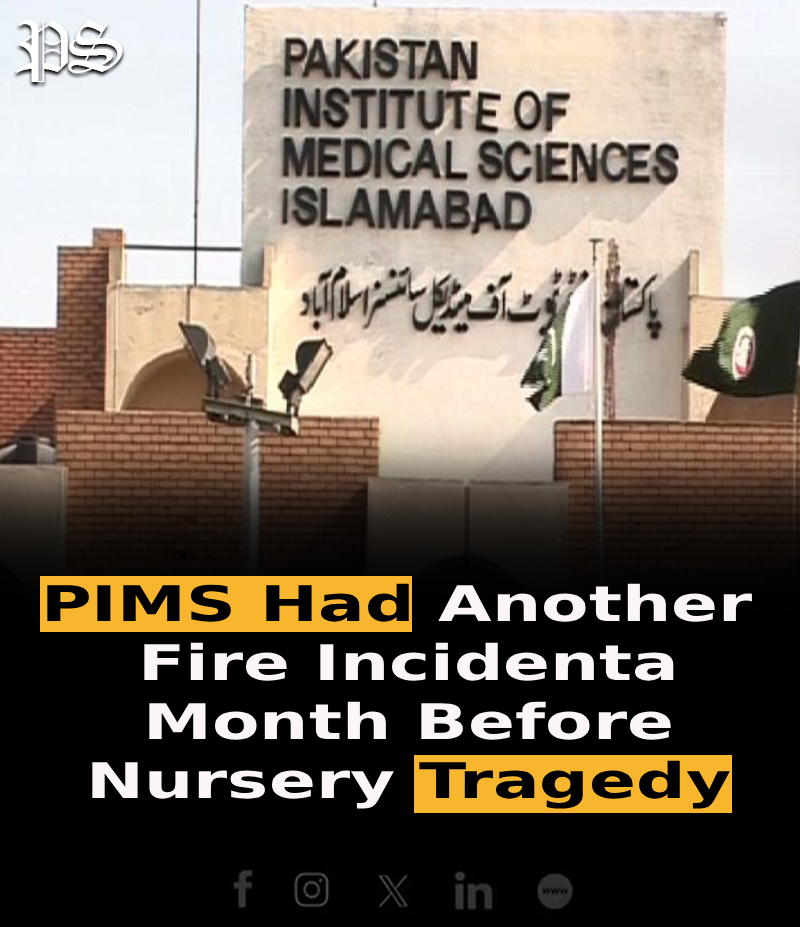
ISLAMABAD — Documents have revealed that Pakistan Institute of Medical Sciences (PIMS) witnessed another fire incident about one month before the deadly nursery fire that claimed the lives of 14 newborn babies.
According to the document, a fire broke out at the reception area of the PIMS Nursing Hostel at around 3 a.m. on July 6. The incident occurred during the night and caused damage to furniture in the reception area.
The document stated that three sofas placed at the reception were burned in the fire. Despite the incident, no one was injured and there was no loss of life.
At the time of the fire, 78 female students were residing in the nursing hostel. According to the document, all 78 students remained safe and no casualties were reported.
Although the July fire did not result in injuries or deaths, its disclosure has raised fresh questions about fire safety arrangements at PIMS. The revelation is particularly significant because it came only about a month before a much more serious fire occurred in the hospital’s nursery.
The latest information has added to growing concerns over the hospital’s emergency preparedness, fire prevention systems and ability to protect people during emergencies.
The nursing hostel fire took place at around 3 a.m., when most residents would normally be asleep. Fires occurring during nighttime hours can be particularly dangerous because people may not immediately notice smoke or flames.
In this case, however, the fire remained limited to the reception area and burned three sofas. The 78 students living in the hostel were able to remain safe.
The document does not indicate that the earlier fire caused any major structural damage or resulted in casualties. Nevertheless, any fire at a hospital facility can be considered a serious safety warning and requires proper investigation and follow-up.
The revelation comes after the deadly fire at the PIMS gynecology ward nursery, where 14 newborn babies died. According to hospital authorities, 15 babies were present in the nursery when the fire started, and only one baby could reportedly be rescued.
The nursery fire has already prompted questions about the hospital’s fire safety arrangements. A report by the Capital Development Authority’s Fire Brigade Department reportedly found several shortcomings in fire prevention and emergency arrangements at PIMS.
The fire brigade report identified blocked emergency exits and obstacles along evacuation routes. It also highlighted difficulties faced by firefighters during their initial response.
Rescue sources had separately reported problems including the absence of water at a fire point, issues with fire hose couplings and locked emergency evacuation routes.
Against this background, the disclosure of the July nursing hostel fire has become significant. Authorities may now need to examine whether the earlier incident was properly investigated and whether any safety improvements were made afterward.
A fire incident should normally lead to an assessment of its cause and a review of safety arrangements in the affected facility. This can help identify electrical faults, maintenance problems or other hazards that could potentially cause another fire.
The nursing hostel is an important part of the PIMS complex because it houses medical and nursing students. Fire safety arrangements in such residential facilities are essential because residents may need to evacuate quickly, particularly during nighttime emergencies.
Emergency exits, fire alarms, extinguishers and evacuation plans are important safety measures in residential buildings. Residents should also be familiar with evacuation procedures through regular fire drills and safety training.
The July incident also raises questions about whether PIMS maintains a complete record of fire-related incidents across its facilities. A detailed record can help hospital management identify recurring risks and determine whether additional safety measures are needed.
The fact that 78 students escaped the earlier incident safely is a positive aspect of the event. However, authorities cannot rely on a favorable outcome in every emergency. A relatively small fire can become deadly if it spreads rapidly or if people are unable to evacuate.
This is particularly true in hospitals, where many patients are unable to move without assistance. Newborn babies, intensive-care patients and people undergoing treatment may depend entirely on medical staff during an emergency.
The nursery tragedy has demonstrated how quickly a fire can become fatal when vulnerable patients are involved. It has therefore increased the importance of reviewing all previous fire incidents at PIMS.
Authorities may now examine whether the July hostel fire was caused by an electrical fault, equipment failure or another source. They may also review whether the fire was detected quickly and whether firefighting equipment was available and functional.
A comprehensive review could include the nursing hostel as well as hospital wards, laboratories, emergency departments and other buildings within the PIMS complex.
The review should also consider staff training. Doctors, nurses, security personnel, students and other employees need to understand how to respond during a fire. Regular drills can help people react quickly rather than becoming confused during an actual emergency.
Fire safety equipment also requires regular inspection. Fire extinguishers must be functional, fire alarms must operate properly and emergency exits must remain accessible at all times.
The latest disclosure comes at a time when fire safety standards at major public hospitals across Pakistan are receiving increased attention. Following the PIMS nursery tragedy, concerns have also emerged about fire preparedness at hospitals in Karachi and other cities.
The incidents have highlighted the need for stronger monitoring and enforcement of fire safety regulations in healthcare facilities.
For PIMS, the discovery of a previous fire incident provides another reason for authorities to conduct a complete safety assessment. The purpose should not only be to identify responsibility for past incidents but also to prevent future emergencies.
The July fire caused limited damage and no deaths, but it should still be treated as an important warning. The later loss of 14 newborn lives has made the need for effective preventive measures even more urgent.
Authorities will now need to determine whether appropriate action was taken after the July incident and whether any recommendations were implemented.
The safety of patients, medical workers and students depends on functioning fire protection systems and proper emergency planning. Regular inspections, maintenance, training and drills can significantly improve a facility’s ability to respond to a fire.
The revelation that PIMS experienced a fire at its nursing hostel only a month before the nursery tragedy has therefore added to concerns surrounding the hospital’s overall safety record.
A transparent investigation into both incidents could help establish whether there were common safety weaknesses and what measures are required to address them.
For a major public hospital like PIMS, fire safety must remain a continuous priority. Every fire incident, even one that causes no casualties, should be investigated carefully so that potential risks are identified before they lead to a larger tragedy.
About The Author