

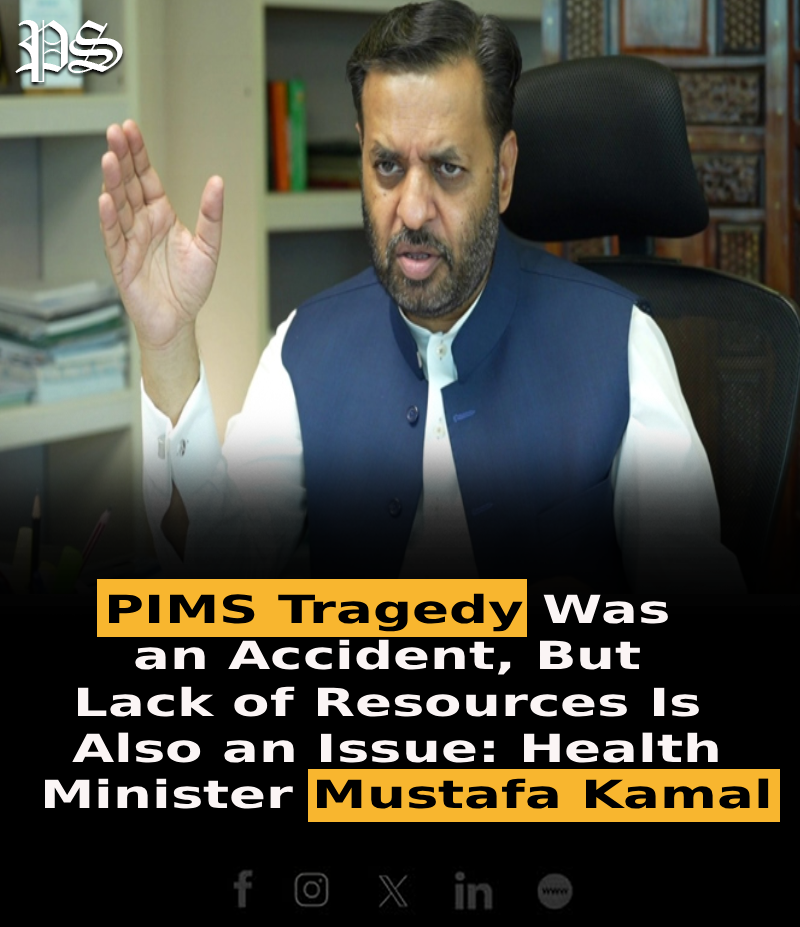
ISLAMABAD — Federal Health Minister Mustafa Kamal has described the deaths of 14 newborn babies in a fire at PIMS Hospital as an accident, while acknowledging that a lack of resources is also a major challenge facing the country’s healthcare system.
Speaking on Geo News programme “Aaj Shahzeb Khanzada Kay Sath,” the federal health minister said that he had discussed several issues, including fire safety and staff training, with Prime Minister Shehbaz Sharif. He said the government was facing resource constraints and that the PIMS incident had also supported the government’s position regarding the management of administrative units.
Mustafa Kamal said the deaths of 14 babies at PIMS were an accident and argued that the prime minister or federal health minister should not be directly responsible for managing individual hospitals. According to him, the responsibility for hospital administration should rest with the relevant management and administrative authorities.
The minister, however, made it clear that accountability would be pursued if negligence or wrongdoing was established. Earlier, while speaking to the media outside PIMS Hospital, he had said that anyone found responsible for a mistake or negligence would not be spared.
His comments came amid growing public concern over the circumstances surrounding the deaths of the newborn babies. The incident has raised questions about fire safety systems, emergency preparedness, staff training and the overall management of the hospital.
When asked whether he would resign following an evacuation route, but the guard had been stationed there primarily because of the earlier incidents involving the theft of newborn babies. He said the the tragedy, Mustafa Kamal said he had already presented himself for accountability before the prime minister. He described the prime minister as his boss and said he would accept whatever decision the prime minister made.
The minister also explained the presence of security personnel near one of the hospital’s doors. He said a guard was deployed there around the clock because newborn babies had previously been stolen from the hospital.
According to Mustafa Kamal, the same area was also part of an evacuation route, but the guard had been stationed there primarily because of the earlier incidents involving the theft of newborn babies. He said the guard remained on duty 24 hours a day.
The explanation has drawn attention to the difficult balance hospitals face between security and emergency evacuation requirements. While security arrangements are necessary to protect newborns and prevent child theft, emergency exits must also remain accessible and usable during fires and other emergencies.
The PIMS fire occurred on Wednesday morning in the nursery of the hospital’s gynecology ward. According to rescue sources, the fire started at approximately 6:45 a.m. after an air-conditioning compressor reportedly exploded.
Hospital authorities said there were 15 babies inside the nursery when the fire broke out. A female doctor was reportedly able to rescue only one baby, while the remaining 14 newborns died in the incident.
The tragedy has triggered serious questions about the hospital’s fire prevention and emergency response systems. Since newborn babies cannot evacuate independently, a fire in a nursery can become extremely dangerous within a very short period.
Hospitals require specialized emergency plans for neonatal wards because babies need to be physically carried or moved using appropriate equipment. Staff must also be trained to respond immediately when an alarm is activated or when smoke and fire are detected.
The health minister’s comments have also brought the issue of resources into focus. Maintaining large public hospitals requires significant funding for infrastructure, equipment, maintenance, staff training and emergency systems. A lack of resources can affect the ability of hospitals to upgrade old All of these systems need continuous maintenance and testing buildings, replace faulty equipment and conduct regular safety inspections.
However, the incident has also raised questions about whether existing resources were being used effectively and whether basic safety requirements were being properly monitored.
Fire safety in hospitals involves several interconnected measures. These include functioning fire alarms, smoke detection systems, fire extinguishers, emergency exits, evacuation plans, emergency lighting and regular staff training. All of these systems need continuous maintenance and testing.
The incident at PIMS has therefore generated calls for a wider review of safety arrangements at public hospitals across the country. Authorities may need to inspect neonatal units and other high-risk departments to determine whether emergency exits are accessible and whether firefighting systems are functional.
The issue of staff training is also critical. Doctors, nurses, security personnel and other employees must know exactly how to respond during a fire. Regular drills can help staff identify evacuation routes and understand how to move vulnerable patients to safety.
The government’s response to the PIMS tragedy is likely to remain under public scrutiny as investigations continue. The health minister has indicated that accountability will take place if anyone is found responsible for negligence.
At the same time, his statement that the incident was an accident and that resource limitations are a problem points toward a broader discussion about the condition of public healthcare infrastructure.
PIMS is one of the country’s major public hospitals and serves a large number of patients from Islamabad and other parts of Pakistan. Any weakness in its emergency systems can therefore have serious consequences.
The deaths of 14 newborns have highlighted the urgent need for effective fire prevention and emergency preparedness in hospitals. While accidents cannot always be completely prevented, strong safety systems can reduce the chances of loss of life when an emergency occurs.
The tragedy also demonstrates why fire safety should be treated as a continuous responsibility. Equipment must be maintained, staff must be trained and emergency routes must remain accessible at all times.
For the government, the immediate challenge is to establish what happened inside the PIMS nursery, determine whether safety procedures were followed and identify any failures that may have contributed to the deaths.
If negligence is established, accountability will be necessary. At the same time, addressing resource shortages and improving hospital infrastructure will be essential to prevent similar tragedies in the future.
The PIMS incident has ultimately placed both hospital administration and the wider healthcare system under renewed scrutiny. The government now faces pressure to ensure that lessons from the tragedy result in practical improvements in fire safety, emergency training and patient protection across public hospitals.
About The Author