

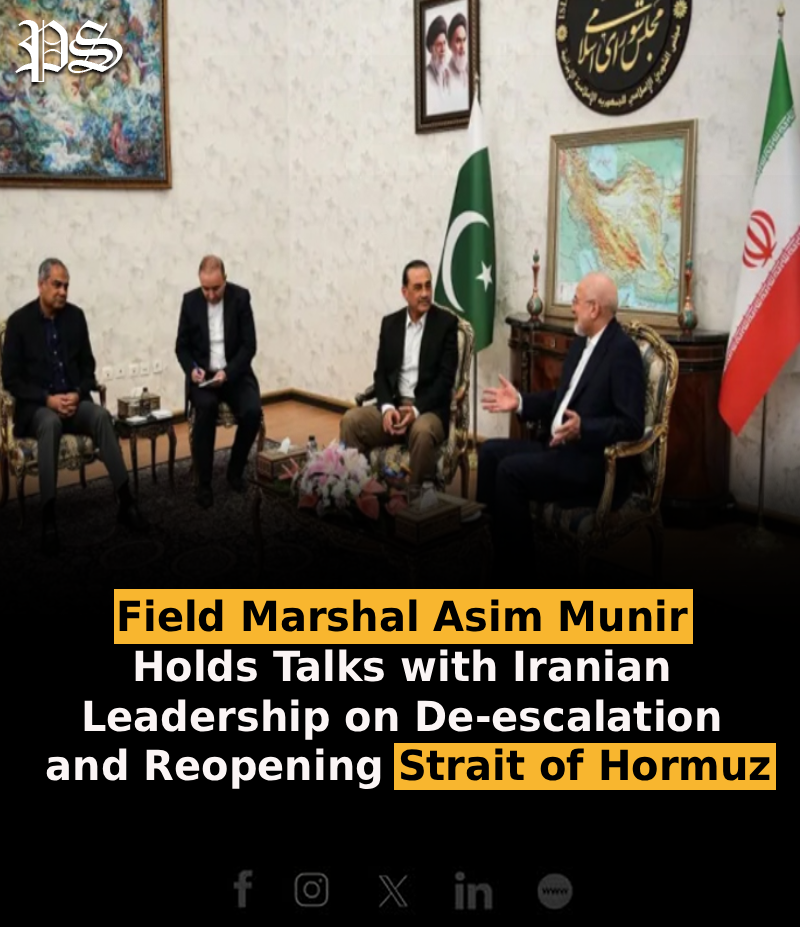
Pakistan’s Chief of Defence Forces, Field Marshal Syed Asim Munir, has completed his visit to Iran, where he held meetings with the country’s senior political, security and military leadership. Discussions focused on preventing further escalation, reopening the Strait of Hormuz and exploring measures for an early end to the ongoing conflict.
According to Pakistan’s Inter-Services Public Relations (ISPR), Interior Minister Mohsin Naqvi accompanied Field Marshal Asim Munir during the visit.
Upon his arrival in Iran, Field Marshal Munir was received by Iranian Interior Minister Eskandar Momeni and other senior civilian and military officials.
During the visit, the Pakistani military chief held meetings with Iranian President Masoud Pezeshkian, Mohsen Rezaei, the Supreme Leader’s representative at the Supreme National Security Council, Iranian Parliament Speaker Mohammad Bagher Ghalibaf, and the Iranian foreign and interior ministers.
The meetings focused primarily on efforts to prevent any further escalation of tensions in the region. The two sides also discussed measures aimed at reopening the Strait of Hormuz and facilitating an early resolution to the conflict.
The Strait of Hormuz is a critical international waterway through which a significant portion of global energy supplies passes. Any prolonged disruption in the strait can have serious consequences for international oil markets, shipping and regional economies.
According to ISPR, the discussions also covered regional peace and mechanisms for resolving disputes through negotiations and dialogue.
Pakistan emphasized the importance of diplomatic engagement and peaceful mechanisms for resolving regional conflicts. The discussions were held against the backdrop of heightened tensions in the Middle East and concerns about further escalation.
The Iranian leadership appreciated Pakistan’s constructive role and sincere efforts to facilitate negotiations, reduce tensions and promote a peaceful resolution to the conflict, according to ISPR.
The visit therefore focused not only on bilateral relations between Pakistan and Iran but also on wider regional stability. Islamabad has sought to use diplomatic engagement to encourage de-escalation and create space for negotiations.
Field Marshal Munir’s meetings with Iran’s senior leadership provided an opportunity to discuss the concerns of both sides and explore practical measures for reducing tensions.
The participation of Interior Minister Mohsin Naqvi alongside the military chief also underscored the broader nature of Pakistan’s diplomatic engagement. The discussions involved security, regional stability and political efforts to address the conflict.
The issue of the Strait of Hormuz was particularly significant because its reopening would be important for restoring the normal movement of commercial and energy shipments. Any progress toward reopening the waterway could help reduce pressure on international markets and regional economies.
ISPR said the two sides discussed ways to prevent further escalation and facilitate an early conclusion to the conflict. They also exchanged views on how regional disputes could be addressed through negotiations rather than continued confrontation.
Iranian officials welcomed Pakistan’s efforts to facilitate dialogue and reduce tensions. Their appreciation of Islamabad’s role indicates that Pakistan is seeking to position itself as a constructive intermediary in efforts to promote regional stability.
The visit concluded with discussions centered on de-escalation, dialogue and the peaceful settlement of disputes. While no specific agreement or timeline for reopening the Strait of Hormuz was announced in the statement, the talks provided a diplomatic channel for addressing the immediate regional crisis.
Pakistan’s engagement with the Iranian leadership is expected to remain focused on preventing further escalation, supporting negotiations and encouraging measures that could contribute to lasting regional peace.
About The Author