

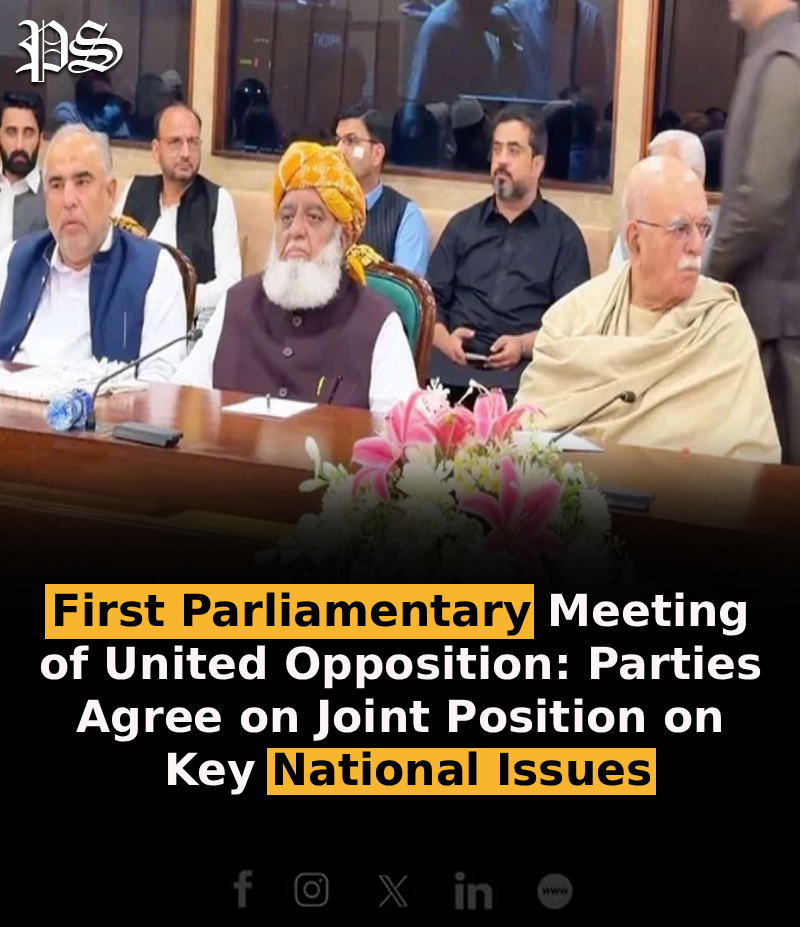
Islamabad: Pakistan’s opposition parties held their first joint parliamentary meeting and agreed to adopt a unified position on major national issues while keeping their political struggle focused on parliamentary and legislative forums.
The joint parliamentary meeting of opposition parties was held at Parliament House under the chairmanship of National Assembly Opposition Leader Mahmood Khan Achakzai. Opposition Leader in the Senate Allama Raja Nasir Abbas, Jamiat Ulema-e-Islam (F) chief Maulana Fazlur Rehman, PTI Chairman Barrister Gohar Ali Khan and other opposition lawmakers attended the meeting.
The meeting focused on several major political, economic and national issues facing the country. Participants agreed that opposition parties would coordinate their positions and present a common stance inside Parliament on matters of national importance.
According to the decisions reached during the meeting, the opposition will jointly raise issues including inflation, the deteriorating law-and-order situation, the creation of new provinces, the judiciary, the economy, terrorism and political prisoners.
The opposition parties also agreed to keep their struggle confined to legislative and parliamentary forums. The decision is aimed at providing a coordinated platform for opposition lawmakers to raise issues and challenge government policies through parliamentary proceedings.
Following the meeting, Jamiat Ulema-e-Islam (F) chief Maulana Fazlur Rehman spoke to the media and commented on proposals concerning the creation or division of provinces.
Fazlur Rehman said the current circumstances were not appropriate for dividing provinces. He argued that such a move at this stage could increase mistrust and uncertainty rather than resolve existing political and administrative problems.
He said the issue of creating new provinces should not be pursued without considering the prevailing political environment and its potential impact on national cohesion.
Mahmood Khan Achakzai described the opposition’s unity on a single platform as a positive development, particularly amid what he characterized as an atmosphere of political pressure and restrictions.
He welcomed the participation of different opposition groups in the joint parliamentary forum and stressed the importance of maintaining coordination among opposition lawmakers.
Barrister Gohar Ali Khan also addressed the meeting and highlighted the opposition parties’ agreement to work together on important national matters.
The formation of a joint parliamentary platform represents an effort by opposition parties with different political backgrounds to coordinate their activities inside Parliament. Rather than pursuing separate positions on every issue, the parties have agreed to formulate common positions on matters they consider to be of national significance.
The opposition’s agenda includes economic concerns, particularly inflation, as well as security-related issues such as terrorism and the deteriorating law-and-order situation. Political and institutional issues, including the judiciary and the status of political prisoners, are also expected to remain important components of their parliamentary strategy.
The creation of new provinces was another major issue discussed during the meeting. While some political circles have advocated administrative restructuring and the creation of additional provinces, Fazlur Rehman cautioned against pursuing such changes under the current circumstances.
The opposition parties’ decision to focus their struggle on legislation and parliamentary proceedings could also shape their approach to future political disputes. By working collectively within Parliament, they can coordinate speeches, legislative proposals and responses to government measures.
The first joint parliamentary meeting therefore marks an attempt to strengthen cooperation among opposition parties and establish a common political position on major national issues.
The effectiveness of the alliance will depend on how consistently its member parties maintain their agreed positions, particularly given their differences on various political and policy matters.
For now, the opposition has agreed to use Parliament as the principal forum for its collective struggle and to speak with a unified voice on issues including inflation, security, terrorism, the economy, judicial matters, political prisoners and proposals for new provinces.
About The Author