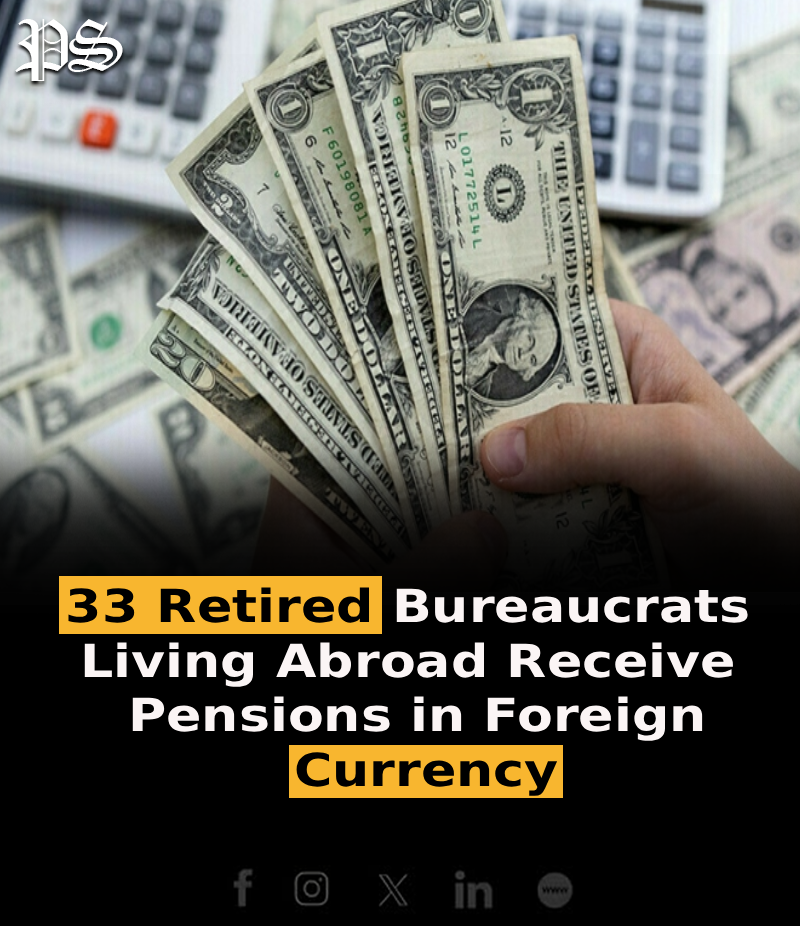
A new disclosure regarding retired government officials has revealed that dozens of former senior bureaucrats are currently living abroad after retirement and receiving their pensions in foreign currencies.
According to sources, 33 retired senior officials from various government departments are currently residing outside Pakistan and receiving pension payments after moving abroad following their retirement.
The Ministry of Foreign Affairs has submitted details concerning retired government officials living overseas to Parliament. The information provides an overview of former government employees who have settled abroad while continuing to receive pensions from the Government of Pakistan.
According to the documents, the 33 officials retired from different government departments and are currently residing in foreign countries. Their pension payments are being made through arrangements involving the government and the relevant authorities responsible for processing pensions for officials living overseas.
A significant aspect of the disclosure is that some of these retired officials receive their pensions in foreign currencies corresponding to the countries in which they reside. The government pays their pensions in the applicable foreign currency rather than requiring them to receive the amounts in Pakistani rupees.
The documents reportedly show that the government spends approximately Rs342.1 million annually on pensions for officials who receive their payments in foreign currency. This amounts to more than Rs28.5 million per month when calculated across the year.
The revelation has drawn attention to the financial implications of pension payments to retired officials who have relocated abroad. Because these payments are made in foreign currency, they can also have implications for Pakistan’s foreign exchange requirements, depending on the currencies and mechanisms used for transferring the pension amounts.
The Ministry of Foreign Affairs has provided Parliament with information about the retired officials residing overseas. However, the available data does not cover all retired government officials living outside Pakistan.
According to the information presented, the Foreign Office does not have statistics on retired officials who live abroad but receive their pensions in Pakistani rupees. Consequently, the number of former government officials residing overseas may be higher than the 33 officials identified in the foreign-currency pension figures.
The distinction between foreign-currency and Pakistani-rupee pension payments is important because the figures provided by the Foreign Office only cover officials whose pensions are being paid in foreign currencies. Those receiving pensions in Pakistani currency are not included in the available statistics.
The disclosure has raised questions about the rules governing pension payments to retired government officials who settle abroad. It also highlights the need for comprehensive and centralized records showing how many retired officials are living overseas, where they reside and in what currency their pensions are being paid.
The issue comes amid broader scrutiny of government expenditure on retired officials and the benefits available to members of Pakistan’s bureaucracy. Pension liabilities have become an increasingly important issue for public finances, particularly as governments seek to control recurring expenditure.
The reported annual payment of Rs342.1 million to the 33 officials represents an average of roughly Rs10.4 million per official per year, although actual pension amounts can vary substantially depending on an individual’s rank, service history and applicable pension rules.
The disclosure does not, by itself, indicate that the pension payments are unlawful or that the officials are receiving benefits outside the applicable rules. Rather, it highlights the scale and nature of pension payments being made to former government officials who are now residing abroad.
The information presented to Parliament could lead to further questions regarding the government’s pension policies, particularly the procedures for transferring pensions overseas and the currency in which payments are made.
It also underscores a broader information gap. While the government has records identifying 33 retired officials receiving pensions in foreign currencies while living abroad, the Foreign Office does not maintain corresponding figures for those receiving their pensions in Pakistani rupees.
A complete assessment of the government’s overseas pension obligations would therefore require consolidated data covering both categories.
The revelation is likely to attract further attention as Pakistan continues efforts to manage government expenditure, reform pension systems and improve oversight of payments made to former public servants.
About The Author