

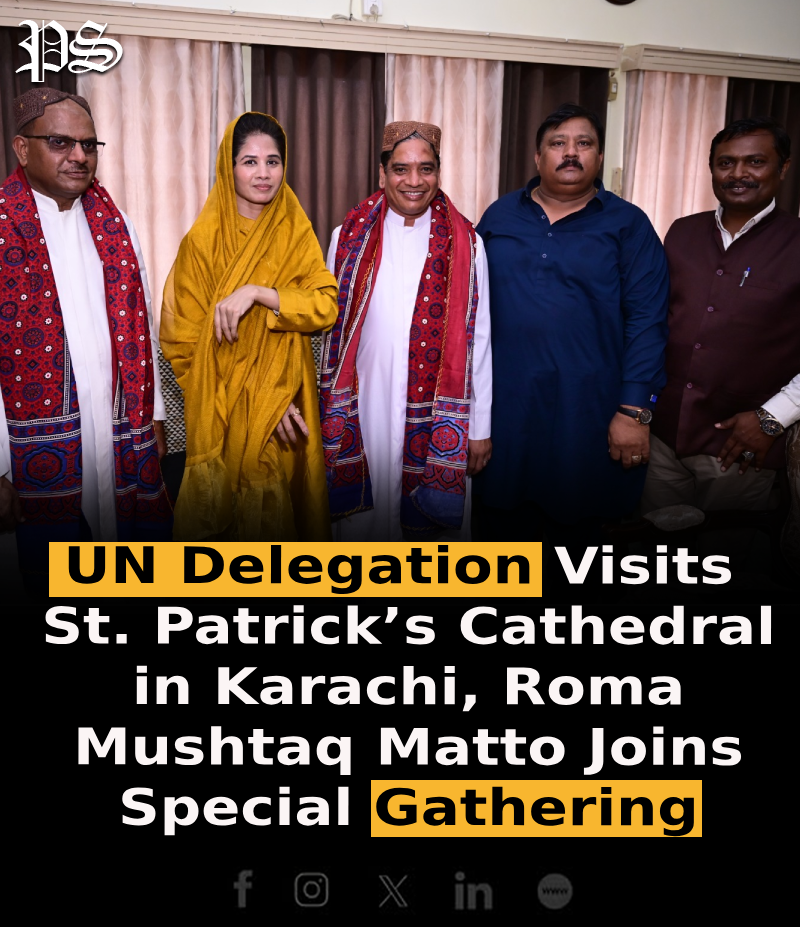
A United Nations delegation led by Mohamed Yahya, United Nations Resident Coordinator and Humanitarian Coordinator in Pakistan, paid a special visit to the historic St. Patrick’s Cathedral in Karachi. The delegation included Afke Bootsman, Head of the United Nations Resident Coordinator’s Office in Pakistan, and Imran Khan Laghari, Provincial Coordinator of the United Nations Resident Coordinator’s Office in Sindh. On the special invitation of the church administration, Roma Mushtaq Matto, Member of the Sindh Provincial Assembly and Parliamentary Secretary for Minorities Affairs, also attended the occasion and warmly welcomed the visiting delegation. The distinguished Fathers and members of the church administration received the UN delegation and Roma Mushtaq Matto with warmth and hospitality. During the visit, the church authorities briefed the guests about the historical and religious importance of St. Patrick’s Cathedral and its role in serving the Christian community in Karachi. They also highlighted various welfare, social and community-based initiatives carried out by the church. The visit provided an opportunity for the participants to discuss matters related to religious harmony, minority welfare, social inclusion and community development. Welcoming the UN delegation, Roma Mushtaq Matto emphasized the importance of joint efforts to promote religious harmony and respect among different faith communities in Pakistan. She said that mutual respect, tolerance and meaningful dialogue could play an important role in strengthening peace and harmony throughout society. She stressed that people belonging to different religions and communities should be encouraged to work together for the welfare and development of the country. Roma Mushtaq Matto also appreciated the role of the United Nations in humanitarian welfare, sustainable development, climate-related challenges, disaster response and assistance to vulnerable communities. She said that international organizations and local institutions could achieve better results when they worked together on issues affecting ordinary people. She highlighted the importance of cooperation in addressing social and humanitarian challenges and supporting communities that require assistance. Speaking about the Pakistan Peoples Party, Roma Mushtaq Matto said that the party’s leadership has traditionally emphasized tolerance, equality, human rights and the protection of minorities. She said that under the leadership of PPP Chairman Bilawal Bhutto Zardari and Sindh Chief Minister Syed Murad Ali Shah, the Sindh government was taking practical measures for the welfare of minorities and other sections of society. She emphasized the importance of providing equal opportunities to citizens regardless of their religious or social background. According to Roma Mushtaq Matto, cooperation between the Sindh government, the United Nations and religious and social institutions could become an important means of promoting public welfare and social inclusion. She said that coordinated efforts could help address community-level challenges, encourage sustainable development and improve opportunities for vulnerable groups. She further stated that the PPP leadership believes that all religious communities living in Pakistan are equal partners in the country’s development and prosperity. She stressed that Pakistan’s diverse communities can contribute positively to national progress when they are given equal opportunities and are able to participate fully in social and economic life. During the visit, the UN delegation and church representatives exchanged views with Roma Mushtaq Matto on a range of issues. Discussions included minority welfare, interfaith harmony, human development, social inclusion and cooperation at the community level. The participants also discussed the importance of creating an environment in which people from different religious backgrounds can live together peacefully and work collectively for the betterment of society. Mohamed Yahya thanked the Fathers, the church administration and Roma Mushtaq Matto for the warm welcome and hospitality extended to the UN delegation. He emphasized the importance of continued cooperation to promote religious harmony, tolerance and social inclusion in Pakistan. He also highlighted the value of joint efforts aimed at improving human development and supporting communities in need. The visit to St. Patrick’s Cathedral also provided an opportunity for the UN representatives to learn more about the role of religious institutions in community welfare. Religious institutions often have strong connections with local communities and can contribute to education, healthcare, social support and assistance to vulnerable people. Cooperation between such institutions and international and government organizations can help strengthen community-based welfare initiatives. The participants agreed that promoting dialogue between different religious communities is important for building trust and reducing misunderstandings. Interfaith activities can provide opportunities for people to learn about one another’s traditions and develop greater respect for differences. Such initiatives can also contribute to peaceful coexistence and social stability. The discussion at St. Patrick’s Cathedral reflected the shared interest of the participants in promoting these values across Pakistan. The meeting also highlighted the importance of including minorities in broader development efforts. Social inclusion means ensuring that all communities have opportunities to participate in education, employment, public services and decision-making. The participants emphasized that cooperation between government institutions, international organizations and community leaders can help create more inclusive policies and programmes. The UN delegation’s visit was therefore not only a courtesy visit but also an opportunity to exchange views on important social and humanitarian issues. The presence of Roma Mushtaq Matto added a provincial government perspective to the discussion, particularly regarding minority affairs and community welfare in Sindh. Her participation demonstrated the importance of communication between government representatives, religious institutions and international organizations. The church administration also provided information about its services and initiatives for the Christian community. The historic St. Patrick’s Cathedral remains an important religious and cultural site in Karachi and has a long connection with the city’s Christian community. The visit allowed the delegation to learn about its history while also discussing its role in social and community activities. At the conclusion of the visit, the participants expressed a shared commitment to promoting peace, tolerance, mutual respect and cooperation among Pakistan’s diverse religious communities. The meeting ended in a cordial and friendly atmosphere, with all sides recognizing the importance of continued dialogue and cooperation. Overall, the visit of the United Nations delegation to St. Patrick’s Cathedral in Karachi brought together representatives of the UN, the Sindh government and the Christian community. The discussions focused on minority welfare, interfaith harmony, social inclusion, human development and community cooperation. Roma Mushtaq Matto emphasized the need for collective efforts to strengthen religious harmony and ensure equal opportunities for all citizens, while Mohamed Yahya highlighted the importance of continued cooperation in promoting tolerance and human development.
About The Author