

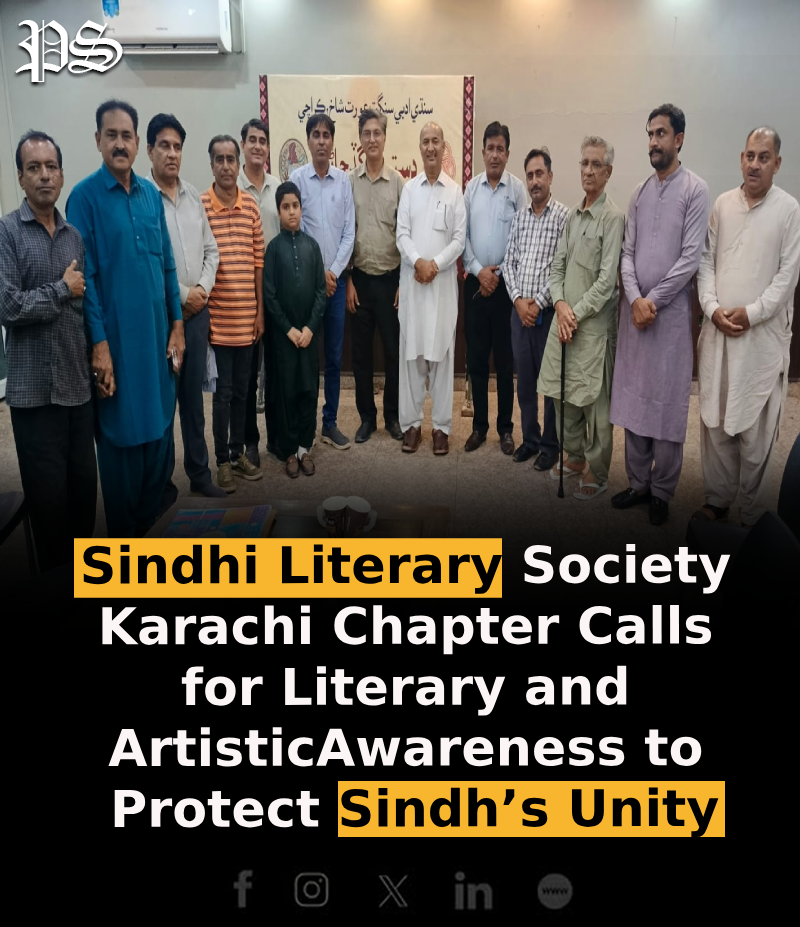
KARACHI — The regular meeting of the Karachi chapter of the Sindhi Adabi Sangat was held at the Gul Rang Hall of the Arts Council, with writer and poet Sarwar Samejo presiding over the session.
The proceedings of the meeting were conducted by the chapter’s secretary, Nisar Naz Ruk. A number of writers and poets presented their literary works during the gathering, including ghazals by Waheed Mohsin and Murtaza Naz, a poem by Amjad Durrani, and a ghazal by Nisar Naz Ruk.
Participants, including Sahib Khan Bhund, Mureed Ali Jamro, Sarang Munir Soomro, Muzaffar Memon, Ameen Joiyo, Ghafoor Khatri, Saleem Anwar Abbasi, Zulfiqar Solangi and others, offered critical observations and feedback on the works presented during the meeting.
During the discussion, participants also expressed concern over what they described as attempts or proposals that could potentially affect the territorial and social unity of Sindh. They called on writers, poets, artists and journalists to use literature, poetry, art and their public voices to promote awareness, unity and social consciousness among the people.
The participants said that literature and art have historically played an important role in preserving a society’s national, cultural, historical and geographical identity. They argued that, in the current situation, writers and intellectuals should not ignore concerns surrounding the possible division of Sindh.
Instead, they said, writers should use their creative abilities to communicate verified information to the public and help people develop a deeper understanding of their history, land, language and cultural heritage.
The participants emphasized that poets should understand the sensitivity of the current circumstances and produce poetry that reflects resistance, social consciousness and a commitment to cultural identity. They said poetry should convey a message of love for Sindh’s history, land, unity, language and culture while simultaneously promoting peace, social cohesion and democratic awareness.
They also called on artists, singers and musicians to contribute through their respective forms of expression. According to the participants, creative arts can play an important role in raising public awareness and encouraging peaceful and constructive civic engagement.
A particular emphasis was placed on the need for writers and intellectuals to avoid emotional slogans and instead rely on historical facts, evidence, research and reasoned analysis. The participants said that responsible writing could help society distinguish between reliable information, rumours and misinformation.
They argued that public awareness should be based on knowledge and facts rather than unverified claims or emotionally charged narratives. In their view, writers and journalists have a responsibility to research issues carefully before presenting information to the public.
The participants further stated that protecting the unity of Sindh should not be regarded as the responsibility of political leadership or any single social group. They described it as a shared civic responsibility involving citizens, writers, poets, journalists, artists, teachers, students and civil society.
They stressed that literature, journalism, poetry, music, drama and other forms of artistic expression could be used to create public awareness through peaceful and democratic means.
The meeting also called for greater cooperation among Sindh’s literary and artistic communities. Participants said writers, poets, artists and journalists should work together to promote an informed cultural movement focused on the protection of Sindh’s unity, peace, tolerance, cultural identity and public rights.
About The Author