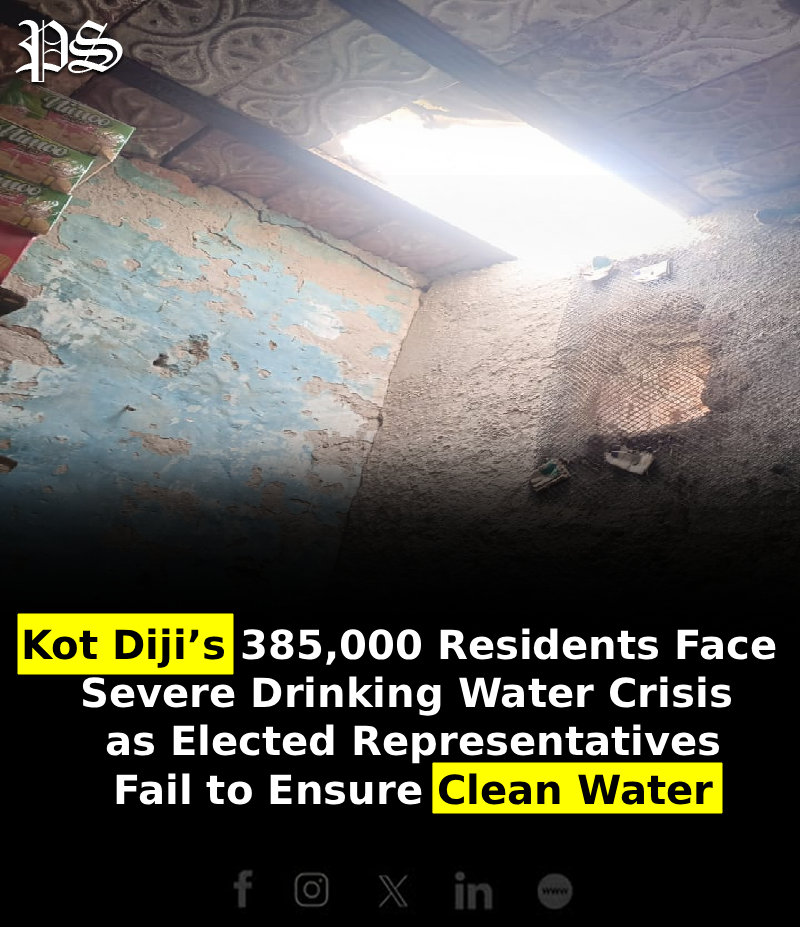
KANB (N.P. Soch): Elected representatives of Kot Diji have allegedly failed to provide clean drinking water to the population, leaving more than 385,000 residents facing serious difficulties. Claims of development and public service by MNAs and MPAs have reportedly remained confined to promises, while saline and contaminated water in various parts of the taluka has contributed to an increase in health problems.
According to the 2023 census, Kot Diji taluka has a total population of 385,872, comprising 291,472 rural residents and 94,400 urban residents.
The drinking water crisis has become particularly serious in various union councils and the three urban centres of Kot Diji, Kanb and Faqirabad. Residents say seepage and salinity have contaminated groundwater, while increasing levels of salt have made water in many areas brackish, bitter and potentially harmful for human consumption.
Local residents said that due to the unavailability of clean and sweet drinking water, people are compelled to consume and use saline water. They claimed that cases of various stomach and digestive illnesses, as well as hepatitis and other diseases, have increased as a result. Residents further claimed that several people had died from water-related and other illnesses, while many others were suffering from various health problems.
The performance of various water-supply, filtration and other schemes established to provide clean drinking water has also come under question. Residents said that many filtration and clean-water plants have remained closed or out of order for a long time, while several areas still lack a permanent supply of safe drinking water.
The water crisis is not limited to public health and is also affecting agriculture. Farmers said that the deteriorating condition of groundwater due to salinity and waterlogging was affecting the fertility of agricultural land. In several areas, farmland is gradually becoming barren, putting the livelihoods of thousands of farming families at risk.
Residents questioned the elected MNAs and MPAs, asking where the development promises made to the public during elections had gone. They said that if people in a taluka with a population of hundreds of thousands could not even access clean drinking water, the claims of public service and development had little meaning.
According to residents, the activities of elected representatives often appear to remain focused on condolence visits and formal political engagements rather than practical solutions to public problems, while basic issues continue to persist.
The residents have urged the Sindh Chief Minister and senior officials of the Public Health, Irrigation and Health departments to collect drinking-water samples from all areas of Kot Diji taluka and have them scientifically tested. They demanded the immediate restoration of non-functional water-supply and filtration plants, permanent planning for areas affected by waterlogging and salinity, and measures to ensure the provision of clean and safe drinking water.
The residents said that access to clean drinking water was not a political favour but a fundamental human right, and called upon elected representatives to move beyond promises and condolence visits and take practical steps to address the crisis.
About The Author