

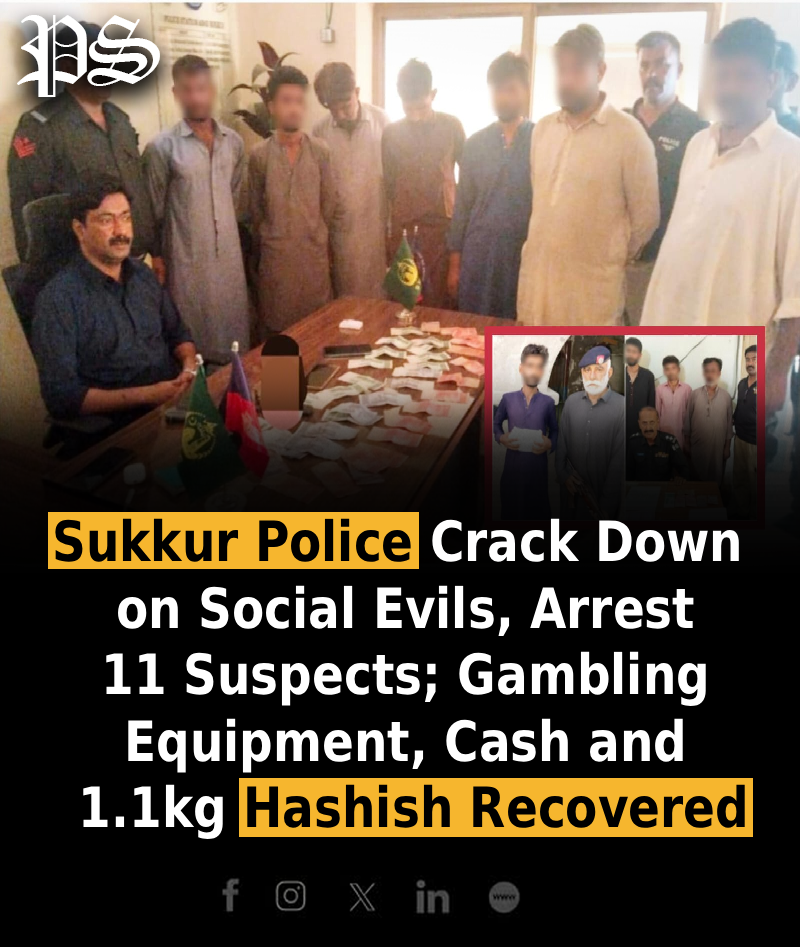
SUKKUR : Sukkur Police continued their crackdown against elements allegedly involved in social evils, carrying out operations in different police station jurisdictions and arresting a total of 11 suspects. During the operations, gambling equipment, Okara betting slips, playing cards, cash and 1,100 grams of hashish were recovered. Cases have been registered against the arrested suspects under relevant laws, and further legal proceedings are underway.
According to police, acting on a tip-off, the SHO of Abad Police Station, under the supervision of Site Area DSP Naseem Bhutto, raided a gambling den within his jurisdiction and arrested seven alleged gamblers. Police recovered playing cards, equipment used for different gambling games and Rs19,000 in cash from their possession.
The arrested suspects were identified as Farhan Abro, Zohaib Solangi, Mureed Ali Umrani, Mola Bakhsh Umrani, Murad Solangi, Munawar Umrani and Aamir Bakhsh Umrani. Police registered a case against them under the Gambling Act. The case was registered as CR No. 188/2026 under Section 5-A of the Gambling Act at Abad Police Station.
In another operation, the SHO of Bagharji Police Station conducted an action within his jurisdiction and arrested an alleged drug dealer, Rehmatullah Laghari. Police said that 1,100 grams of hashish were recovered from his possession. A case was subsequently registered against him under the relevant narcotics law. The case was registered as CR No. 17/2026 under Section 9(I)3C SCNS at Bagharji Police Station.
Similarly, the SHO of New Pind Police Station, acting on secret information, raided a gambling den and arrested three alleged gamblers. Police said that an Okara betting slip box, equipment used for various gambling games and cash were recovered from their possession.
The arrested suspects were identified as Abid Hussain Jagirani, Asghar Mirani and Mondal Shar. Police registered a case against all three suspects under the Gambling Act. The case was registered as CR No. 133/2026 under Section 6 of the Gambling Act at New Pind Police Station.
Sukkur Police said that operations against social evils, drug trafficking and gambling would continue across the district without discrimination. They added that strict action would be taken against elements involved in such activities in accordance with the law.
SSP Sukkur Azhar Khan appreciated the successful operations carried out by the police teams and praised the officers and personnel involved. He directed the police to further intensify operations against elements involved in social evils and ensure effective enforcement of the law.
About The Author