PPP Leaders Extend a Helping Hand to the People of Kingri
Solar Panels, Fans and Sewing Machines Distributed Among Deserving Families
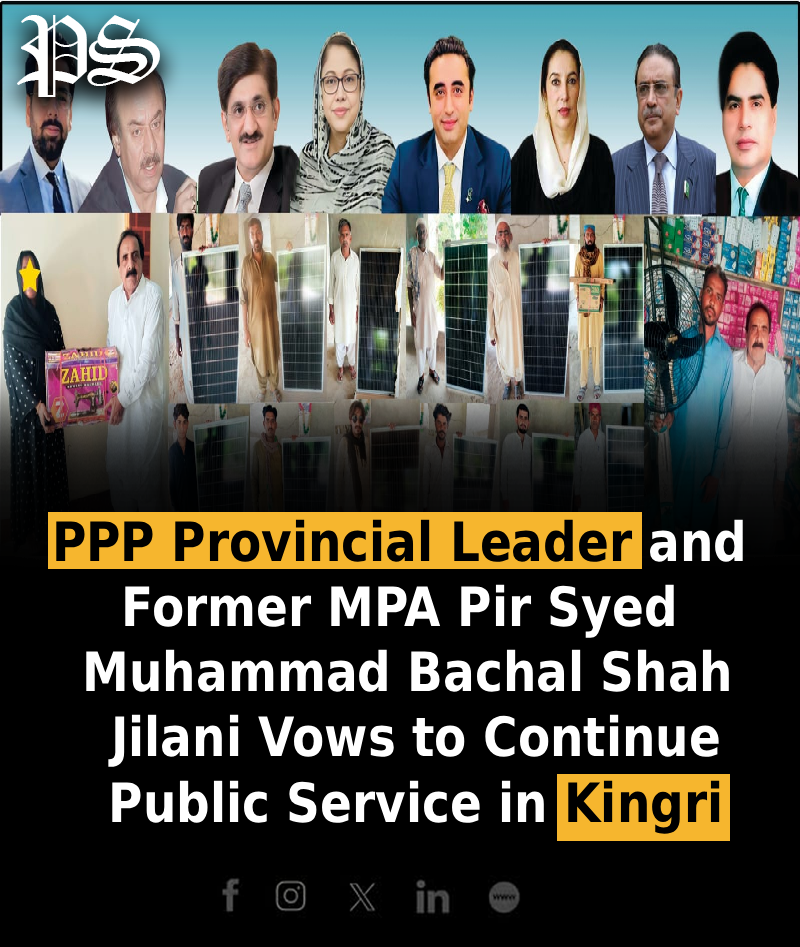
Khairpur : In a significant initiative aimed at supporting deserving families and promoting public welfare, solar panels, electric fans and sewing machines were distributed among needy people in different areas of Taluka Kingri on the directives of Pakistan Peoples Party (PPP) provincial leader and former MPA Pir Syed Muhammad Bachal Shah Jilani and Pir Syed Hussain Shah Jilani.
A special ceremony was held at Mehr Shah Jilani House, Luqman, Khairpur, where deserving families were provided with essential items to help them cope with electricity shortages and create opportunities for household income.
Addressing the gathering, Pir Syed Muhammad Bachal Shah Jilani said that serving the people, supporting the underprivileged and resolving their basic problems had always remained a central mission of the Pakistan Peoples Party.
He said that from Shaheed Zulfikar Ali Bhutto to Shaheed Mohtarma Benazir Bhutto, the PPP leadership had regarded the people as the real source of political power. He added that under the leadership of PPP Chairman Bilawal Bhutto Zardari, the party was continuing its mission of public service and welfare.
Pir Syed Muhammad Bachal Shah Jilani said that PPP workers of Taluka Kingri are the party’s valuable strength, as they have stood by the party and its leadership in every difficult situation. He urged workers to strengthen their direct contact with the people, identify the problems of deserving families and raise their voice for the resolution of public issues.
Pir Syed Hussain Shah Jilani, addressing the ceremony, said that the true purpose of politics is to serve the people. He said that the relationship between the Jilani family and the people of Taluka Kingri was not merely political but was based on love, brotherhood and a commitment to public service.
He said that every possible effort would be made to extend facilities and assistance to deserving families in the area. He also urged PPP workers to remain connected with the people, listen to their problems and strengthen the party organization at the grassroots level.
Public Welfare Initiative at Mehr Shah Jilani House
At Pir Mehr Shah Jilani House, Luqman, another ceremony was organized under the supervision of Zawar Moharram Ali Abro, where solar panels, fans and sewing machines were distributed among deserving families.
Speaking on the occasion, Zawar Moharram Ali Abro said that the initiative was being carried out under the directives of Pir Syed Muhammad Bachal Shah Jilani and Pir Syed Hussain Shah Jilani, with the objective of providing practical assistance to deserving people.
He said that families facing electricity shortages were being provided with solar panels and fans, while sewing machines were being given to women to help them develop home-based livelihoods and become economically empowered.
“Our mission is to continue serving the people and to ensure that assistance reaches those who genuinely need it,” he said, adding that the welfare initiative would continue in the future as well.
A large number of PPP local leaders, workers and prominent residents attended the ceremony. The beneficiaries expressed their gratitude to Pir Syed Muhammad Bachal Shah Jilani, Pir Syed Hussain Shah Jilani and the organizers for extending practical support to deserving families.
The initiative was widely appreciated by the local community as a meaningful step towards public welfare, empowerment and grassroots service.
About The Author