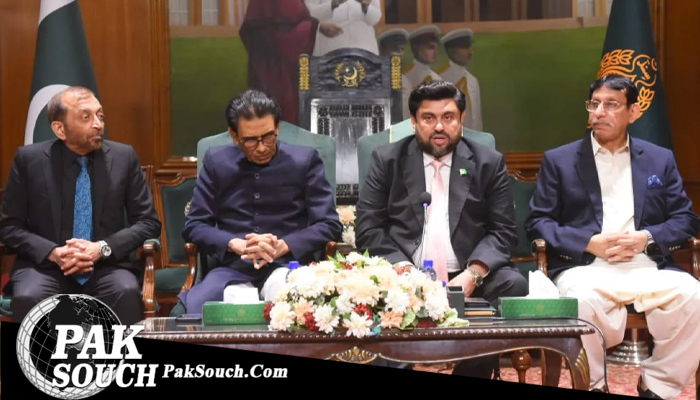
Karachi: Sindh Governor Kamran Tessori has called for the Pakistan Tehreek-e-Insaf (PTI) to be dealt with in the same manner as the Muttahida Qaumi Movement (MQM) was treated in the past, asserting that there should be no negotiations with PTI and that the party must clearly distance itself from what he termed an anti-state narrative.
Addressing a joint press conference in Karachi alongside MQM Chairman Dr. Khalid Maqbool Siddiqui, senior leader Farooq Sattar, and party leader Syed Aminul Haq, Governor Tessori strongly criticized PTI’s alleged activities and rhetoric, particularly abroad. He referred to statements made in the United Kingdom against Pakistan’s senior military leadership, describing such language as unacceptable and equating it with terrorism.
The Sindh governor said that using abusive and inflammatory language against state institutions, especially from foreign soil, crossed all red lines. “In a country like Britain, such statements have been made against our Field Marshal. This falls within the category of terrorism,” Tessori said, adding that the state should respond firmly to such actions.
He further alleged that PTI was misleading overseas Pakistanis by spreading what he called a false and dangerous narrative. Warning expatriates not to fall for such messaging, Tessori said that this narrative would not succeed. “PTI is inciting overseas Pakistanis, but people should stay away from this agenda. This narrative will not work,” he declared, adding that he and his party were prepared to politically confront PTI even on foreign soil, including in the United Kingdom.
Governor Tessori reiterated his stance that PTI should face the same treatment MQM faced during its most difficult periods. “The same approach that was adopted toward MQM should be adopted toward PTI,” he said. He accused PTI of using the name of negotiations merely as a tactic, claiming that the party had “opened a shop in the name of talks” without any real intention of constructive dialogue. According to him, there should be no negotiations with PTI at this stage.
He also made pointed remarks about PTI’s founding chairman, Imran Khan, stating that he was enjoying extensive facilities in jail. “The founder of PTI has so many facilities in prison that he does not even want to come out,” Tessori alleged. He questioned the sincerity of PTI’s claims of victimization and urged party leaders and supporters to reassess their position.
In a particularly strong statement, the governor said that PTI members of the National Assembly and party workers should openly declare their dissociation from Imran Khan. “PTI MNAs and workers should announce their separation from Imran Khan. They must also prove that they are Pakistanis, just as we have done,” he said, implying that loyalty to the state must come before loyalty to any individual.
Speaking at the same press conference, MQM Chairman Dr. Khalid Maqbool Siddiqui advised PTI workers to move beyond personality-driven politics. He said that Pakistan’s political crisis could not be resolved as long as parties remained centered around individuals rather than public issues. “PTI workers should come out of personality worship and raise their voice for the people,” Siddiqui remarked.
Dr. Siddiqui also highlighted the grave challenges facing Karachi, describing the situation as an emergency. He said the city was suffering from severe administrative and governance problems, while continuous obstacles were being created by the government. “Karachi is passing through an emergency-like situation. There are constant hurdles being placed by the government,” he said.
Referring to the constitutional role of the governor, Dr. Siddiqui said that MQM leaders had requested Governor Tessori, as the representative of the federation, to play his constitutional role in addressing Karachi’s issues. He emphasized that the city, which serves as Pakistan’s economic backbone, could not be neglected any further.
The joint press conference reflected a united MQM stance alongside the governor against PTI’s politics and narrative. The statements underscored deepening political polarization, with strong demands for accountability, loyalty to state institutions, and a rejection of what was described as confrontational and divisive politics.
Governor Tessori concluded by reiterating that the state must act decisively to protect its institutions and maintain stability. He stressed that political disagreement should not turn into hostility toward the country itself and that any party crossing that line must face firm consequences, regardless of its popularity or past political standing.