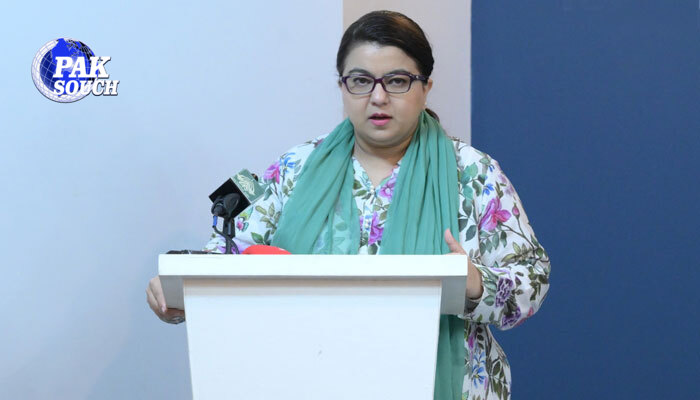
ISLAMABAD: Federal Minister for Information Technology and Telecommunication Shaza Fatima Khawaja has strongly rejected concerns surrounding the proposed Telecom Bill, stating that the legislation will not permit the government or telecom companies to forcibly occupy any citizen’s private land or property. She emphasized that the bill is aimed solely at improving Pakistan’s digital infrastructure and ensuring faster internet connectivity across the country.
Addressing a joint press conference alongside Federal Law Minister Azam Nazeer Tarar, Shaza Fatima said it had become necessary to clarify misconceptions regarding the proposed legislation. According to her, several misleading claims had been circulated about the bill, creating unnecessary confusion among the public and lawmakers.
“The Telecom Bill is being introduced through a transparent and consultative legislative process,” she said. “There is absolutely no provision that allows anyone to seize private land or property against the owner’s will. Citizens’ constitutional and legal rights remain fully protected.”
The minister explained that Pakistan’s existing telecommunications law had become outdated and no longer met the requirements of the rapidly evolving digital landscape. She said the proposed bill seeks to modernize the legal framework governing the telecom sector and align it with current technological developments.
“Our objective is to implement the Prime Minister’s vision of expanding high-speed internet access across Pakistan,” Shaza Fatima stated. “Reliable digital connectivity is essential for education, healthcare, business, e-commerce, and overall economic growth. Updating the legal framework is necessary to support these goals.”
She noted that as the federal minister responsible for information technology, it was her duty to facilitate improved internet services for citizens and encourage investment in digital infrastructure.
Shaza Fatima also highlighted the legislative journey of the Telecom Bill, saying it remained before the National Assembly for nearly six months before being debated. Later, it was referred to the Senate committee for further examination, a process she described as an example of democratic scrutiny.
“The National Assembly eventually approved the bill after incorporating six amendments,” she said. “This demonstrates that lawmakers carefully considered concerns and suggestions before passing the legislation.”
Clarifying one of the most controversial aspects of the bill, the minister said the proposed law mainly addresses issues involving housing societies and developers that sign agreements for telecommunications infrastructure but later fail to fulfill their commitments.
She stressed that property owners retain the legal authority to refuse the use of their private property for telecom installations if they choose to do so.
“If a citizen does not want telecom infrastructure installed on his or her private property, that decision will be respected,” she said. “The law does not override an individual’s ownership rights.”
Responding to allegations made against her and senior officials of the Ministry of IT, Shaza Fatima said she had personally requested Prime Minister Shehbaz Sharif to order an inquiry into the accusations.
She maintained that the allegations were baseless and politically motivated, adding that transparency remained a priority for the ministry.
“False narratives have been created against me and the IT secretary without any evidence,” she said. “We ourselves requested an impartial investigation so that the facts can come before the public.”
The minister further stated that she and other officials reserve the legal right to initiate proceedings against those making defamatory financial allegations without proof.
“We have every legal right to defend our reputation against false accusations,” she remarked.
Shaza Fatima added that detailed categories and regulations concerning private properties would be clearly defined through relevant rules and procedures, ensuring that there is no ambiguity in implementing the law.
She reiterated that the Telecom Bill is not intended to interfere with citizens’ property rights but to remove administrative and legal obstacles that have slowed the expansion of telecommunications services in Pakistan.
Federal Law Minister Azam Nazeer Tarar also supported the government’s position, emphasizing that legislation passed by Parliament must comply with constitutional safeguards protecting citizens’ rights.
The government believes that modernizing Pakistan’s telecom laws will encourage investment in the digital sector, improve internet accessibility in underserved regions, and strengthen the country’s digital economy. Officials say the updated legal framework is expected to facilitate the rollout of advanced telecommunications infrastructure while maintaining a balance between public interest and private property rights.
The proposed Telecom Bill has generated considerable debate in recent weeks, particularly on social media, where concerns were raised about the possibility of forced acquisition of private land. Government officials, however, insist that such claims are inaccurate and that the legislation contains sufficient safeguards to protect citizens’ legal rights while supporting Pakistan’s digital transformation agenda.
About The Author