

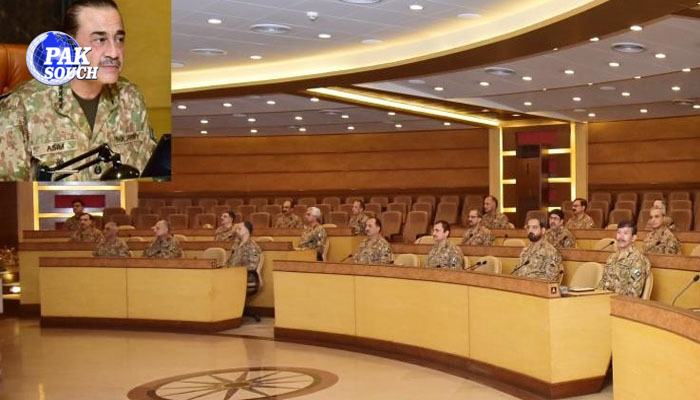
RAWALPINDI: Pakistan’s military leadership has reaffirmed its commitment to safeguarding the country’s sovereignty, combating terrorism, and countering what it described as hybrid warfare and disinformation campaigns, according to a statement issued by the Inter-Services Public Relations (ISPR) following the 276th Corps Commanders’ Conference.
The conference was chaired by Field Marshal Syed Asim Munir, who emphasized that Pakistan’s sovereignty and national interests would be protected under all circumstances.
According to the ISPR, the army chief stated that the armed forces remain fully committed to defending the country’s territorial integrity and ensuring national security against all forms of external and internal threats.
Focus on Regional Security
The conference reviewed the prevailing regional security environment and discussed the challenges posed by terrorism. According to the ISPR, participants observed that lasting peace and stability in the region are linked to preventing militant groups and proxies from operating from Afghan territory.
The statement added that Pakistan reserves the right to protect its citizens and defend itself against terrorism in accordance with international law and its national security requirements.
The forum also reiterated that intelligence-based operations against militant groups would continue, emphasizing the need to eliminate terrorist networks and improve security in affected regions.
Kashmir Issue
The Corps Commanders’ Conference reaffirmed Pakistan’s longstanding position on Jammu and Kashmir, describing the territory as central to Pakistan’s national interests.
According to the ISPR, the forum condemned what it described as serious human rights violations in Indian-administered Jammu and Kashmir and rejected alleged unilateral demographic changes in the region.
Participants reiterated Pakistan’s diplomatic, political, and moral support for the people of Kashmir and called for the implementation of relevant United Nations Security Council resolutions, stating that the Kashmiri people should be able to exercise their right to self-determination.
Indus Waters Treaty
The conference also discussed recent statements by India regarding the Indus Waters Treaty.
According to the ISPR, participants emphasized that Pakistan would take all necessary measures to ensure the availability of its legitimate share of water under the treaty framework. The forum referred to the decisions of the National Security Committee dated April 24, 2025, as providing guidance on the matter.
Hybrid Warfare and Disinformation
The military leadership also discussed what it described as attempts by hostile elements to spread instability through hybrid warfare and false narratives.
According to the ISPR statement, the forum asserted that following what it referred to as the enemy’s defeat in “Operation Marka-e-Haq”, efforts were being made to create unrest through misinformation and externally supported activities.
The conference stated that any attempts to spread instability or disorder through such means would be dealt with firmly and in accordance with the law.
Governance and Counterterrorism
The participants emphasized that military operations alone are not sufficient to ensure long-term peace and stressed the importance of effective governance in areas affected by militancy.
According to the ISPR, the forum called for the establishment of a strong administrative framework focused on public service, welfare, and the rule of law. It also stressed the need to dismantle any nexus between terrorism, organized crime, and political patronage.
Pakistan’s Regional Role
The conference praised Pakistan’s efforts to promote regional stability and reduce tensions through constructive engagement and diplomacy.
The ISPR said the participants reaffirmed their commitment to working with all relevant institutions to strengthen national security, maintain internal stability, and protect the country’s strategic interests while continuing counterterrorism efforts across affected areas.
The statement concluded by emphasizing the armed forces’ resolve to safeguard Pakistan’s sovereignty, uphold constitutional responsibilities, and support initiatives aimed at ensuring lasting peace, security, and stability in the region.
About The Author