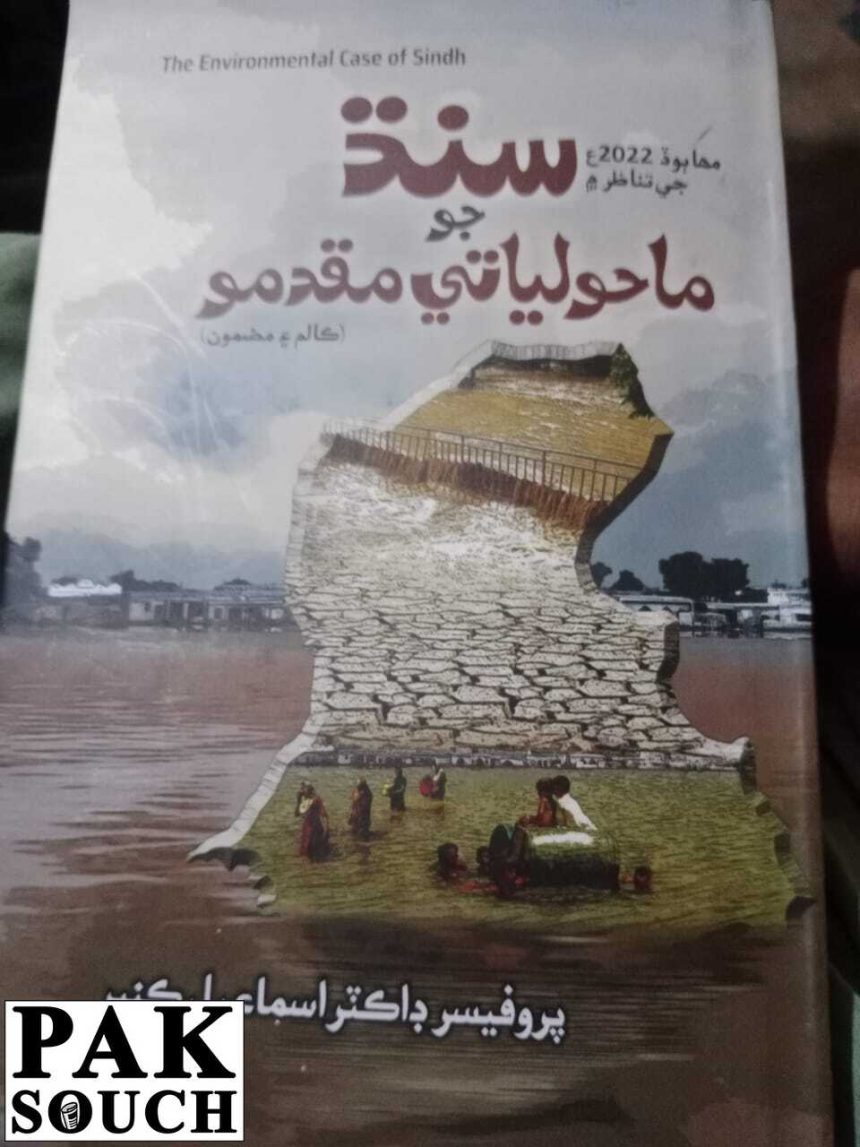
The book Sindh Jo Maholiyati Maqadmo (Sindh’s Environmental Case), authored by Professor Dr. Muhammad Ismail Kumbhar, was published in August 2024 by Kanwal Publications. The volume is well-produced with a colorful hardbound cover, comprising 160 pages, and focuses primarily on the environmental issues of Sindh.
The author begins with the idea that human survival is directly linked with the earth itself. The planet is divided into diverse components: land, mountains, deserts, barren plains, and water bodies. Earth supports a wide range of life forms, including living creatures, vegetation, mountains, seas, and rivers.
The beauty and sustenance of the earth depend on agriculture and forestry. Greenery and plantations are vital for survival, and water is indispensable to this process. Countries with dense forests enjoy abundant oxygen and rainfall, both of which sustain life. The earth itself is alive—it breathes like a human, remaining healthy at times and falling ill at others. To keep it healthy, the natural system (ecosystem) must be preserved.
Dr. Kumbhar recalls that 35 years ago he wrote a research paper titled The Earth Breathes, which was well received by agronomy experts such as Professor Waseemuddin and Dr. Ghulam Haider Jamro. He explains that the earth’s soil has different layers, known in Soil Science as A, B, C, and D horizons. A healthy climate, lush greenery, and forests make the planet thrive, while pollution, smoke, and nuclear wars lead to its sickness.
In Sindh, areas where oil, gas, and coal have been extracted have witnessed rising heat levels. Underground water is turning increasingly brackish, crops fail to ripen on time, and people are suffering from heat-related illnesses, including widespread jaundice caused by poor water quality. Ideally, every country should maintain 25% of its land as forests, but in Pakistan only 5–10% remain, which is fueling rising temperatures.
The author also highlights how solar radiation has been heavily disturbed, with global warming turning earth into a heated furnace. In Islamkot, Tharparkar, after coal mining began, rainfall has led to devastating lightning storms, causing loss of human and animal life. By presenting these issues on a scientific basis, Dr. Kumbhar compels readers to reflect.
He also discusses the floods of 2010 and the more recent monsoon rains, which, while beneficial in some ways, have also caused immense damage. He ties environmental degradation to growing unemployment, inflation, and suicides in Sindh, particularly among the middle and lower classes. The country’s economic system, especially its pricing mechanisms, requires urgent reform.
Agricultural collapse and recovery are key themes. Prices of crops like onions fluctuate wildly—from 250 rupees per kilogram at times to just 10 rupees, when no one buys them. This imbalance in market forces extends to fruits and vegetables, disproportionately harming impoverished communities in underdeveloped areas such as Thar and coastal Sindh. Malnutrition and rising death tolls are the outcome.
The author also addresses the destruction of the coastline, the dangers of sea intrusion, and the government’s efforts through the Left Bank Outfall Drain (LBOD) embankment. Education is another important focus, where policy discrimination between the children of the rich and poor has bred a sense of deprivation. The famous saying “whoever tills, eats” has lost its meaning, as farmers remain impoverished. Rising costs of seeds, fertilizers, tractors, threshers, and pesticides have left growers without fair returns.
Dr. Kumbhar gives an expert overview of changing weather patterns. Mangoes, a prized product of Sindh with both local and international significance, are also being affected by climate shifts. The review stresses that farmers deserve attention at the state level.
The book includes commentaries from intellectuals and reformists such as Gul Muhammad Umrani, Suleman J. Abro, Zulfiqar Halepoto, and Syed Zawar Naqvi, all of whom add depth to the work. The reviewer expresses high expectations from Dr. Muhammad Ismail Kumbhar and prays for his long life, recognizing him as a source of pride for Sindh.