

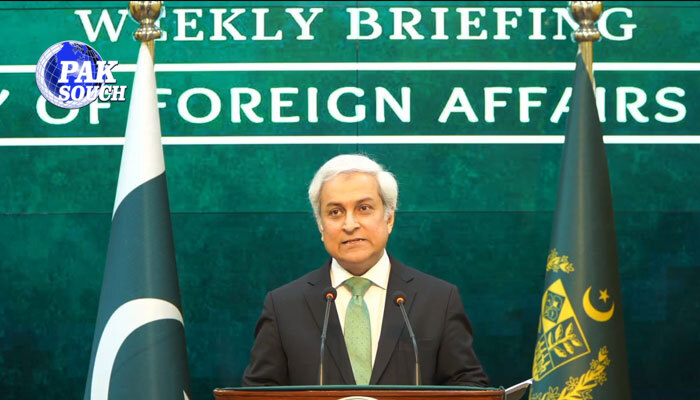
Islamabad: Pakistan and Qatar will continue to coordinate with the technical working groups established as part of the ongoing U.S.-Iran negotiations, Foreign Office spokesperson Tahir Hussain Andrabi said during a weekly media briefing.
Speaking to journalists, the spokesperson highlighted recent diplomatic developments involving Pakistan, Iran, and regional peace efforts. He stated that Iranian President Masoud Pezeshkian visited Pakistan on the invitation of Prime Minister Shehbaz Sharif. During the visit, the Iranian president held meetings with both the Prime Minister and the President of Pakistan.
According to Andrabi, discussions between the two sides focused on strengthening bilateral relations and expanding cooperation in areas of mutual interest. The leaders reaffirmed their commitment to enhancing political, economic, and regional ties while emphasizing the importance of collaboration for peace and stability in the region.
The Foreign Office spokesperson also referred to the second round of U.S.-Iran negotiations, which took place on June 21 in Bürgenstock, Switzerland. He said that Pakistan was represented at the talks by Prime Minister Shehbaz Sharif and Field Marshal Asim Munir, underscoring Islamabad’s active role in regional diplomatic initiatives.
Providing details about the next phase of negotiations, Andrabi explained that three specialized technical working groups have been established to address key issues between the United States and Iran.
The first working group is focused on matters related to Iran’s nuclear program and associated technical concerns. This group is expected to discuss issues surrounding nuclear activities, monitoring mechanisms, and potential frameworks for future cooperation and compliance.
The second working group is dealing with sanctions and frozen assets. Discussions in this forum are aimed at reviewing economic restrictions imposed on Iran and exploring possible arrangements concerning Iranian assets held abroad. The outcome of these discussions could have significant implications for Iran’s economy and broader international relations.
The third working group has been assigned to address the situation in Lebanon, reflecting the wider regional dimensions of the U.S.-Iran dialogue. The group is expected to examine political and security developments in Lebanon and assess possible measures that could contribute to stability in the country.
Andrabi said that Pakistani and Qatari technical teams would remain in communication with their American and Iranian counterparts as the negotiations move forward. He noted that this engagement demonstrates the commitment of both Pakistan and Qatar to supporting diplomatic efforts aimed at reducing tensions and promoting regional peace.
The spokesperson further stated that several countries had appreciated Pakistan’s constructive role in promoting peace and stability in the region. He said the international community has acknowledged Islamabad’s efforts in facilitating dialogue and encouraging diplomatic solutions to complex regional issues.
“Pakistan welcomes the recognition and appreciation shown by the global community for its constructive contribution toward regional peace,” Andrabi said. He added that Pakistan remains committed to supporting initiatives that encourage dialogue, conflict resolution, and mutual understanding among nations.
He also praised the Pakistani media for its responsible coverage of mediation efforts and peace initiatives, saying that balanced reporting had contributed positively to public understanding of sensitive diplomatic developments.
The Foreign Office spokesperson noted that on June 21, the foreign ministers of Pakistan, Egypt, Saudi Arabia, and Türkiye also held a meeting. During the discussions, participants exchanged views on the Islamabad Memorandum of Understanding (MoU) and the outcomes of the Bürgenstock negotiations.
In addition, Pakistan’s Deputy Prime Minister and Foreign Minister held separate conversations with the foreign ministers of Saudi Arabia, Italy, Canada, Bahrain, and Iran, reflecting Islamabad’s active diplomatic engagement with regional and international partners.
Responding to a question regarding reports that Pakistani citizens had been taken hostage off the coast of Somalia, Andrabi confirmed that the incident had occurred near the Somali coast. He said Pakistani authorities are in contact with Somali officials and relevant agencies to secure the safe recovery of the affected citizens.
The spokesperson emphasized that the government is closely monitoring the situation and is making every possible effort through diplomatic channels to ensure the well-being and release of the hostages.
The briefing highlighted Pakistan’s continuing diplomatic outreach and its efforts to play a constructive role in regional peace initiatives, while also addressing concerns related to the safety of Pakistani nationals abroad. As negotiations between the United States and Iran continue, Pakistan’s involvement through technical coordination and diplomatic engagement is expected to remain an important aspect of its foreign policy in the region.
About The Author