

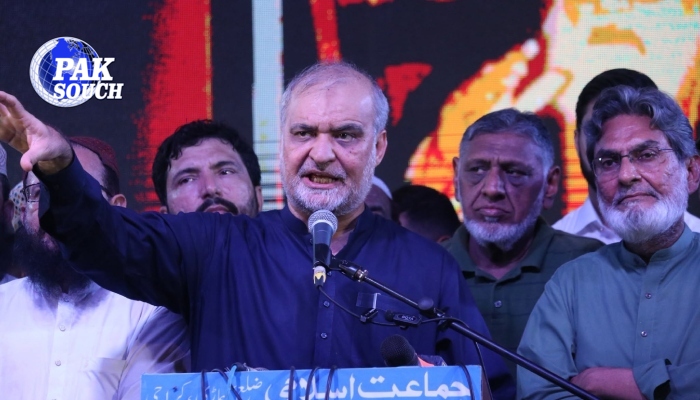
Karachi: Jamaat-e-Islami (JI) Emir Hafiz Naeem ur Rehman has called on the government and private employers to increase the salaries of private sector employees, arguing that workers in the private sector have received no meaningful relief despite rising inflation and increasing living costs.
Speaking at a press conference in Karachi, Hafiz Naeem criticized the federal budget and said that it failed to address the financial difficulties faced by millions of working families.
Call for Relief Amid Rising Inflation
According to Hafiz Naeem, the government announced a 7 percent increase in salaries for public-sector employees, while inflation has risen by around 8 percent, effectively reducing the purchasing power of workers.
He argued that private-sector employees have been overlooked altogether and have not received any salary adjustments despite facing the same economic pressures.
“In a period of high inflation, no relief has been provided to employees working in the private sector. Their salaries have not been increased, and we demand a rise in their wages,” he said.
Criticism of Interest-Based Debt
The Jamaat-e-Islami chief also criticized the country’s economic structure, claiming that a significant portion of the national budget is consumed by interest payments on debt.
He stated that nearly half of government expenditures are directed toward servicing loans and alleged that authorities are not taking serious steps to eliminate interest-based financial arrangements despite court directives on the issue.
“Half of the government’s budget goes toward interest payments, and despite higher court rulings, there is no serious effort to eliminate interest-based systems,” he said.
Remarks on the Federal Budget
Hafiz Naeem described the new budget as lacking innovation and meaningful reforms. He argued that the measures announced by the government would not substantially improve the lives of ordinary citizens struggling with inflation, unemployment, and rising utility costs.
He maintained that workers require practical economic relief rather than limited salary adjustments that fail to keep pace with increases in the cost of living.
Criticism of PPP Governance in Sindh
The Jamaat-e-Islami leader also criticized the Pakistan Peoples Party (PPP), accusing it of failing to improve essential services in Sindh despite being in power in the province for nearly two decades.
He questioned why many areas of interior Sindh continue to face challenges in education and healthcare.
“PPP has been ruling the province for 18 years. Why are children still deprived of quality education and healthcare? Basic health centers are in poor condition, and there is a shortage of education, employment opportunities, and health facilities,” he said.
Hafiz Naeem further pointed to the lack of a comprehensive public transport system in Karachi, saying residents continue to suffer due to inadequate transportation infrastructure.
Concerns Over Political Developments
Commenting on political matters, he alleged that public funds were being used to influence political alignments in Gilgit-Baltistan. He also criticized the imposition of petroleum-related levies, arguing that such measures place additional burdens on citizens.
According to him, petroleum levies should be abolished immediately and the government should adopt policies aimed at reducing fuel costs for consumers.
Proposal on Fuel Prices
Hafiz Naeem suggested that the government should stabilize petroleum prices and maintain a fixed fuel rate to provide long-term relief to the public.
He argued that predictable fuel prices would help control inflation and reduce economic uncertainty for households and businesses.
Demand for Broader Economic Reforms
Concluding his press conference, the Jamaat-e-Islami chief urged policymakers to focus on public welfare, reduce financial burdens on citizens, improve public services, and ensure that both public- and private-sector workers receive adequate protection against inflation.
He reiterated that private-sector employees constitute a major portion of Pakistan’s workforce and deserve salary increases that reflect the realities of rising living expenses and economic challenges.
About The Author