

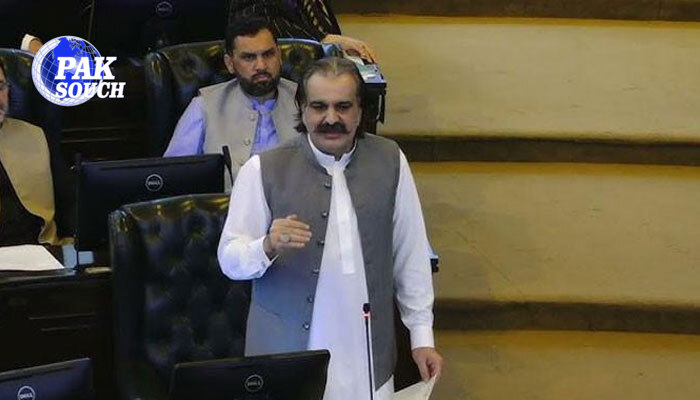
Peshawar: Former Khyber Pakhtunkhwa Chief Minister Ali Amin Gandapur delivered a candid and critical speech during the provincial assembly’s budget debate, openly questioning his own government’s policies, development priorities, and distribution of resources while calling for greater accountability and balanced development across the province.
Addressing the Khyber Pakhtunkhwa Assembly, Gandapur said that the continued failure to resolve public issues reflected a collective failure of elected representatives and government institutions. He argued that although laws are regularly passed in the assembly, the benefits of legislation are often not reaching ordinary citizens.
Need for Effective Governance and Human Development
Gandapur emphasized that the provincial assembly is fundamentally a law-making institution, but stressed that legislation alone is insufficient unless its impact is felt by the public.
He called for stronger protection of human rights and stated that Pakistan Tehreek-e-Insaf (PTI) founder Imran Khan should be granted all legal rights available under the law, including access to television and newspapers if regulations permit.
“Societies progress by investing in people,” he said, adding that governments should prioritize building a strong economy, an effective justice system, and human development initiatives rather than focusing solely on announcements and political narratives.
According to the former chief minister, if public problems remain unresolved, responsibility ultimately lies with governments and elected representatives.
Demand for Full Constitutional Share
Gandapur also highlighted financial issues facing the province and demanded that Khyber Pakhtunkhwa receive its full constitutional share under the Net Hydel Profit (NHP) mechanism and the National Finance Commission (NFC) Award.
He argued that the merger of the former tribal districts into Khyber Pakhtunkhwa should not result in a reduction of the province’s financial rights.
“The province must receive its complete constitutional share. Any reduction creates a sense of injustice and weakens public trust,” he said.
Support for Opposition’s Position
In a notable development, Gandapur endorsed a point raised by the opposition leader regarding development planning. He argued that governments should complete ongoing projects before launching new ones.
According to him, citizens are not impressed by foundation stone ceremonies or inauguration events. Instead, they judge governments based on improvements in hospitals, schools, and other essential public services.
“People want better healthcare, quality education, and functioning public facilities. They are concerned with results, not ceremonies,” he remarked.
Concerns Over Development Budget
The former chief minister expressed serious reservations about allocations for development projects in the provincial budget.
He cited the example of the Hazara Package, claiming that despite announcements of Rs200 billion, only Rs4 billion had actually been allocated in the budget.
Gandapur warned that many projects have received such limited funding that, at the current pace, completion could take decades.
He urged citizens to examine budget documents themselves rather than relying solely on government announcements.
“Public appreciation should be based on actual allocations and progress, not just promises and speeches,” he said.
Key Economic Sectors Overlooked
Gandapur also criticized what he described as inadequate budgetary attention to sectors with significant economic potential.
He noted that livestock, agriculture, minerals, and tourism have been allocated relatively small amounts despite their capacity to strengthen the provincial economy and create employment opportunities.
According to him, these sectors could play a major role in improving Khyber Pakhtunkhwa’s financial position if given sufficient investment and policy support.
Questions Over Borrowing Policies
The former chief minister also questioned the use of public borrowing, arguing that loans should not be taken for the benefit of a single district or a limited number of projects.
Instead, he said borrowed funds should be invested in initiatives capable of generating revenue and producing long-term economic benefits for the province.
“Debt should be utilized for projects that strengthen the economy and create future income streams,” he stated.
Call for Fair Distribution of Resources
Gandapur stressed that elected representatives have a responsibility to ensure fairness in the distribution of public resources.
He warned against policies that favor certain regions while neglecting others and urged the government to guarantee equal development opportunities across all parts of Khyber Pakhtunkhwa.
“Resource allocation must be balanced and just because the people have entrusted us with their votes,” he said.
Admission of Past Mistakes
In one of the most striking moments of his speech, Gandapur openly acknowledged mistakes made during his own tenure.
He admitted that supporting the allocation of funds to political supporters in opposition constituencies had been wrong and urged current lawmakers not to repeat such practices.
“I made that mistake. You should not repeat it,” he told assembly members.
Call for Systemic Reform
Concluding his address, Gandapur said that he had spent years defending government departments and official policies but now felt freer to speak openly.
He argued that many individuals within the existing system are constrained by political and administrative pressures, making meaningful reform difficult.
According to him, genuine progress will require changing outdated structures and adopting a governance model focused on transparency, accountability, equitable development, and public welfare.
His remarks drew attention because they represented a rare instance of a senior PTI leader publicly criticizing policies associated with his own government while advocating broader reforms in governance, budgeting, and development planning.
About The Author