


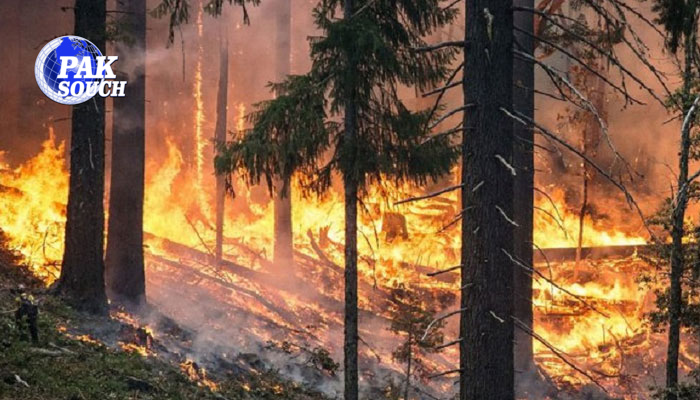
PESHAWAR/MUZAFFARABAD: Rising temperatures and prolonged dry weather have triggered forest fires in the mountainous regions of Malakand and Muzaffarabad, with authorities and local residents struggling to contain the rapidly spreading flames.
Officials say the fires have engulfed several hills and forested areas, damaging valuable trees and posing a threat to the local environment. The situation has become increasingly challenging due to strong winds, difficult terrain, and limited firefighting resources.
Fire Intensifies in Malakand’s Mountain Ranges
One of the most severe fires has been reported on Sangina Mountain in Batkhela Tehsil of Malakand district, where flames have continued to spread across the hillside.
As the blaze intensified, announcements were reportedly made through local mosques urging residents to come forward and assist in firefighting efforts. Community members have joined authorities in attempts to prevent the fire from spreading further into surrounding forest areas.
According to police officials, multiple mountain ranges across all three tehsils of Malakand are currently affected by fires.
Several Areas Affected
Authorities reported that fires are burning in:
- Sangina Mountain in Batkhela Tehsil
- Jaban Mountain in Dargai Tehsil
- Mountainous areas of Bayzi, Ala Dhund Dheri, and Zarkandi Tangi in Thana Tehsil
The fires have already scorched large numbers of valuable trees and vegetation, raising concerns about environmental damage and the potential loss of wildlife habitats.
Local residents have expressed concern over the scale of the destruction, particularly as many of these forests play an important role in maintaining ecological balance and supporting local biodiversity.
Forest Fires Also Reported Near Muzaffarabad
Meanwhile, similar incidents have been reported in the forested hills surrounding Muzaffarabad, the capital of Azad Jammu and Kashmir.
Forest areas in the region have caught fire amid soaring temperatures, adding to the growing number of wildfire incidents being recorded during the ongoing heatwave.
Authorities are monitoring the situation closely, although difficult access to remote mountain locations has complicated firefighting efforts.
Extreme Heat Blamed for Outbreak of Fires
Officials from the Forest Department have linked the increasing number of fires to unusually high temperatures and dry conditions.
Conservator of Forests Mir Nasir stated that the intense heat has led to natural outbreaks of fire in forests dominated by pine trees. Pine forests are particularly vulnerable during hot weather because dry pine needles and resin-rich vegetation can ignite easily and allow flames to spread quickly.
He explained that many of the current fires appear to have started naturally as a result of extreme environmental conditions rather than deliberate human activity.
Lack of Equipment Hindering Response
Forest officials have acknowledged significant challenges in controlling the fires.
According to Mir Nasir, the Forest Department faces a severe shortage of modern firefighting equipment and resources. As a result, teams are relying largely on traditional methods to combat the flames.
Workers and volunteers are attempting to create firebreaks and manually suppress advancing fires, but the scale of the blazes has made containment difficult.
The situation is further complicated by:
- Strong winds that rapidly spread flames
- Steep and rugged mountain terrain
- Limited road access to affected areas
- Shortage of specialized firefighting machinery
These factors have slowed response efforts and increased the risk of the fires expanding into additional forested regions.
Environmental Concerns Growing
Environmental experts warn that large-scale forest fires can have long-term consequences for ecosystems and local communities.
Besides destroying trees and vegetation, wildfires can:
- Damage wildlife habitats
- Increase soil erosion
- Reduce biodiversity
- Affect water conservation systems
- Contribute to air pollution through smoke emissions
The destruction of mature trees can also take years or even decades to reverse, making forest protection a critical concern during periods of extreme weather.
Heatwave Continues Across Pakistan
The fires come as Pakistan experiences an intense heatwave affecting several regions of the country. Temperatures have recently exceeded 50 degrees Celsius in parts of Sindh, while many northern and central areas are also witnessing unusually hot and dry conditions.
Meteorologists have warned that elevated temperatures are likely to persist, increasing the risk of additional wildfire outbreaks in forested and mountainous regions.
Authorities have urged residents to remain vigilant and immediately report any signs of fire to local administrations and forest officials.
About The Author