

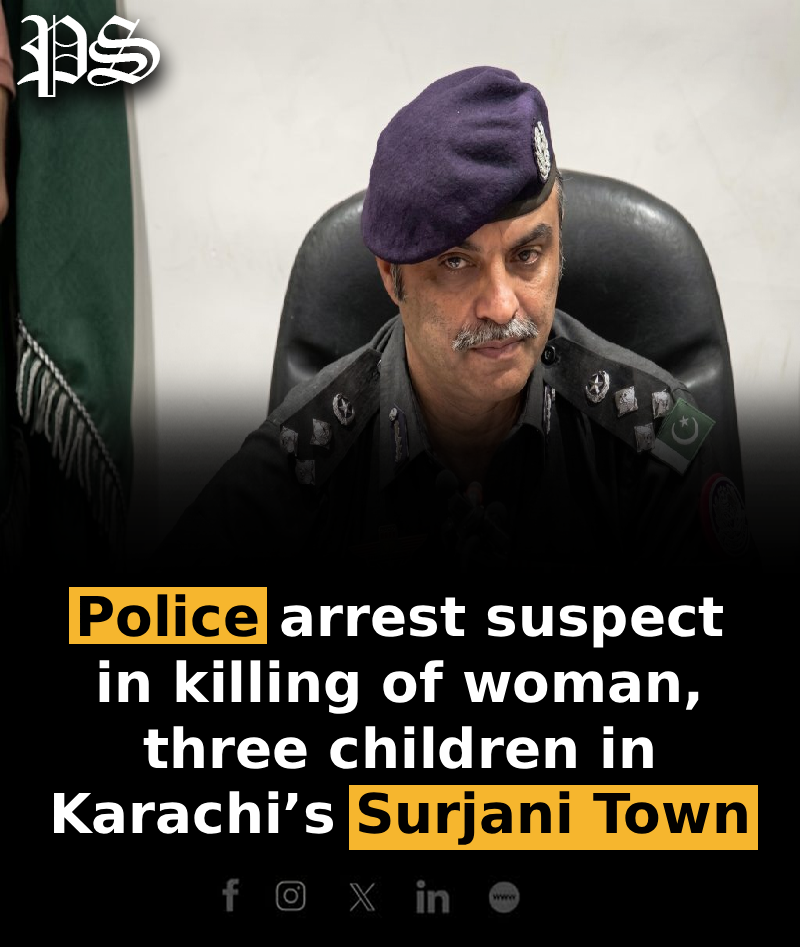
Police have arrested a suspect in connection with the killing of a woman and her three children in Karachi’s Surjani Town, with investigators saying eyewitness accounts and mobile data helped identify him.
West DIG Irfan Baloch said in a press conference on Thursday that police arrested the suspect with the help of eyewitnesses and technical evidence. He added that the suspect had confessed to the killings during interrogation.
The woman and her two children were found dead inside their home in Sector 7-D, Surjani Town, on Monday night. A third child, who was critically injured, later died at Jinnah Postgraduate Medical Centre (JPMC).
On Tuesday, a case was registered on the complaint of Muhammad Yameen, the children’s grandfather, under Sections 302 (premeditated murder) and 34 (common intention) of the Pakistan Penal Code against unknown persons.
Baloch said investigators believed the suspect had planned the attack.
According to the DIG, the suspect switched off his mobile phone before approaching the house, did not use his motorcycle and instead travelled by a Qingqi rickshaw. He then got off at a particular location and walked to the victims’ house.
He said police were still investigating whether the suspect had initially intended to harm the woman or had another motive, but that the situation escalated and he killed the woman and all three children.
Baloch said the suspect allegedly attempted to make the killings appear to be a robbery. He took clothes out of a cupboard and broke open a children’s money-saving box to create the impression that the house had been burgled.
However, investigators concluded early on that the incident was not a robbery but a targeted killing, he said.
The DIG said police identified the suspect after questioning people during the investigation.
According to Baloch, a neighbour who worked as a security guard had a wife who used to visit the victim as a friend. During questioning, she told investigators that she was at the house around 1am or 1:30am when only one man entered.
Police also found another witness who said he had greeted the suspect as he was leaving the area after the killings.
“These two things” made the suspect the prime suspect, Baloch said. Police subsequently analysed his mobile data and other evidence, leading them to identify him as the alleged perpetrator.
Baloch said no other person had been found to be involved in the killings so far.
He added that the weapon allegedly used in the killings had been thrown into a drain and police teams were searching for it, expressing hope that it would be recovered.
The DIG also said the suspect’s mobile phone had not been recovered. Police believed it may have been picked up by someone among the 2,000 to 2,500 people who had gathered at the crime scene before officers arrived, and said the matter was being investigated.
Police Surgeon Dr Summaiya Syed had earlier said all four victims suffered multiple severe injuries to the head and brain, with the blows causing extensive damage to their brain tissues.
The incident came to light when the woman’s husband returned home from work on Monday night. According to the woman’s brother, the husband worked as an electrician at a shopping centre on Rashid Minhas Road.
The woman’s brother said the husband found the house dark and, after switching on the lights, discovered the blood-soaked bodies of his wife and two children. Another child was found critically injured.
The husband then alerted his brother-in-law and other relatives by telephone and called the police emergency helpline 15.
Baloch said investigators had found no evidence so far of a prior relationship between the suspect and the woman. He said the woman had resisted during the attack, which police considered inconsistent with the suggestion of a relationship between them.
PAK SOUCH MEDIA GROUP
Daily Pak Souch Newspaper Sukkur – Daily Pak Special Newspaper Karachi – Daily Pak Today Newspaper Karachi – Daily Pak Jazbo Newspaper Sukkur
Head Office : Ayub Gate Shaikh Muhalla Near Rabbania Masjid Sukkur
Karachi Office : Office No. 1901-B, 19th Floor Saima Trade Tower (B) Block I.I Chandigarh Road Near Jung Press, Shaheen Complex & National Museum of Pakistan Karachi Sindh Pakistan.
Contact : 03009319022
Website 1 : https://paksouch.com/
Website 2 : https://sindhi.paksouch.com/
Website 3 : https://pakjazbo.com/
Website 4 : https://urdu.pakjazbo.com/
About The Author