

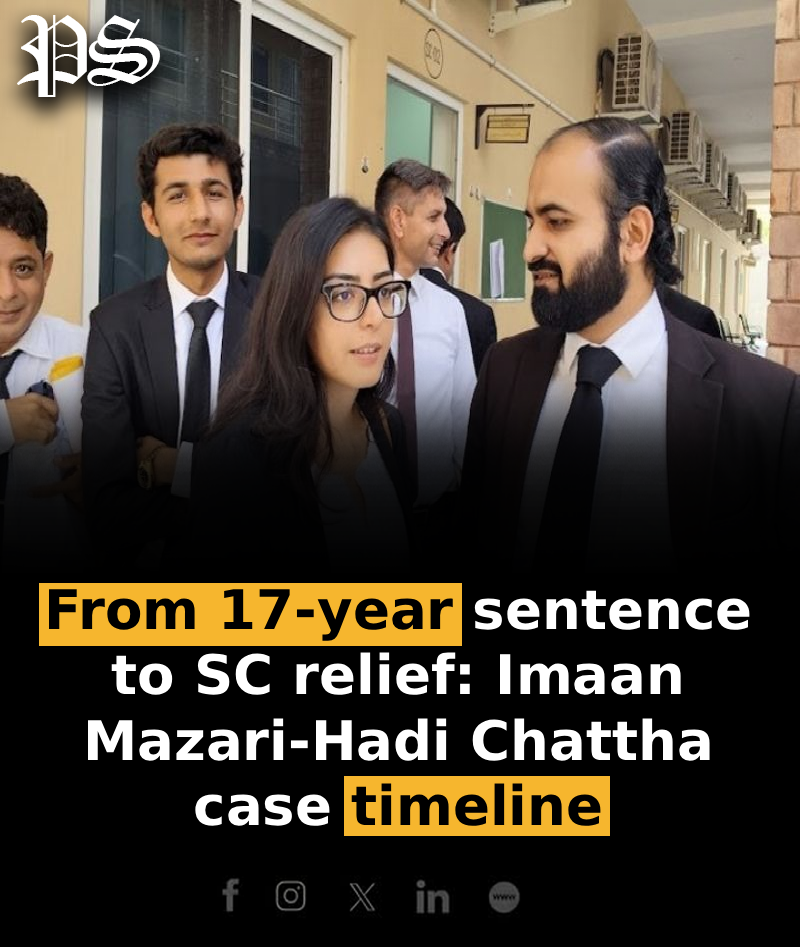
ISLAMABAD: The legal proceedings against human rights lawyer and activist Imaan Zainab Mazari-Hazir and her husband and lawyer Hadi Ali Chattha, have stretched for more than a year, beginning with a National Cyber Crime Investigation Agency (NCCIA) complaint in August 2025 and culminating, so far, in the Supreme Court’s decision on Thursday to grant them bail and suspend the effect of their 17-year sentences in the controversial social media posts case, pending proceedings before the Islamabad High Court.
The case centres on social-media posts that the prosecution alleged promoted narratives associated with hostile or proscribed groups, criticised the security forces and sought to create divisions on linguistic grounds.
Mazari and Chattha denied the allegations and challenged the proceedings at several stages, arguing, among other things, that their right to a fair trial had been compromised.
The couple were ultimately sentenced by an Islamabad sessions court to 17 years each, with the sentences to run concurrently, under Sections 9, 10 and 26-A of the Prevention of Electronic Crimes Act (Peca).
Their conviction triggered criticism from lawyers, rights groups and UN experts, while government representatives defended the judicial process.
Aug 12, 2025 — NCCIA registers the case
The controversy that led to the convictions began with a complaint registered on August 12, 2025 by an NCCIA investigating officer in Islamabad.
According to the prosecution’s case, Mazari had disseminated and “propagated narratives that align with hostile terrorist groups and proscribed organisations”. Chattha was implicated primarily over reposting some of her social-media posts.
The FIR alleged that the couple had held security forces responsible for cases involving missing persons in Khyber Pakhtunkhwa and Balochistan and had portrayed the armed forces as ineffective against proscribed groups including the Baloch Liberation Army (BLA) and Tehreek-i-Taliban Pakistan (TTP).
The case was registered under Sections 9, 10, 11 and 26 of Peca.
Sept 2025 — couple obtains pre-arrest bail
On September 8/9, an Islamabad sessions court granted Mazari and Chattha interim pre-arrest bail, restraining the cybercrime agency from arresting them while it sought the agency’s response.
On September 11/12, the court confirmed the pre-arrest bail after hearing arguments from both sides.
The defence argued that the sections invoked in the FIR did not apply and that, in Chattha’s case, the allegation essentially concerned the reposting of one of Mazari’s posts. The defence also argued that some of the material related to an earlier period. The prosecution opposed the bail and maintained that the tweets were attributable to the couple.
Oct 29, 2025 — Hadi Chattha arrested outside court
The case took a dramatic turn on October 29, when Chattha was arrested outside an Islamabad courtroom.
Additional District and Sessions Judge Muhammad Afzal Majoka issued an arrest warrant after finding that Chattha had not appeared before the court at the required time and cancelled his bail bonds. Mazari publicly objected to the arrest, saying her husband had appeared in court.
Oct 30 — couple indicted
The following day on October 30, an Islamabad district and sessions court indicted both Mazari and Chattha.
The prosecution accused them of attempting to create divisions on linguistic grounds through social-media posts and of creating the impression that the armed forces were engaged in terrorism within Pakistan.
Both denied the charges.
Nov 5–6 — arrest warrants, then withdrawal
On November 5, the trial court issued non-bailable arrest warrants for both after they failed to appear at a hearing. Chattha also expressed lack of confidence in the trial proceedings.
The following day, however, the court withdrew the warrants. The defence challenged aspects of the proceedings, including the appointment of state counsel.
Nov 28 — acquittal plea and dispute over defence counsel
On November 28, Chattha sought acquittal in the case.
The defence also objected to the appointment of state counsel and questioned the circumstances surrounding the withdrawal or appointment of lawyers representing the couple. Mazari raised concerns about an application attributed to one of their lawyers seeking removal from the case.
Dec 4-5 — defence witnesses and distrust petition
On December 4, the Islamabad sessions court rejected Mazari’s application seeking acquittal. It also rejected an application challenging the appointment of state counsel.
On Dec 5, Mazari and Chattha submitted a list of defence witnesses. Chattha also sought permission for both accused to record their statements under Section 342 of the Criminal Procedure Code and to produce defence witnesses.
The same day, the couple filed an application expressing lack of confidence in the trial judge and seeking transfer of the case to another court. The petition alleged that transparency requirements were not being met.
Dec 11 — Supreme Court stays trial proceedings
The proceedings then reached the Supreme Court.
On Dec 11, a three-member SC bench headed by Justice Muhammad Hashim Khan Kakar, with Justice Salahuddin Panhwar and Justice Ishtiaq Ibrahim, ordered a stay of the trial proceedings until the Islamabad High Court decided the relevant pending matter.
The defence had argued that prosecution witnesses had been examined in circumstances that raised questions about the accused’s presence and right to a transparent trial. The Supreme Court stressed the importance of a fair process.
Dec 16–17 — IHC orders witnesses to be recorded afresh
On December 16, the Islamabad High Court directed the trial court to record the prosecution witnesses’ statements afresh within three days.
Justice Muhammad Azam Khan issued the order while hearing Mazari’s petition against the trial court’s November 19 proceedings, during which prosecution witnesses had been examined.
The IHC made clear that its direction did not address the merits of the allegations but was concerned with the procedure followed in recording the evidence. The trial court subsequently began recording the witnesses’ statements again.
Dec 23 — tense courtroom exchange
On December 23, proceedings became particularly tense when lawyers representing the prosecution and defence nearly came to blows after a heated exchange.
Jan 5–7, 2026 — cross-examination and DG ISPR request
In early January, the defence continued cross-examination of prosecution witnesses.
On January 7, Mazari and Chattha asked the trial court to summon the DG ISPR as a defence witness.
Their case was that the witness could assist the court in determining questions arising from the allegations concerning the military and the social-media material.
Jan 15 — bail cancelled and right of cross-examination withdrawn
On January 15, the trial court cancelled the couple’s bail after they failed to appear before it.
Additional District and Sessions Judge Afzal Majoka also terminated their right to cross-examine prosecution witnesses.
The judge ordered their arrest and production before the court.
Jan 16–17 — arrest orders and warrants reissued
On January 16, the trial court directed the Islamabad police to arrest Mazari and Chattha within 24 hours.
The judge warned that failure to execute the order could lead to contempt proceedings.
On January 17, non-bailable warrants were reissued after the couple again did not appear before the court.
Jan 19–21 — protective bail and restoration of defence rights
The couple challenged the arrest orders before the IHC.
On January 19/20, the IHC granted protective relief, allowing them to appear before the court.
On January 20, Justice Muhammad Azam Khan restored their bail and reinstated their right of defence, suspending the trial court’s earlier orders. The court also directed that cross-examination be completed within three days.
On January 21, the IHC granted them pre-arrest bail in another case relating to a July 2025 Baloch Yakjehti Committee protest.
Jan 22 — couple takes refuge at IHC Bar office
As police moved to arrest them in connection with another case, Mazari and Chattha took refuge at the Islamabad High Court Bar Association president’s office, where they spent the night after an arrest warrant was issued against them.
The IHC subsequently granted them bail in the BYC-related case.
Jan 23 — arrest near Serena Hotel
On January 23, the couple were arrested near the underpass outside the Serena Hotel while travelling towards the district courts.
The arrest was in a separate case concerning a protest outside the IHC and an alleged scuffle with the IHC Bar Association president.
An anti-terrorism court subsequently sent them on 14-day judicial remand.
The arrest prompted protests and criticism from sections of the legal fraternity, journalists and rights groups, who raised concerns about the treatment of the lawyers and their right to a fair trial.
Jan 24 — 17-year sentences
One day after their arrest in the separate case, the Islamabad sessions court delivered its verdict in the social-media case.
Mazari and Chattha were sentenced to 17 years each, with the sentences running concurrently:
Five years each under Section 9 of Peca, relating to glorification of an offence, plus a Rs5 million fine each; 10 years each under Section 10, relating to cyberterrorism, plus a Rs30 million fine each and two years each under Section 26-A, relating to false and fake information, plus a Rs1 million fine each.
The total prison term for each accused was therefore 17 years, while the combined fines amounted to Rs72 million. The court acquitted them of the Section 11 hate-speech charge.
The court said the prosecution had proved its case. The couple, however, had boycotted the proceedings after appearing through video link and raising objections concerning their treatment in custody and the conduct of the proceedings.
Jan 25–Feb 2026 — national and international reaction
The convictions triggered strong reactions from lawyers, civil-society organisations, political figures and rights groups.
UN special-procedure experts had already communicated concerns to the Pakistani government in December 2025, saying they had received allegations concerning repeated prosecutions, arrests, fair-trial violations, threats and intimidation against Mazari and Chattha in connection with their work as lawyers and human-rights defenders.
Following the conviction, UN experts publicly raised concerns about the 17-year sentences and the implications for freedom of expression and the work of human-rights defenders.
Feb 7 — appeals filed in IHC
On February 7, Mazari and Chattha filed separate criminal appeals before the Islamabad High Court challenging their convictions.
They asked the IHC to set aside the trial court’s Jan 24 judgment and also sought suspension of their sentences pending disposal of their appeals.
Feb 19 — IHC issues notices but does not suspend sentences
On February 19, the IHC admitted the appeals for consideration and issued notices to the NCCIA.
The court also issued notices on their applications seeking suspension of their sentences, but did not suspend the sentences at that stage.
March 2 — IHC appeal bench dissolved
On March 2, the IHC dissolved the bench hearing the couple’s appeals and directed that the matter be placed before the chief justice for constitution of a new bench.
This further complicated the proceedings against the couple.
April–May — couple approaches Supreme Court
In late April, Mazari and Chattha approached the Supreme Court seeking an early hearing of their challenge to the IHC’s February 19 order.
The couple argued that although the IHC had issued notices, their applications for suspension of sentence had not been decided.
On May 12, a three-member Supreme Court bench headed by Justice Shahid Waheed directed the IHC to decide the couple’s applications seeking suspension of sentence within two weeks.
The SC kept the matter pending before itself until the high court reached a decision.
June — repeated delays
The IHC proceedings did not conclude within the period set by the Supreme Court.
On June 1, the IHC adjourned the sentence-suspension applications because members of the special prosecution team were unavailable.
In June, the NCCIA also challenged the Supreme Court’s May 12 direction, arguing that the authority to decide sentence-suspension applications rested with the high court and that the SC should not interfere while the matter was pending there.
On June 17, the couple again approached the Supreme Court seeking an early hearing of their challenge to the IHC’s Feb 19 order.
July 2026 — maintainability becomes another issue
The IHC fixed the sentence-suspension applications for hearing on July 24.
At the same time, the Supreme Court also listed the matter for July 21, creating an issue concerning parallel proceedings in the two courts.
On July 21, the SC adjourned the proceedings after hearing arguments about whether the matter should continue while the IHC was seized of the applications.
On July 24, the IHC reserved its decision on whether the sentence-suspension applications were maintainable. The NCCIA had argued that the applications were premature.
On July 25/26, however, Justice Muhammad Azam Khan rejected the prosecution’s objection and declared the applications maintainable/admissible, clearing the way for the high court to consider the suspension requests on their merits.
Aug 20–21 — SC questions delay
The matter returned to the Supreme Court in August.
A two-member bench comprising Justice Naeem Akhtar Afghan and Justice Ishtiaq Ibrahim questioned the continuing delay.
Justice Afghan remarked that the “system should be fully exposed” after defence counsel expressed concern that the matter could continue disappearing from the court schedule.
The defence told the SC that its May 12 order directing the IHC to decide the suspension applications within two weeks had not been implemented. The government side maintained that the IHC had its own procedure for fixing cases.
The SC adjourned the matter until Sept 17.
Sept 4 — early-hearing application disposed of by IHC
On September 4, the IHC disposed of miscellaneous applications seeking an early hearing because the main sentence-suspension petitions had already been fixed for Sept 8.
Sept 8 — hearing adjourned again
On September 8, the IHC was due to hear the sentence-suspension applications.
However, the NCCIA prosecutor was unavailable, and no substantial proceedings could take place.
Justice Muhammad Azam Khan consequently adjourned the matter until Sept 23.
That meant the couple’s applications for suspension of their sentences remained undecided despite the Supreme Court’s earlier direction.
Sept 17 — Supreme Court grants bail and suspends sentences
On Thursday, September 17, the Supreme Court finally intervened directly.
A two-member bench comprising Justice Naeem Akhtar Afghan and Justice Ishtiaq Ibrahim heard the couple’s plea.
The SC granted bail to Imaan Mazari-Hazir and Hadi Ali Chattha pending the final decision of the IHC and ordered their release against surety bonds of Rs200,000 each.
Justice Afghan said that both applicants were lawyers and that the court was respecting their dignity, while also stressing that they should observe the decorum of the court.
The government opposed the relief, arguing that the IHC had not yet decided the matter and that Section 426 provided the high court with the relevant jurisdiction to suspend a sentence.
Justice Afghan, however, questioned the repeated adjournments before the IHC and referred to the earlier Supreme Court direction requiring the high court to decide the matter within two weeks.
The Supreme Court’s latest order therefore changes the immediate position of the couple: they are to be released on bail while the IHC proceedings on their appeals and sentence suspension continue.
The IHC’s next scheduled hearing on the sentence-suspension applications is September 23, although the effect of Thursday’s Supreme Court order will now have to be reflected in those proceedings.
PAK SOUCH MEDIA GROUP
Daily Pak Souch Newspaper Sukkur – Daily Pak Special Newspaper Karachi – Daily Pak Today Newspaper Karachi – Daily Pak Jazbo Newspaper Sukkur
Head Office : Ayub Gate Shaikh Muhalla Near Rabbania Masjid Sukkur
Karachi Office : Office No. 1901-B, 19th Floor Saima Trade Tower (B) Block I.I Chandigarh Road Near Jung Press, Shaheen Complex & National Museum of Pakistan Karachi Sindh Pakistan.
Contact : 03009319022
Website 1 : https://paksouch.com/
Website 2 : https://sindhi.paksouch.com/
Website 3 : https://pakjazbo.com/
Website 4 : https://urdu.pakjazbo.com/
About The Author