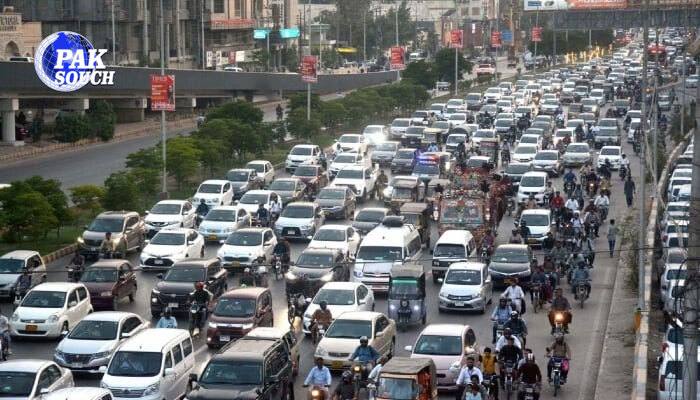
In an effort to improve traffic flow and road safety, Karachi authorities have decided to once again allocate separate lanes for motorcycles and buses on Shahrah-e-Faisal, one of the city’s busiest and most important thoroughfares.
According to Deputy Inspector General (DIG) Traffic Pir Muhammad Shah, the decision has been finalized as part of broader measures to enhance traffic discipline and reduce congestion on key roads. Shahrah-e-Faisal, which connects major commercial and residential areas of Karachi, experiences heavy daily traffic, including a high volume of motorcycles, public transport buses, and private vehicles.
The initiative aims to streamline traffic movement by clearly separating different types of vehicles, thereby minimizing lane violations, reducing accidents, and improving overall road efficiency. Motorcycles, which make up a large portion of Karachi’s daily commuters, often share lanes with larger vehicles, increasing the risk of accidents. Similarly, buses frequently stop or maneuver unpredictably, disrupting traffic flow.
By assigning specific lanes for motorcycles and buses, traffic authorities hope to create a more organized system where each category of vehicle operates within defined boundaries. This approach has been tested in the past on Shahrah-e-Faisal and other major roads in Karachi, with mixed results due to inconsistent enforcement and public compliance.
DIG Traffic Pir Muhammad Shah emphasized that this time, stricter enforcement mechanisms will be implemented. Violations of the designated lanes will be monitored through surveillance cameras, and offenders will be issued e-challans (electronic fines). This digital enforcement is expected to reduce human intervention and improve transparency in traffic management.
Officials believe that the use of technology, including automated monitoring systems, will play a crucial role in ensuring compliance. Drivers who fail to adhere to the new lane rules may face penalties, which authorities hope will act as a deterrent against reckless driving and lane indiscipline.
The move is part of a broader campaign by Karachi’s traffic police to improve road discipline across the city. In recent months, several initiatives have been introduced, including setting speed limits on major roads, installing new traffic signage, and increasing the presence of traffic personnel during peak hours.
Traffic congestion remains one of Karachi’s most pressing urban challenges. With a rapidly growing population and increasing number of vehicles on the roads, managing traffic has become increasingly complex. Shahrah-e-Faisal, in particular, serves as a critical artery connecting the airport to the city center, making it a focal point for traffic management efforts.
Urban planners and traffic experts generally support the idea of dedicated lanes, noting that such measures can significantly improve road safety if properly implemented. However, they also stress that success depends on consistent enforcement, public awareness, and infrastructure adjustments such as clear lane markings and proper signage.
Past attempts at implementing dedicated lanes in Karachi have faced challenges, including encroachments, lack of driver awareness, and weak enforcement. Authorities now appear determined to address these issues by combining policy measures with technological solutions.
Residents and commuters have expressed cautious optimism about the initiative. While many acknowledge the potential benefits, they also emphasize the need for sustained implementation and strict action against violators to ensure long-term success.
If effectively enforced, the reintroduction of separate lanes for motorcycles and buses on Shahrah-e-Faisal could mark a significant step toward improving Karachi’s traffic system, enhancing commuter safety, and reducing travel time on one of the city’s most vital roads.