


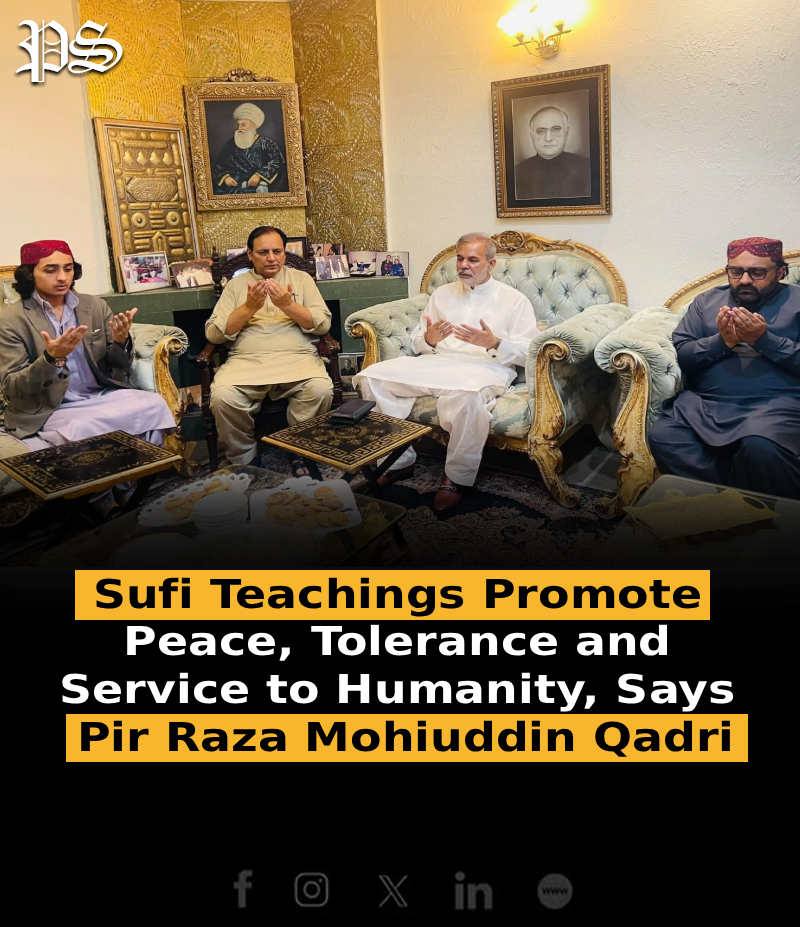
KHAIRPUR: Central Senior Vice President of the Pakistan International Mashaikh Council, Pir Sardar Raza Mohiuddin Qadri, has said that the spiritual guidance associated with shrines and Khanqahs plays an important role in promoting religious teachings, tolerance, harmony and service to humanity.
He said that saints and Sufi elders had, through their practical lives and teachings, demonstrated the values of love, patience, brotherhood, compassion and humanity. According to him, these values remain highly relevant in the present era, particularly at a time when societies are facing challenges including intolerance, extremism, sectarianism and social divisions.
Pir Raza Mohiuddin Qadri expressed these views while meeting and offering condolences to personalities belonging to different schools of thought who had gathered following the death of his brother, Sardar Arshad Rafiq Khan.
The gathering also provided an opportunity for people from different religious and social backgrounds to express their condolences and solidarity with the bereaved family. Pir Raza Mohiuddin Qadri thanked those who visited and offered prayers for the departed soul.
According to the Central Spokesperson of the Pakistan International Mashaikh Council, Pir Raza Mohiuddin Qadri said that the Council was continuing its series of meetings with custodians and Sajjada Nashins of shrines and Khanqahs across different areas.
He said that the purpose of these meetings was to strengthen cooperation among custodians of spiritual centers and explore ways to promote the peaceful teachings and traditions associated with the saints and Sufi elders.
The Council is also making efforts to organize programmes during annual Urs celebrations and other events held at various shrines, he said. Such programmes, according to Pir Raza Mohiuddin Qadri, could provide an important platform for conveying messages of peace, unity, brotherhood and respect to people from different communities.
He stressed that spreading the teachings and philosophy of the saints was an urgent need in the present era. He said that society could address problems such as sectarianism, extremism, hatred and intolerance by promoting the principles of compassion, mutual respect and peaceful coexistence taught by the Sufi tradition.
Pir Raza Mohiuddin Qadri emphasized that Islam does not permit hatred, violence or injustice. He said that the Holy Quran and the Sunnah of the Holy Prophet Muhammad ﷺ provide guidance on kindness toward humanity, justice, mercy, patience and tolerance.
He said that these teachings should be presented to younger generations in a way that encourages them to develop positive attitudes toward other members of society.
According to him, the Khanqahs and shrines of saints have historically served as centers where people were encouraged to live together peacefully and respect one another. The message associated with Sufi saints, he said, transcended differences of colour, race, language, sect and religion.
He noted that many Sufi saints devoted their lives to serving humanity without discrimination. Their teachings emphasized that human dignity and compassion should remain central to social life.
The Council leader said that these principles could play an important role in strengthening social cohesion in Pakistan. He stressed that sustainable development and national prosperity could not be achieved without peace, stability and mutual respect within society.
He called for concerted efforts to eliminate hatred, prejudice, sectarianism, extremism and intolerance. He said that religious and social leaders had a responsibility to guide communities toward peaceful coexistence and discourage attitudes that create divisions among citizens.
Pir Raza Mohiuddin Qadri also highlighted the importance of educating the younger generation. He said young people should be introduced to the values of peace, knowledge, morality, tolerance and positive thinking.
He expressed the hope that a generation equipped with knowledge and strong moral values would be better prepared to contribute positively to Pakistan’s future. Young people, he said, could play an effective role in the country’s development and progress if they were provided with constructive guidance and opportunities.
He further urged citizens to promote mutual love, respect, tolerance and brotherhood in their daily lives. He advised people to avoid hateful speech, provocative statements and unverified rumours, which he said could contribute to social tension and misunderstanding.
The Council leader also called on religious scholars, spiritual leaders and community representatives to use their influence to promote peace and discourage extremism and intolerance.
He said that religious and spiritual institutions could make an important contribution to creating a peaceful social environment by emphasizing the universal values of compassion, justice, forgiveness and service.
Pir Raza Mohiuddin Qadri maintained that Pakistan’s stability and prosperity required collective efforts from all segments of society. Citizens, religious scholars, political and social leaders and educational institutions all had a role to play in promoting tolerance and strengthening national unity.
He urged people to rise above differences and work together for the peace, security and prosperity of the country. He said that mutual respect and brotherhood should be strengthened while attempts to spread hatred and division should be rejected.
Concluding his remarks, Pir Raza Mohiuddin Qadri reiterated the importance of the teachings of the saints and Sufis in addressing contemporary social challenges. He said that the message of love, humanity, tolerance and service remained relevant and could contribute significantly to building a peaceful and harmonious society.
He called upon citizens to make positive contributions to their communities, respect differences and avoid actions or statements that could create conflict.
According to him, promoting the peaceful teachings of the saints was not only a religious responsibility but also an important social need for building a tolerant, stable and prosperous Pakistan.
About The Author