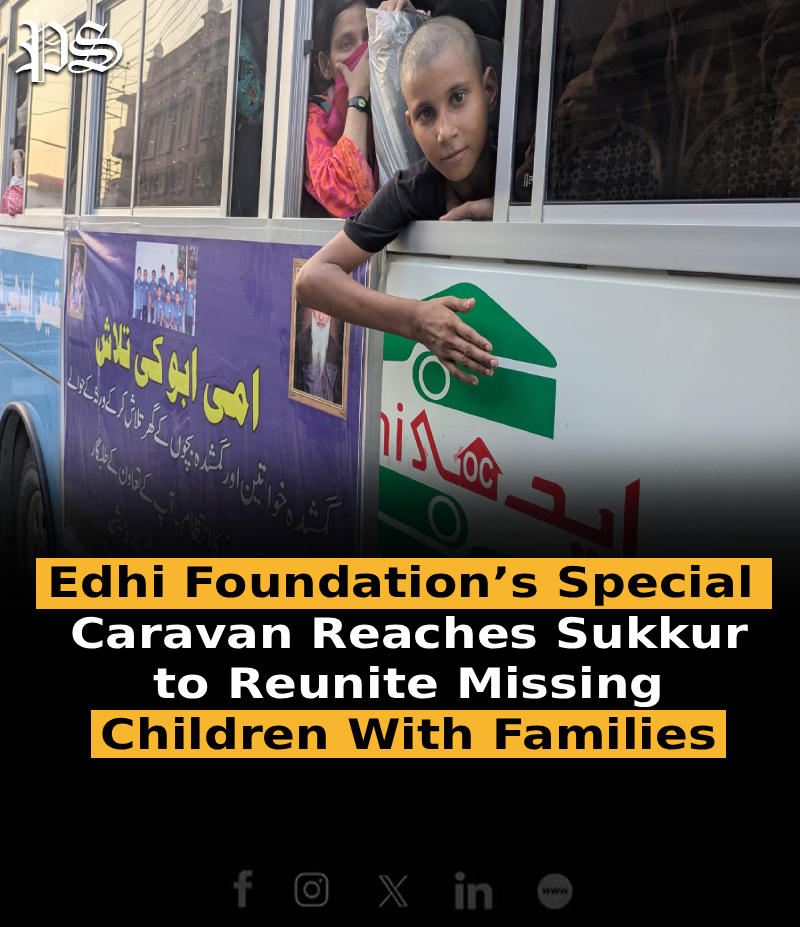
SUKKUR — Report by Danish Rajput: A special caravan organized by the Edhi Foundation as part of its ongoing mission to reunite missing children with their parents and families has reached Sukkur after travelling from Karachi through several cities.
The caravan, which departed from Karachi under the supervision of Faisal Edhi, is carrying 25 missing boys and girls who are being taken to different locations across the country in an effort to reconnect them with their loved ones.
Upon reaching Sukkur, the caravan was welcomed at the Edhi Home on Bandar Road by Gul Mehr and other representatives and officials associated with the Edhi Foundation. The arrival marked another important stage in the foundation’s continuing effort to trace families and return missing children to their homes.
During the caravan’s stay in Sukkur, children belonging to different parts of interior Sindh were identified and handed over to their parents and family members. The reunions provided emotional moments for the families, many of whom had been waiting for the safe return of their children.
The initiative is part of the Edhi Foundation’s long-running humanitarian efforts to help missing and abandoned children reconnect with their families. Through its welfare network, the organization works to provide shelter, care and assistance to vulnerable children while efforts are made to identify their families.
The special caravan has been travelling across different cities with the objective of completing these family reunions. After its stop in Sukkur, the caravan is scheduled to travel onward to Sadiqabad, Rahim Yar Khan, Multan and Faisalabad.
At each location, efforts will be made to hand over children to their parents and relatives after appropriate identification and verification procedures. The caravan will then continue its journey toward Islamabad, where the special mission is expected to conclude.
The initiative has highlighted the importance of coordinated efforts to locate missing children and facilitate their safe return to their families. For parents, the disappearance of a child can be an extremely distressing experience, and the process of tracing and reuniting families can provide much-needed relief.
The arrival of the caravan in Sukkur was particularly significant for families from interior Sindh. Children who had been separated from their families were reunited with their parents, bringing an emotional conclusion to their period of separation.
Representatives of the Edhi Foundation said the organization remains committed to helping vulnerable children and supporting families in difficult circumstances. The foundation
About The Author