

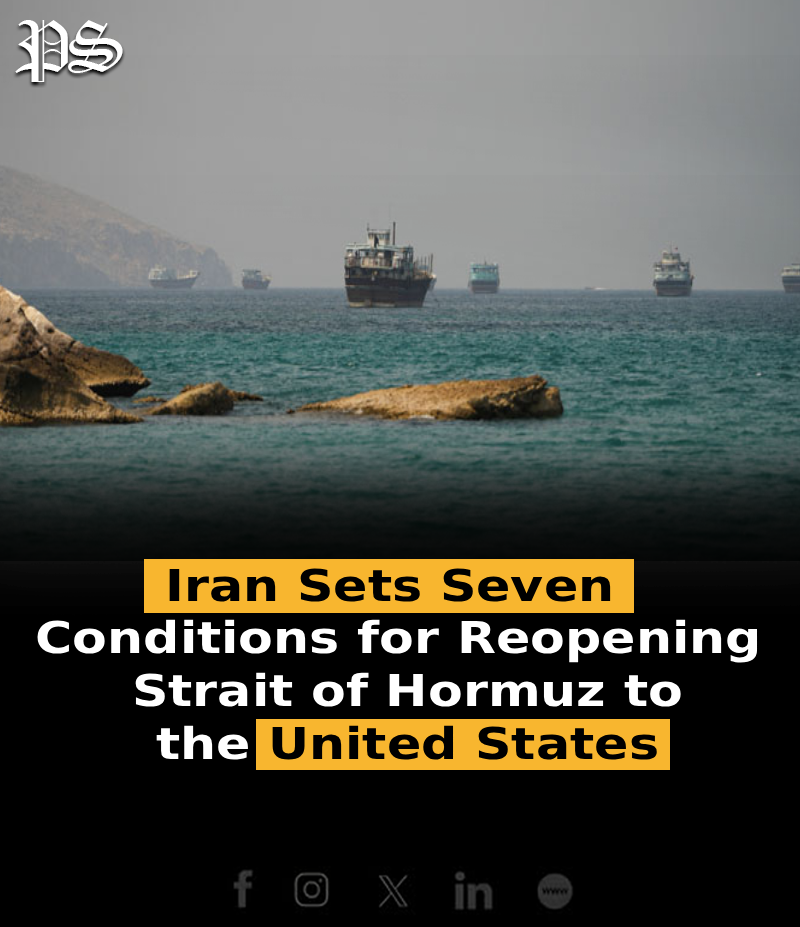
TEHRAN: Iran has reportedly presented the United States with seven conditions for reopening the Strait of Hormuz, while making it clear that an agreement reached with Oman on Monday would not result in the immediate reopening of the strategic waterway.
According to Russian media reports, Iran has conveyed seven conditions to the United States through intermediaries. The specific details of the conditions have not been made public, but Iranian authorities have reportedly made it clear that the Strait of Hormuz will remain closed unless Washington agrees to and fulfills the conditions put forward by Tehran.
The development adds another layer of complexity to the ongoing tensions surrounding one of the world’s most strategically important maritime routes. The Strait of Hormuz is a critical passage connecting the Persian Gulf with the Gulf of Oman and the wider Arabian Sea, making any disruption to traffic through the waterway a matter of international concern.
Russian media reports said that Iranian officials had communicated their position through mediators involved in diplomatic efforts between Tehran and Washington. Although the exact nature of the seven conditions remains undisclosed, Iran has reportedly insisted that the conditions must be fulfilled before the waterway can be reopened.
The Iranian position indicates that Tehran is linking the reopening of the strait to broader political and security arrangements rather than treating the issue as a separate maritime matter. The conditions could therefore become an important element in any future negotiations aimed at reducing tensions in the region.
Iran’s Foreign Ministry has also announced that Tehran will host a meeting in Muscat on Monday, with representatives from Iraq and several Gulf countries expected to attend. The meeting is intended to provide participating countries with information about the proposed alternative route and the arrangements for transit.
The involvement of regional countries indicates that Iran is seeking to coordinate the new transit arrangements with neighboring states and ensure that they are informed about the route and related procedures.
Under an agreement reached between Iran and Oman, the entry route into the Persian Gulf will pass entirely through Iranian waters, while the exit route from the Persian Gulf will pass partially through Iranian waters.
The transit movement will reportedly take place under Iranian protocols. According to the information provided, the southern route that the United States has been insisting on opening will remain closed.
The proposed arrangement could have significant implications for maritime transportation in the Gulf region. Any restrictions affecting movement through the Strait of Hormuz can attract international attention because of the waterway’s importance to global shipping and energy markets.
Iran’s decision to present conditions through intermediaries also suggests that diplomatic channels remain active despite the continuing tensions. Regional countries, including Oman and Iraq, have historically played roles in facilitating communication between opposing sides and could become important participants in efforts to resolve the current dispute.
The meeting in Muscat is expected to provide an opportunity for regional representatives to receive further details about the transit system and understand how the proposed routes would operate under Iranian protocols.
The decision to keep the southern route closed is particularly significant because Washington has reportedly been pressing for its reopening. Iran’s position indicates that it does not intend to accept the opening of that route without broader agreement on the terms governing maritime movement.
The lack of publicly disclosed details about Iran’s seven conditions leaves considerable uncertainty over what Tehran is seeking in exchange for reopening the waterway. Until the conditions are formally made public, it remains unclear whether they relate primarily to security arrangements, political commitments, sanctions, maritime access or other issues.
Nevertheless, Iran’s statement that the Strait of Hormuz will not be reopened unless the conditions are met demonstrates the seriousness with which Tehran is approaching the issue.
For the United States and other countries dependent on stable maritime traffic through the region, the development could become an important diplomatic and economic concern. Any prolonged uncertainty surrounding the strait has the potential to influence shipping decisions and regional energy security.
At the same time, Iran’s decision to involve Oman, Iraq and Gulf states in discussions about transit arrangements suggests an effort to develop a regional framework for managing movement in and around the waterway.
The forthcoming meeting in Muscat could therefore become an important step in clarifying Iran’s proposed arrangements and the role of neighboring countries. Representatives are expected to receive information about the alternative route and the procedures required for transit.
The Iranian Foreign Ministry’s announcement also indicates that Tehran wants regional countries to understand the proposed system directly rather than relying solely on information communicated through international mediators.
As diplomatic contacts continue, attention is likely to remain focused on the seven conditions reportedly presented to the United States and whether Washington will respond positively to them. The details of those conditions could ultimately determine whether progress is made toward reopening the Strait of Hormuz.
For now, Iran has made its position clear: the waterway will not be reopened simply as a result of the agreement with Oman. Tehran has tied reopening the strategic passage to the fulfillment of conditions communicated to the United States.
The coming discussions in Muscat may therefore prove crucial in determining the next stage of the dispute. Regional governments, international shipping operators and global energy markets will be closely watching developments as Iran, the United States and neighboring countries seek a way forward.
About The Author