

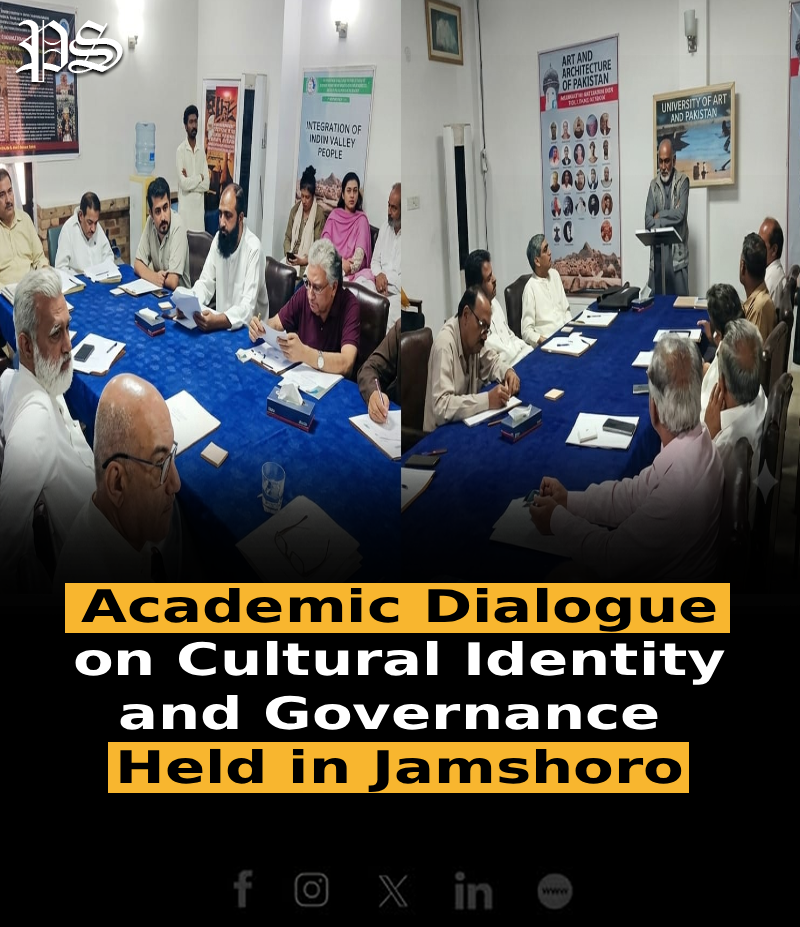
HYDERABAD (Report: Mehboob Hussain Buzdar): An academic dialogue on “Cultural Identity and Governance in Pakistan” was held at the University of Art and Culture in Jamshoro, bringing together more than 20 professors, writers and academics from different educational institutions across Sindh.
The dialogue focused on Pakistan’s current political, social and cultural challenges, with participants emphasizing the importance of constitutional supremacy, federalism, good governance, cultural freedom and respect for the distinct identities of the country’s federating units.
Speakers said that Sindh, Punjab, Balochistan and Khyber Pakhtunkhwa each have their own rich historical and cultural identities. They argued that these identities should be respected and protected within the constitutional framework of Pakistan.
During the discussion, participants also expressed the view that any attempt to divide Sindh was unconstitutional and unethical. Professors and intellectuals discussed the historical unity of Sindh and shared their perspectives on the importance of protecting its cultural and territorial identity.
The objective of the academic dialogue was to examine emerging issues, crises and contemporary challenges facing Pakistan through academic, research-based and intellectual perspectives. The event also aimed to bring different scholarly viewpoints together on a common platform and encourage meaningful discussion about possible solutions.
Around 20 professors associated with various universities and colleges in Sindh participated in the dialogue. Among those attending were Professor Mushtaq Mirani, Professor Ejaz Qureshi, Professor Imdad Chandio, Professor Riaz Sheikh, Professor Abdul Majeed Chandio, Professor Ameer Ali Chandio, Professor Farman Ali Shah, Professor Shuja Mehser, Professor Saleh Muhammad, Professor Sher Khan Selro, Professor Abdullah Mallah, Professor Badr Soomro, Professor Manzoor Solangi, Professor Anwar Mansoor Mangi, Professor Ahmed Khayam, Professor Inam Bhatti, Professor Hussam Mirani, Professor Sohaib Ahmed, Professor Jalal Kori, Professor Hafeez Dayo, Professor Nazir Mahmood, Professor Yaqub Chandio and Professor Abdul Ghaffar Gohar Dautpoto, among others.
Eight major themes were discussed during the dialogue. These included cultural identity, national unity, good governance, cultural and intellectual freedom, current crises affecting the state and society, the role of young people, and emerging problems and challenges facing Pakistan.
Speakers said the primary purpose of such an academic forum was to promote meaningful and constructive dialogue among intellectual and academic circles. They stressed the importance of understanding the different dimensions of Pakistan’s cultural and national identity and addressing contemporary challenges through constitutional and democratic means.
The participants also expressed concern over social divisions, cultural tensions, misinformation, prejudice, hostility and hate-based discourse. They emphasized that these issues should be addressed through education, intellectual debate, constitutional institutions and respect for public opinion.
According to the speakers, strengthening the federation and ensuring the supremacy of the Constitution are essential for creating an environment in which citizens can express their views peacefully and participate meaningfully in national affairs.
The professors also presented their views and recommendations regarding the historical unity of Sindh, the rule of law and constitutional principles. They emphasized that cultural identities should be treated as an important part of Pakistan’s diversity rather than as a source of conflict.
The discussion also highlighted the role of young people in addressing Pakistan’s future challenges. Participants said that young people should be encouraged to engage in education, research, constructive political discussion and social development.
The academics maintained that dialogue between different cultural and intellectual groups can help reduce misunderstandings and promote national cohesion. They called for greater tolerance, respect for differences and adherence to constitutional principles.
The event concluded with a renewed emphasis on academic freedom, cultural rights, democratic values and constitutional supremacy. Participants agreed that Pakistan’s complex challenges require informed debate, research and peaceful political and social engagement rather than division, hatred or confrontation.
About The Author