

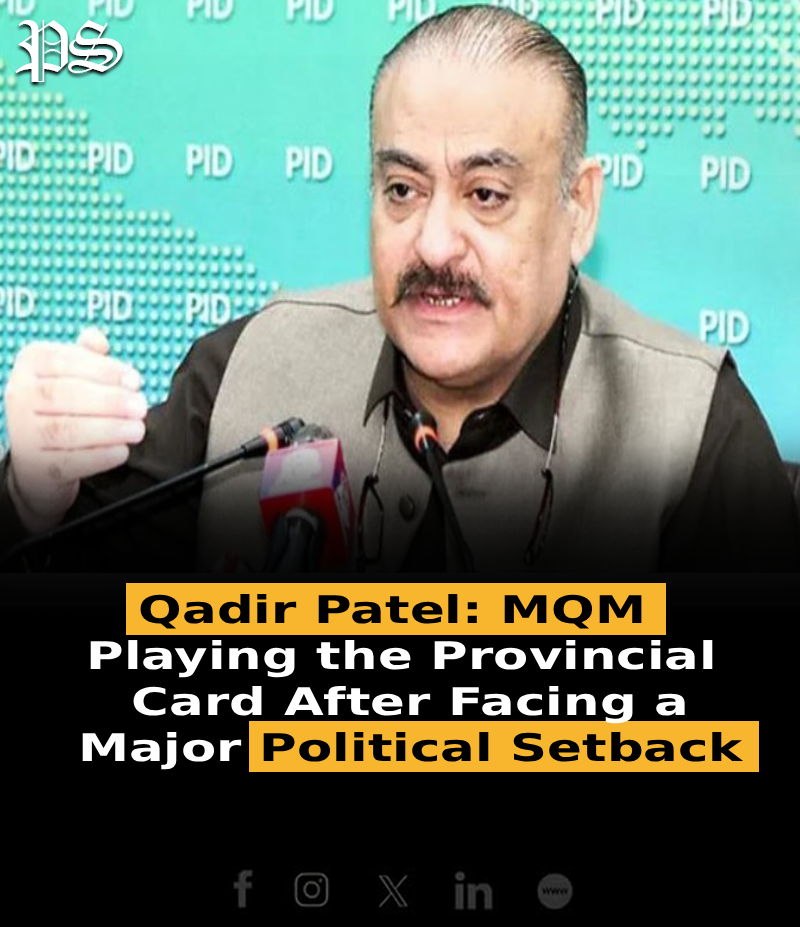
Pakistan Peoples Party (PPP) Member of the National Assembly Qadir Patel has accused the Muttahida Qaumi Movement (MQM) of resorting to the “provincial card” after suffering what he described as a major political failure.
Patel was responding to a statement by MQM leader Khalid Maqbool Siddiqui, who has once again raised the issue of creating a new province. The PPP lawmaker criticized the MQM’s political strategy and alleged that the party repeatedly turns to issues of administrative division and new provinces whenever it loses public support.
According to Patel, the MQM’s latest demand is not driven by the genuine interests of the people but is an attempt to regain political relevance. He argued that the party has historically used the demand for a separate province as a political slogan during periods when its popularity and influence were declining.
Patel said that whenever the MQM has faced a loss of public confidence, it has attempted to revive debates over political and administrative divisions. He suggested that the current situation was another example of the same strategy.
The PPP leader’s comments come amid renewed political debate over the possibility of creating new provinces in Pakistan. The question has remained politically sensitive for years, particularly in Sindh, where discussions about the creation of a separate province for Karachi or the division of Sindh have repeatedly generated strong reactions from political parties and civil society.
The MQM has traditionally maintained that Karachi’s governance and administrative problems require structural reforms. Its leadership has, at different times, advocated greater administrative and political autonomy for Karachi and discussed the possibility of a new province. Supporters of the proposal argue that Karachi’s huge population, economic importance and administrative challenges require a governance structure capable of addressing the city’s needs more effectively.
Opponents, however, including the PPP, have strongly resisted proposals that could lead to the division of Sindh. The PPP has historically presented the unity of Sindh as an important political issue and has rejected demands for a separate province based on Karachi.
Patel’s criticism reflects this longstanding political divide. By accusing the MQM of playing the “provincial card,” he framed the demand as an electoral and political tactic rather than a serious constitutional or administrative proposal.
The remarks also highlight the broader competition between the PPP and MQM over political influence in urban Sindh, particularly Karachi. Both parties have sought to establish themselves as major representatives of the city’s residents, although their political bases and approaches have differed significantly over the years.
For the PPP, the issue of Sindh’s territorial unity remains particularly important. The party has repeatedly opposed the creation of a separate province in the province and has emphasized the need to address Karachi’s problems through improved local governance, development and administrative reforms.
MQM leaders, on the other hand, have argued that Karachi’s size and economic contribution justify a stronger political and administrative structure. The party has frequently highlighted issues including municipal authority, infrastructure, public services, employment and the distribution of resources.
The latest exchange between Siddiqui and Patel therefore reflects more than a disagreement over the creation of a province. It is part of a much larger political debate over who should control Karachi’s administration, how resources should be distributed and whether Sindh’s existing administrative structure is capable of meeting the needs of its rapidly growing population.
Patel’s statement also indicates that the PPP does not view the renewed provincial demand as an isolated policy discussion. Instead, he sees it as part of the MQM’s broader political response to changing public sentiment.
The controversy is likely to remain politically significant because any proposal to create a new province requires substantial constitutional and political consensus. Such a move would involve debate in Parliament and would have major implications for Sindh’s political structure, administration and resource distribution.
While MQM leaders continue to argue that new administrative arrangements could improve governance, the PPP and other opponents maintain that dividing Sindh is not the solution to Karachi’s problems.
The latest comments from Qadir Patel have consequently added another layer to an already contentious debate. His allegation that the MQM is using the provincial issue after losing public support suggests that the PPP intends to challenge the demand politically rather than allow it to dominate the public discourse.
As the debate continues, the central questions will remain whether Karachi’s governance challenges can be resolved within the existing provincial framework, whether greater local-government powers are sufficient, or whether proponents of a new province can build the political and constitutional consensus required for such a major change.
About The Author