

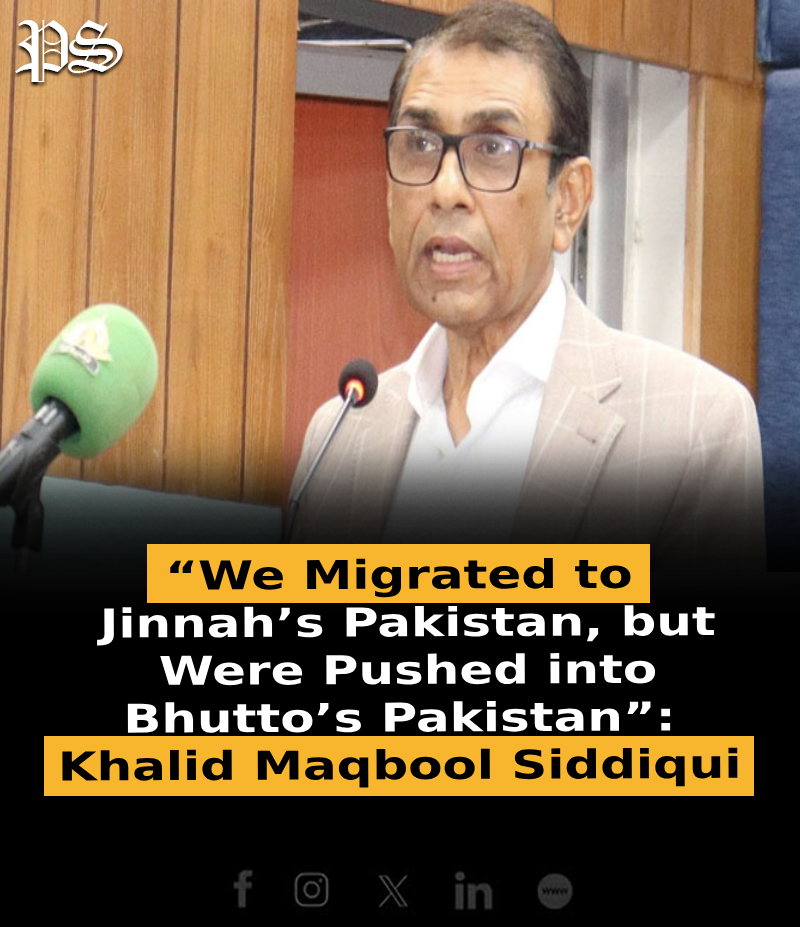
KARACHI: Muttahida Qaumi Movement-Pakistan (MQM-P) Chairman Khalid Maqbool Siddiqui has called for the creation of provinces on the basis of population, saying that provinces should remain administrative units rather than becoming a source of ethnic or political division.
Addressing a gathering in Karachi, Siddiqui said that Pakistan was the only homeland and that provinces were simply administrative units.
“The motherland is only Pakistan; provinces are only administrative units and nothing more,” he said.
The MQM-P leader claimed that the people living in the urban areas of Sindh had faced the greatest level of exploitation. He said the demand for greater administrative representation had been part of the political discourse associated with the All Pakistan Muttahida Students Organisation (APMSO) and had now become, in his words, an issue concerning the entire country.
Siddiqui said MQM-P’s first demand was that provinces should be created across Pakistan according to population.
He also referred to Article 140-A of the Constitution, which concerns local governments, and argued that greater administrative and political authority should be transferred to local institutions.
“If you give us our province, we will implement Article 140-A ourselves,” he said.
Siddiqui further claimed that his party had not been allowed to introduce a resolution against the concept of Sindhu Desh in the Sindh Assembly.
He argued that there was no need for lengthy arguments to explain why new provinces were necessary, suggesting that administrative problems and population growth had already demonstrated the need for restructuring.
In a particularly pointed remark, Siddiqui said: “We migrated to Quaid-e-Azam’s Pakistan; we were pushed into Bhutto’s Pakistan.”
His remarks reflect MQM-P’s longstanding demand for greater administrative representation for Karachi and other urban areas of Sindh.
The question of creating new provinces has periodically resurfaced in Pakistan’s political debate. Supporters argue that smaller provinces could improve governance, representation and delivery of public services, while opponentsi, however, maintained that the creation of new provinces should not be interpreted as a demand to divide Pakistan along ethnic lines. In his view, Pakistan should have raised concerns about ethnic polarization and the political consequences of redrawing provincial boundaries.
Siddiqui, however, maintained that the creation of new provinces should not be interpreted as a demand to divide Pakistan along ethnic lines. In his view, Pakistan should remain the country’s sole homeland, while provinces should function primarily as administrative units.
His comments come amid renewed political discussion over the possibility of creating additional provinces and reorganizing Pakistan’s administrative structure. The issue remains politically sensitive, particularly in Sindh, where questions surrounding representation, resources, local government and the relationship between Karachi and the provincial government have remained contentious for decades.
About The Author