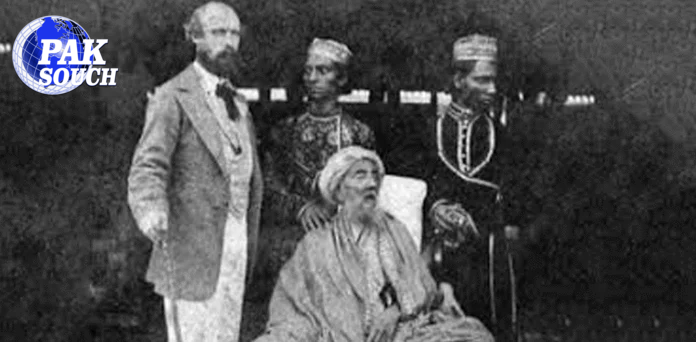
Bahadur Shah Zafar, the last Mughal emperor, is remembered not only as the symbolic head of a once-mighty dynasty but also as a poignant figure whose final years in exile were meticulously documented by British officials. Among these documents, the diary of Captain Nelson Davies stands out as a remarkable historical record. Maintained during Zafar’s imprisonment in Rangoon, these daily entries chronicle the emperor’s declining health, the meticulous care—or strict surveillance—of his captors, and ultimately, his death and burial. Over time, this diary has become an essential part of India’s historical and cultural heritage, providing an intimate glimpse into the last days of the Mughal empire.
After the 1857 revolt, Bahadur Shah Zafar and his family were transported to Rangoon as political prisoners. They lived under close supervision, and Captain Nelson Davies was assigned the charge of overseeing the emperor and other political detainees starting 1 April 1859. Davies’ diary was initially a routine administrative record sent to the Government of India, detailing the prisoners’ daily life, health, and provisions. However, the diary inadvertently became an invaluable historical source, capturing the human side of Zafar’s exile and the final chapter of Mughal rule in India.
The diary provides extensive details about the prisoners’ daily life. Davies meticulously recorded the cost and distribution of food, noting that feeding sixteen political prisoners in Rangoon cost around eleven rupees per day, significantly higher than in India. He also documented allowances given to prisoners for toiletries and other necessities, reflecting both bureaucratic control and the minimal provisions offered. Strict rules prohibited prisoners from keeping pens or paper, limiting their ability to communicate or record their experiences themselves. Despite these restrictions, Davies’ careful accounts allow modern historians to reconstruct the final period of the last Mughal emperor’s life.
Health reports dominate many diary entries. By July 1861, Davies reported to the Governor-General that while most prisoners were in reasonable health, Zafar was noticeably weakening. His personal physician had expressed concerns that the emperor’s life was uncertain. The diary also mentions the conditions of other family members, such as Zafar’s wives and children, including occasional illnesses and the birth of new offspring, illustrating how family life continued even in exile under strict supervision.
Zafar, who had once ruled with grandeur over Delhi, faced a slow decline in Rangoon. The diary portrays him as physically weak and increasingly dependent on his attendants. By October 1862, Davies began to document Zafar’s final days with heightened attention, noting a gradual deterioration in his health. Entries from 23 October onwards repeatedly describe Zafar as “weak” and struggling even to eat. By 3 November, he suffered the effects of a stroke, making swallowing difficult, and by 5 November, the chief civil surgeon expressed doubt that the emperor would survive much longer.
Finally, on 7 November 1862, Bahadur Shah Zafar passed away at 5 a.m. His burial was conducted the same day at 4 p.m. in a simple brick grave, covered with earth and leveled with the ground to ensure that no mark indicated the resting place of the last Mughal emperor. A Muslim cleric oversaw the funeral rites, and the body was placed in a coffin covered with a red cotton sheet. Family members allowed to attend included his sons Jawah Bakht and Shah Abbas, as well as his attendant Ahmed Beg, while other relatives were excluded. Davies’ diary meticulously records these arrangements, underscoring both the controlled nature of the burial and the British effort to obscure the grave.
The diary also highlights the broader historical context. Zafar’s death symbolized the definitive end of the Mughal dynasty, and the leveling of his grave reflected British colonial policies designed to erase the symbolic power of the Mughal emperors. It was only later, through efforts by the Indian Muslim community and the establishment of the Bahadur Shah Zafar Trust, that the emperor’s grave was recognized, and a proper mausoleum was constructed. Contributions from public donations eventually enabled the construction of the memorial, ensuring that Zafar’s resting place became a site of historical reverence rather than obscurity.
Historically, Bahadur Shah Zafar represents a bridge between India’s grand Mughal past and its colonial present in the 19th century. Despite losing political power, he retained immense cultural and literary significance. A poet and patron of the arts, Zafar’s court had long been a center of cultural life, a tradition he carried into exile as best as circumstances allowed. His life in Rangoon, as recorded by Davies, presents a stark contrast between the splendor of his past and the hardships of his final years, offering historians a humanized view of a ruler often reduced to mere political symbolism.
In conclusion, the diary of Captain Nelson Davies provides an extraordinary window into the last chapter of Bahadur Shah Zafar’s life. From his declining health to his carefully monitored burial, these records reveal the human and political dimensions of the final Mughal emperor’s exile. They document not only the end of a dynasty but also the resilience, dignity, and enduring cultural significance of a man who, even in captivity, remained the symbolic custodian of India’s Mughal heritage. Through these entries, history remembers Zafar not merely as a fallen emperor but as a living witness to the profound transformations of 19th-century India.