

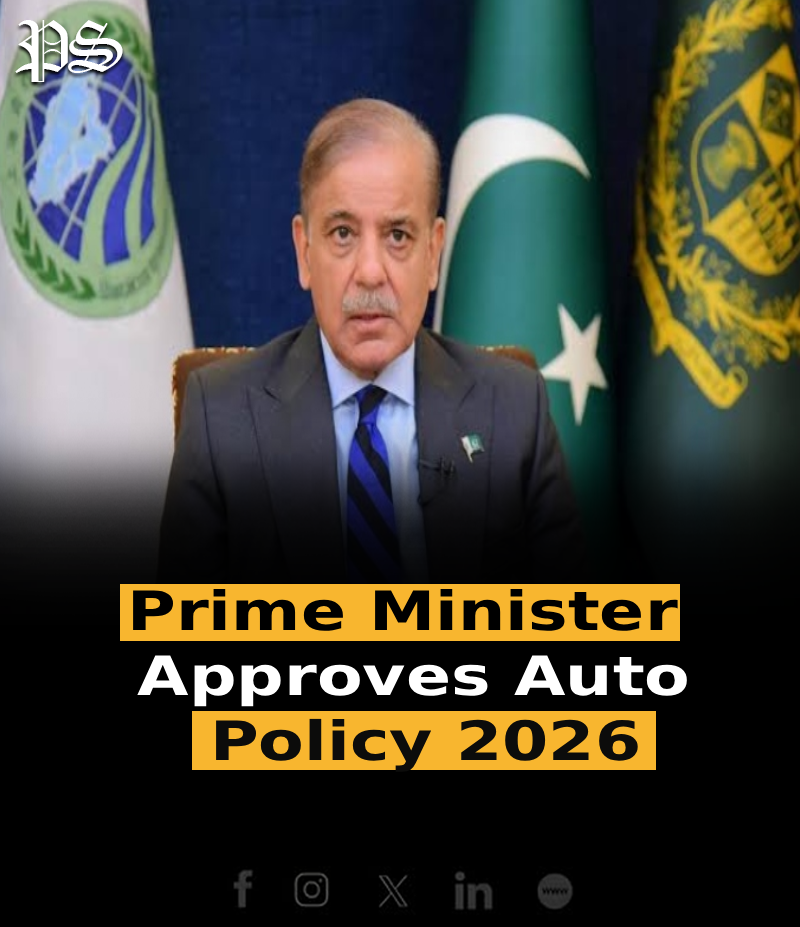
Islamabad: Prime Minister Shehbaz Sharif has approved the Auto Policy 2026, a major step aimed at strengthening Pakistan’s automotive industry, increasing exports and encouraging investment in modern vehicle technologies.
According to sources, the government plans to officially announce the policy next week after obtaining approval from the International Monetary Fund (IMF). The recommendations were prepared by a committee established to review the country’s auto-parts policy.
The proposed policy places particular emphasis on increasing exports of locally manufactured auto parts. According to the policy documents, Pakistan aims to connect its auto-parts industry with global value chains and attract five major anchor manufacturing companies to support export-oriented production.
The government has also proposed creating SME clusters in the automotive sector to help small and medium-sized businesses become part of the industry’s supply chain. Another recommendation is to eliminate duties on imported auto parts that are used in the production of goods intended for export.
A major proposal is the establishment of an Auto Parts Export Council, which would focus on promoting Pakistani auto components in international markets. The policy also recommends making local value addition mandatory and allowing contract manufacturing in the automotive sector.
To improve efficiency and transparency, the Engineering Development Board’s approval procedures are proposed to be digitised. This could reduce paperwork and shorten the time required for businesses to obtain regulatory approvals.
The policy also contains several measures aimed at promoting electric vehicles (EVs) and new-energy vehicles. Equal incentives are proposed for electric vehicles, while new-energy vehicles could be subjected to a sales tax of only one percent under the proposed framework.
The government has also proposed eliminating the Federal Excise Duty (FED), Capital Value Tax (CVT) and withholding tax on electric vehicles. In addition, the financing limit for EV purchases could be increased to Rs100 million, making it easier for consumers and businesses to invest in electric mobility.
The proposed measures are intended to transform Pakistan’s automotive sector from a largely domestic-focused industry into a more competitive, export-oriented manufacturing base.
If implemented effectively, Auto Policy 2026 could encourage investment, expand local production, create employment opportunities and improve Pakistan’s position in regional and international automotive supply chains.
About The Author