

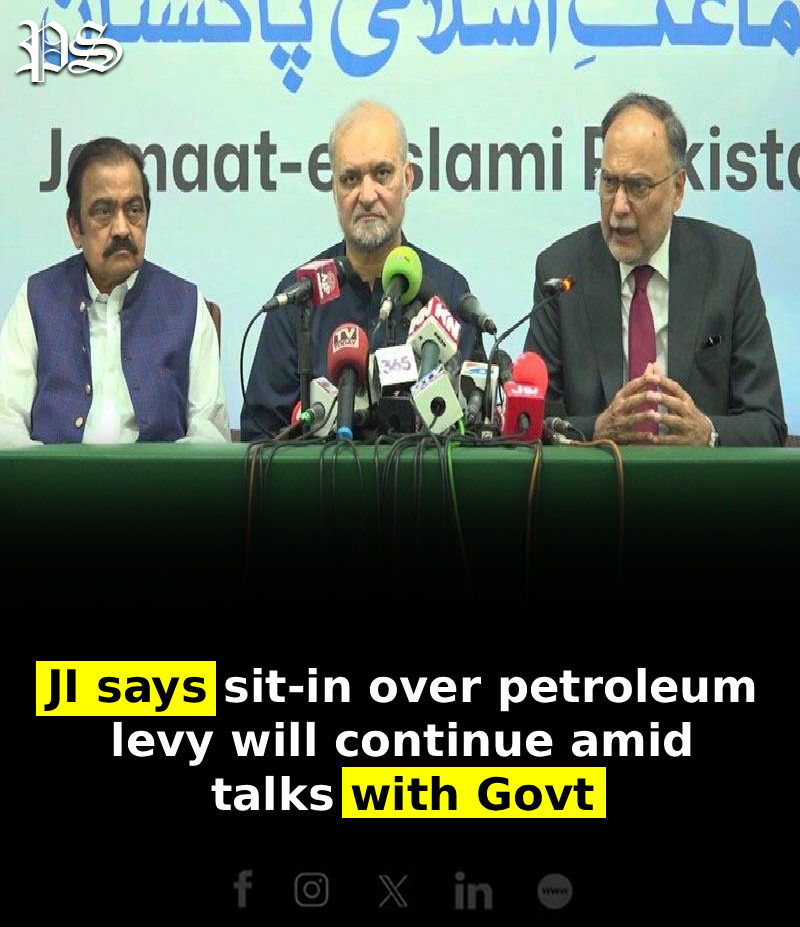
Jamaat-e-Islami (JI) Emir Hafiz Naeem-ur-Rehman said inflation had turned people’s lives upside down, with 90 to 95 percent of the country’s population struggling to meet basic needs.
Hafiz Naeem asserted that nationwide sit-ins and protests would continue despite talks with a government team, as the two sides discussed ways to provide relief to people hit by inflation and high petroleum levy.
“Sit-ins will continue and negotiations will also take place,” Naeem said after meeting a government delegation led by Planning Minister Ahsan Iqbal at the JI headquarters in Mansoora.
Hafiz Naeem made the announcement after a government delegation comprising Ahsan Iqbal, Adviser to the Prime Minister on Political Affairs Rana Sanaullah and former federal minister Khawaja Saad Rafique met him and other JI leaders.
The JI chief said the party’s protests had entered their 19th day and expanded from three cities to around 15 to 20 locations across the country.
“We have said that the sit-ins will continue. The talks will be more meaningful if the protests continue,” Hafiz Naeem said.
The government delegation it was prepared to consider JI proposals aimed at providing relief to ordinary people and would hold further discussions with representatives of the Finance, Federal Board of Revenue and Petroleum ministries.
Ahsan Iqbal said that the government did not want any situation that could lead to unrest in the country or provide an opportunity for Pakistan’s enemies to exploit internal tensions, particularly as the country was already fighting terrorism.
He thanked Naeem and his team for hearing the government’s position and said the JI leadership had assured the delegation that it would not make any demand that could harm the national interest or create difficulties for the public.
Rana Sanaullah said that the government’s focus was also on reducing the burden on ordinary people following the rise in petroleum prices amid the Iran-US conflict.
He said that the government welcomed JI’s proposals for making relief measures more effective and was ready to have its relevant officials sit down with the party to examine them.
“The government is ready to sit with the JI’s team through officials from the FBR, Finance Ministry and, particularly, the Petroleum Ministry,” Sanaullah said.
He said the government would place the relevant details before the JI team and seek consensus on measures that could provide relief to consumers.
Sanaullah also recalled that consultations with the JI had previously contributed to improvements in the electricity sector and said the government was willing to benefit from the party’s recommendations again.
Naeem, however, made clear that the JI’s demands remained unchanged.
He said that the party was protesting against inflation, high petroleum prices, the petroleum levy and expensive electricity, arguing that the burden of economic difficulties was falling disproportionately on ordinary citizens.
“The purpose of our protest is to bring down inflation and provide relief to the common man,” he said.
Naeem said that the JI’s campaign was not driven by political or personal interests, noting that the party was not seeking an election-related advantage.
He said around 90 to 95 per cent of Pakistan’s population was struggling to meet basic needs, while more than 40 per cent of people were living below the poverty line, citing government and international reports.
The JI chief particularly criticised the petroleum levy, saying consumers were being burdened with substantial taxes and levies on fuel.
He questioned the continued collection of the levy despite the government’s earlier stated objectives for using the funds to improve refinery capacity and fuel storage.
Naeem said around Rs8 trillion had been collected through the levy since its introduction and questioned why the burden on consumers had continued to rise even during a period of economic and geopolitical difficulties.
He also criticised capacity payments to independent power producers (IPPs), saying consumers were being made to pay for electricity that was not being generated.
Hafiz Naeem called for renegotiation of IPP agreements and changes to arrangements governing LNG regasification terminals, arguing that payments should be linked to actual utilisation rather than capacity.
He said the JI had four key demands: withdrawal of the petroleum levy, reduction in petroleum prices, renegotiation of agreements with IPPs to lower electricity costs, and measures to reduce the price of flour and bread.
“Petroleum levy should be abolished and petroleum prices should be reduced,” he said.
Hafiz Naeem called for a reduction in the price of bread, saying the government should ensure that basic food items remained affordable for low-income families. He said the government had already reduced the price of diesel following earlier discussions but argued that further measures were needed to bring down fuel prices.
About The Author