

By: Wafa Inayat Rustmani
There is no doubt that education is one of the most fundamental sources of progress and development for any country and nation. A strong education system requires not only a quality curriculum and modern facilities, but also well-trained and professionally qualified teachers. In this regard, a professional teaching license has increasingly become an important requirement of the modern era.
Just as doctors, engineers and professionals in other fields are required to meet specific qualifications and professional standards, teachers should also be required to meet clearly defined professional criteria. Teaching is not simply a job; it is a profession that carries a major responsibility for shaping the future of society.
A teacher is the architect of a nation. His or her responsibility is not limited to teaching textbooks and completing the syllabus. Teachers also play an important role in the intellectual, moral and social development of children. Therefore, individuals entering the teaching profession should possess the required knowledge, skills, patience and professional competence.
I agree with the viewpoint expressed by Sindh Education Minister Syed Sardar Ali Shah that people should not become teachers merely for the purpose of obtaining employment. Treating the education department simply as a source of jobs cannot contribute to improving the quality of education. Teaching should be recognized as a serious and respectable profession requiring commitment, competence and continuous professional development.
A teaching license can provide a systematic mechanism for assessing a teacher’s subject knowledge, teaching abilities, classroom management skills, understanding of child psychology and knowledge of modern teaching methods. Such a system can help ensure that teachers entering classrooms are properly prepared to meet the educational needs of students.
However, the purpose of a teaching license should not be to deprive teachers of employment. Rather, it should be to make teaching a respected and professional field. Teachers should be given opportunities for modern training, practical teaching experience and continuous professional development so that they can meet the changing requirements of education.
At the same time, special consideration should be given to teachers who are already serving in the education sector. They should be provided with sufficient time, proper training and a simple transition process to obtain their licenses. An effective licensing system should improve professional standards without unnecessarily creating difficulties for experienced teachers.
In Sindh and across Pakistan, improving educational standards requires a change in the way teachers are recruited and evaluated. Recruitment should not be limited to passing a written test. A teacher’s practical teaching ability, professional training, communication skills and understanding of students should also be given appropriate importance.
A properly implemented licensing system can increase teachers’ sense of responsibility and accountability. It can also help students receive better-quality education while strengthening the professional status of teachers in society.
However, transparency, merit and fairness must remain the basic principles of any teaching licensing system. The system must never become a means of corruption, favoritism or unnecessary examinations. The process should be simple, transparent and accessible to deserving candidates.
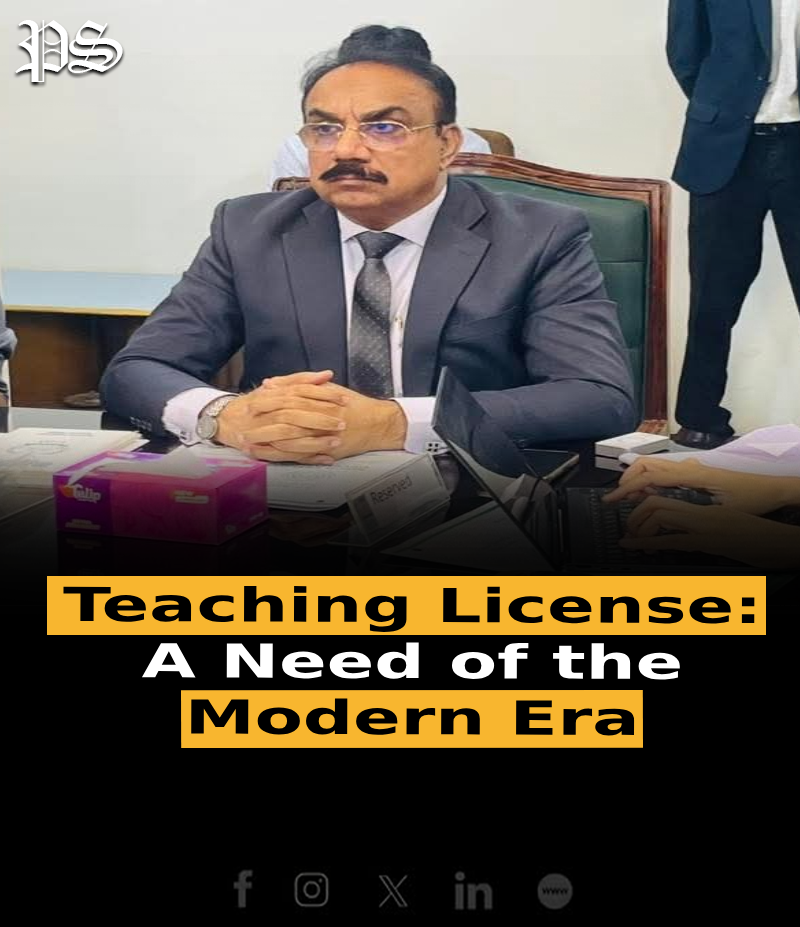
I firmly believe that as long as sincere, honest, education-friendly and courageous professionals such as senior educationist, literary figure and Executive Director of STEDA Sindh, Syed Rasool Bakhsh Shah, remain involved in the process, there should be little reason to doubt the commitment to transparency.
The government should also establish high-quality teacher training institutions, introduce effective online courses and expand continuous professional development programs. Teachers must be given opportunities to update their knowledge and improve their teaching skills throughout their careers.
Major Benefits of a Teaching License
Professional Recognition: A teaching license can give teachers formal professional recognition and establish teaching as a regulated and respected profession.
Improved Quality of Education: Requiring teachers to meet professional standards and complete appropriate training can improve classroom teaching and learning outcomes.
Selection of Competent Teachers: Licensing can help assess teachers according to their knowledge, skills, teaching abilities and professional competence.
Better Teacher Training: A licensing system can encourage greater emphasis on modern teaching techniques, child psychology, classroom management and practical teaching skills.
Greater Accountability: Licensed teachers are more likely to understand and fulfill their professional responsibilities because their qualifications and professional standards are formally recognized.
Enhanced Status of Teachers: Just as licensing strengthens the professional identity of doctors, engineers and other professionals, teaching licenses can enhance the social and professional standing of teachers.
Better Learning for Students: Well-trained and competent teachers can play a major role in improving students’ learning experiences and academic performance.
Continuous Professional Development: Licensing can encourage teachers to continuously update their knowledge and teaching methods according to new educational developments.
Merit and Transparency: If implemented fairly and transparently, licensing can help ensure that teachers are evaluated according to merit rather than personal connections or other irrelevant factors.
In conclusion, a teaching license should not be viewed merely as a certificate. It can become an important instrument for ensuring quality education, competent teachers and a better future for students.
If introduced with merit, transparency, fairness and respect for teachers, a professional teaching license can bring positive and sustainable changes to Pakistan’s education system.
In today’s rapidly changing world, quality education requires quality teachers. Quality teachers, in turn, require professional training, recognized competence and continuous development. Therefore, a teaching license is not merely a requirement of the education system—it is an important need of the modern era.
About The Author