

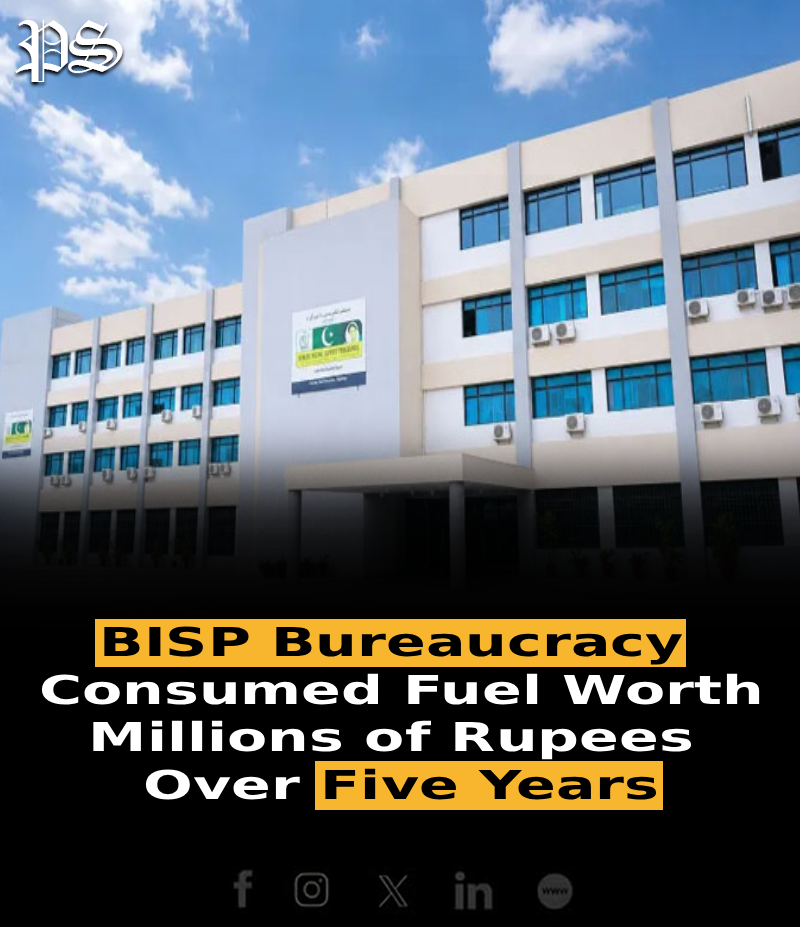
ISLAMABAD: Officials and bureaucracy associated with the Benazir Income Support Programme (BISP) consumed fuel worth millions of rupees through the use of official vehicles over the past five years, according to a report presented in Parliament.
The report reveals that 75 vehicles are currently being used by the Benazir Income Support Programme across different regions of the country. These official vehicles consumed more than 810,000 litres of fuel during the five-year period, resulting in expenditure amounting to millions of rupees.
The figures have raised questions about the use of government resources and the expenses incurred on official transportation by the social welfare programme. BISP is one of Pakistan’s major social protection initiatives, designed to provide financial assistance to vulnerable and low-income families.
According to documents presented before Parliament, the vehicles used by BISP are distributed among its headquarters and regional offices across the country. The BISP headquarters in Islamabad has 28 vehicles, while Punjab has 12 vehicles, Sindh has 17, Khyber Pakhtunkhwa has seven and Balochistan has six.
A total of five vehicles are being used in Azad Jammu and Kashmir and Gilgit-Baltistan, according to the official information.
The documents show that the vehicles collectively consumed more than 810,000 litres of fuel over the last five years. The figures provide an indication of the scale of expenditure incurred by the programme on official transportation.
The Islamabad region alone consumed 402,400 litres of fuel during the five-year period. Vehicles assigned to the Punjab region used 100,788 litres, according to the documents.
The fuel consumption figures for Sindh were also significant. According to the information presented in Parliament, vehicles operating in the Sindh region consumed 1,828,850 litres of fuel over the five-year period.
The figures contained in the available details have raised questions regarding the management and monitoring of government vehicles and fuel consumption. The expenditure is particularly significant because BISP is primarily intended to provide financial assistance to disadvantaged segments of society.
Government-funded programmes are generally expected to maintain strict controls over administrative expenses and ensure that public funds are utilized efficiently. Fuel expenditure on official vehicles is therefore an area that can attract scrutiny, particularly when substantial amounts are involved.
The documents presented in Parliament provide a breakdown of the number of vehicles being used in different regions, as well as fuel consumption figures for the five-year period. However, the information does not by itself establish whether any misuse or irregularity occurred.
The high fuel consumption figures could potentially be influenced by the geographical spread of BISP operations. The programme maintains offices and activities across different parts of Pakistan and its officials may be required to travel extensively to oversee operations and administrative matters.
BISP has a large operational network because its programmes target beneficiaries in different regions of the country. Official vehicles may therefore be used for field visits, administrative duties, inspections and other official activities.
Nevertheless, the disclosure of fuel consumption in Parliament is likely to prompt questions about whether sufficient mechanisms are in place to monitor the use of official vehicles.
The issue of government vehicle expenses has frequently been part of wider discussions about reducing administrative costs and improving financial discipline within public institutions. Fuel prices in Pakistan have also fluctuated significantly in recent years, meaning that high fuel consumption can translate into substantial financial expenditure.
The documents indicate that the BISP headquarters had the largest number of vehicles among the listed offices, with 28 vehicles. Sindh had 17 vehicles, followed by Punjab with 12. Khyber Pakhtunkhwa had seven vehicles, while Balochistan had six. Five vehicles were allocated for operations in Azad Jammu and Kashmir and Gilgit-Baltistan.
The regional distribution reflects the programme’s nationwide presence. However, the reported fuel consumption figures suggest that some regions have significantly higher fuel usage than others.
About The Author