

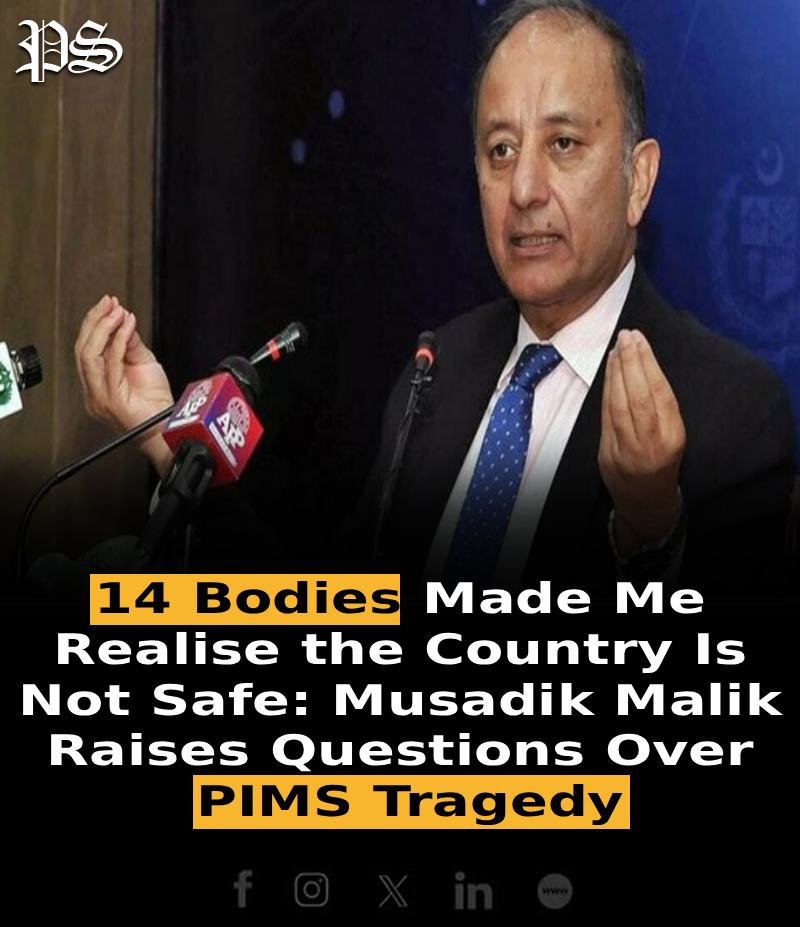
LAHORE: Federal Minister for Climate Change Dr Musadik Malik has also raised serious questions over the PIMS tragedy, saying that the matter must be properly addressed before the government can move forward.
Addressing a ceremony in Lahore, Musadik Malik said the incident had deeply shaken him after he saw the bodies of 14 newborn children.
“Two days ago, when I saw 14 bodies, I realised that I am not safe. I realised that the country is not safe. This is an unsafe country,” the minister said.
Musadik Malik acknowledged that he himself was part of the government and said that he was now facing questions over the tragedy.
“I am part of this government myself. Today, three fingers are being pointed at me,” he said, emphasising that the government must take responsibility for ensuring the safety and wellbeing of ordinary citizens.
The federal minister also pointed out the disparity between ordinary citizens and political leaders when it comes to access to public healthcare.
“No politician’s children go to PIMS,” he said, highlighting the need to improve government hospitals so that public healthcare facilities are capable of providing safe and quality treatment to everyone.
Musadik Malik said the PIMS incident could not simply be treated as another administrative issue and called for concrete action to prevent similar tragedies in the future.
He stressed that the matter needed to be “fixed” and said that there could be no meaningful progress until the issue was properly resolved.
The minister’s remarks come amid growing demands for a transparent investigation into the deaths of newborn children at PIMS.
The tragedy has generated questions about hospital safety, emergency response systems, administrative oversight and the overall condition of public healthcare facilities.
Political leaders from both the government and opposition have already called for accountability and a thorough investigation into the incident.
Musadik Malik said ordinary people were not primarily concerned with economic statistics and government performance figures.
“An ordinary person is concerned about the education and treatment of their child,” he said.
He stressed that people expected the state to provide basic services and ensure a safe and dignified life for their families.
According to the minister, social justice is essential for eliminating divisions and inequalities within society.
He said that access to quality healthcare and education should not depend on a person’s social or economic status.
Musadik Malik also linked improvements in healthcare and education with broader environmental protection and social development.
He said that government schools and hospitals should provide facilities to children without discrimination.
The minister stressed that providing ordinary citizens with a better quality of life was one of the government’s fundamental responsibilities.
His comments reflect the wider debate that has emerged following the PIMS tragedy, particularly regarding the quality and safety of public hospitals.
The incident has prompted calls for authorities to examine not only the immediate cause of the deaths but also the institutional and administrative failures that may have contributed to the tragedy.
The minister’s admission that he himself feels the country is unsafe adds to the political pressure surrounding the incident.
He also suggested that responsibility should not be limited to individuals at lower levels of the hospital administration and that the wider system must be examined.
The PIMS tragedy has raised concerns about whether major government hospitals have adequate emergency preparedness, safety systems, equipment and trained personnel to deal with critical situations.
For ordinary families, the incident has reinforced concerns about the condition of public healthcare facilities and whether hospitals can provide safe treatment during emergencies.
Musadik Malik said that the government’s basic responsibility was to provide people with the best possible quality of life.
He argued that this responsibility includes ensuring access to reliable healthcare and education and creating a society where citizens are treated equally.
The PIMS minister’s remarks also underline the importance of making public institutions functional and accountable for the people they serve.
The PIMS incident has therefore become part of a broader discussion about governance, accountability and the delivery of essential public services.
As investigations into the tragedy continue, families and the wider public are seeking clear answers regarding what happened, who was responsible for any negligence and what measures will be taken to ensure that such an incident does not happen again.
Musadik Malik maintained that the matter must be resolved before moving ahead, signalling the seriousness with which he views the tragedy.
He reiterated that improving public hospitals and ensuring equal access to healthcare should remain a fundamental priority of the state.
The minister’s comments come at a time when public pressure for accountability over the PIMS tragedy continues to grow, with calls for transparent investigations and meaningful reforms in government healthcare facilities.
About The Author