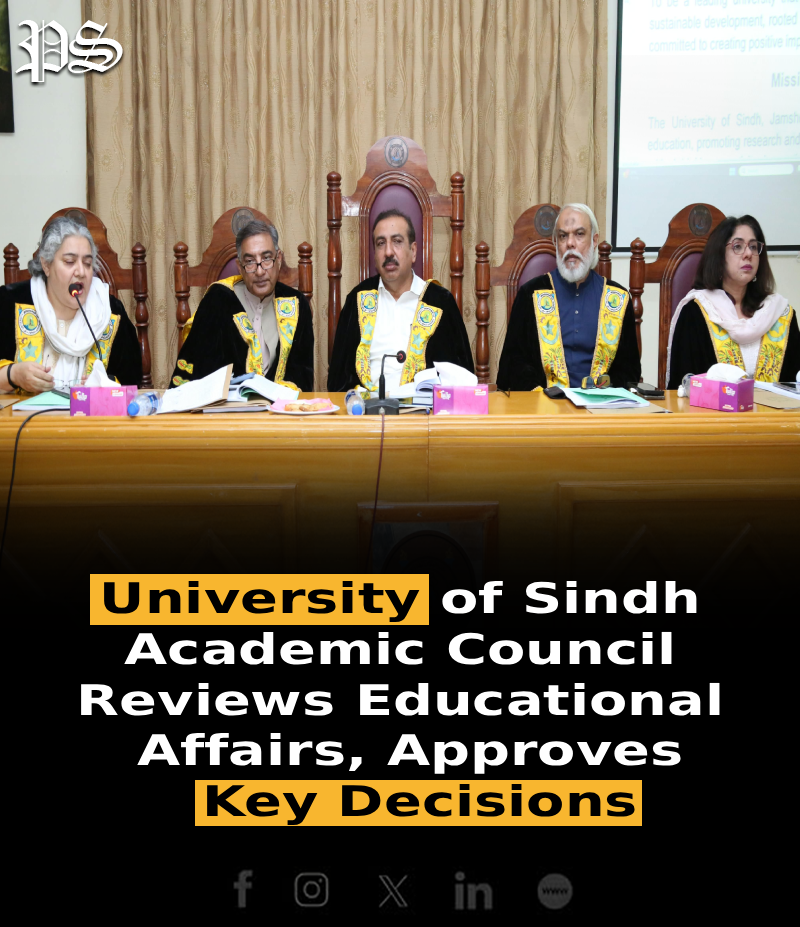
HYDERABAD (Mahboob Hussain Buzdar, Bureau Sindh): The 46th meeting of the Academic Council of the University of Sindh was held under the chairmanship of Vice Chancellor Professor Dr Fateh Muhammad Marri (Tamgha-i-Imtiaz) at the Senate Hall of the Syed Ghulam Mustafa Shah Administration Building, where several important academic matters were reviewed and key decisions were taken.
The meeting was attended by deans of various faculties, heads of teaching departments and other members of the Academic Council. The participants reviewed different academic matters included in the agenda as well as recommendations submitted by relevant university forums.
The council approved the minutes of its 45th meeting held on March 18, 2025, and reviewed progress made on decisions taken during the previous meeting.
The meeting also took note of steps taken by the vice chancellor under the relevant provisions of the University of Sindh Act, 1972, regarding the appointment of teachers to the boards of various faculties and members to the Boards of Studies of different institutes, centres and departments.
One of the major decisions taken by the Academic Council was the approval of a 2 percent reserved quota for religious minorities in bachelor’s degree programmes from 2026. The quota will not apply to the LLB (Honours) and Doctor of Pharmacy (Pharm-D) programmes.
The decision was taken in light of the amended legislation concerning reserved seats for religious minorities.
The council also approved the interim implementation of the revised Form D curriculum issued by the Higher Education Commission (HEC) and the Pakistan Pharmacy Council for students enrolling from 2026.
The revised curriculum will remain applicable on an interim basis until it is formally considered and approved by the relevant Boards of Studies and Boards of Faculties.
The Academic Council also reviewed recommendations submitted by the boards of several faculties, including Engineering and Technology, Natural Sciences, Social Sciences, Islamic Studies, Commerce and Business Administration, Education and Law.
Another matter discussed during the meeting was the implementation of Fahm-e-Quran courses in accordance with guidelines issued by the Higher Education Commission.
The council also reviewed HEC directives regarding the compulsory teaching of Pakistan Studies in undergraduate degree programmes.
An important academic decision taken during the meeting was the approval of a new MPhil course in Disaster Management, proposed by the Sindh Development Studies Centre.
The council discussed the proposed course and approved its introduction, marking an addition to the university’s postgraduate academic offerings in an area of growing importance.
Disaster management has become increasingly significant because of the country’s exposure to floods, extreme weather, earthquakes and other natural and human-induced emergencies. The new course is expected to provide students with an opportunity to develop specialised knowledge in disaster preparedness, risk reduction and management.
The Academic Council also considered recommendations aimed at modernising the process for verification of degrees and other academic certificates.
Members discussed measures to make the verification process more transparent and efficient, while a proposal for the early issuance of academic certificates was also reviewed.
The council was briefed about the upcoming visit of the Commonwealth Independent Evaluation Committee. Members were informed about preparations for the visit, including arrangements concerning the finalisation of results and verification of student attendance.
Officials briefed the members on the steps being taken to ensure that the university is adequately prepared for the evaluation process.
The Academic Council also considered and decided on various other matters included in the meeting’s agenda.
During the meeting, the vice chancellor directed the relevant authorities to ensure timely implementation of all decisions taken by the Academic Council in accordance with the university’s applicable rules, regulations and HEC guidelines.
Professor Dr Fateh Muhammad Marri stressed the importance of ensuring that academic decisions are implemented within the prescribed framework and that relevant university authorities complete the required procedures without unnecessary delay.
The meeting provided an opportunity for representatives of different faculties and academic departments to discuss issues affecting academic programmes, curricula, student affairs and institutional procedures.
The council’s decisions also covered matters relating to curriculum implementation, academic certification, degree verification and compliance with national higher education requirements.
The approval of the minority quota from 2026 is among the significant decisions expected to affect admissions to bachelor’s programmes at the university.
Similarly, the interim implementation of the revised Form D curriculum is intended to ensure that relevant programmes remain aligned with updated requirements of the Higher Education Commission and the Pakistan Pharmacy Council.
The council’s consideration of Fahm-e-Quran and Pakistan Studies courses also reflects the university’s efforts to implement national higher education guidelines within its undergraduate academic programmes.
The approval of the MPhil course in Disaster Management is another notable development, potentially expanding opportunities for postgraduate research and specialised education in disaster-related fields.
The discussion on degree and certificate verification also highlighted the university’s efforts to improve administrative services for students and graduates.
Efficient verification and timely issuance of academic documents are important for students seeking employment, higher education and professional opportunities.
The briefing on the Commonwealth Independent Evaluation Committee’s upcoming visit also focused on institutional preparedness and the need to ensure accurate academic records and student attendance verification.
At the conclusion of the meeting, the vice chancellor reiterated the need for all concerned authorities to follow university regulations and HEC guidelines while implementing the council’s decisions.
According to the proceedings of the meeting, the remaining matters on the agenda will be presented before the next meeting of the Academic Council, which is expected to be held after September 4.
The meeting concluded with an emphasis on timely implementation of approved decisions, compliance with higher education standards and continued efforts to strengthen the academic and administrative systems of the University of Sindh.
About The Author